Banner discussion highlights vastly different American experiences
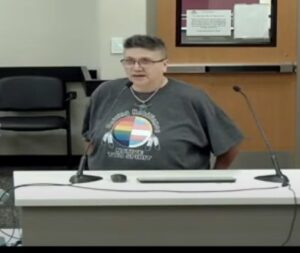
Muffie Mousseau speaking at Rapid City Council. Photo from Rapid City livestream.
RAPID CITY – Rapid City residents rallied to protect the right to display the pride flag and other banners that represent their multiculturalism and freedom of expression. The issue was on the City Council agenda at the last regular meeting on April 21, put there by Mayor Jason Salamun who said he was concerned about meeting the decision made by the Supreme Court regarding banners on government property. In the final decision, the Council approved the restriction of downtown banners to official government property and communications and a select few organizations.
“I want flags and banners to remain neutral,” explained Salamun. “A lot of people want messages on flags and banners throughout our city, including our wonderful non-profits.” He noted that he wanted to fulfil a recent Supreme Court ruling. “You either open it up to all which is really difficult to manage, or you restrict it with government speech. So, honoring your military, using the flag,” he motioned to the flag on display in chambers, “they’re distinguishing that they are for city and government purposes versus everybody else.”
But the debate over the resolution has sparked significant concern among Rapid City residents. Many fear that the policy is inspired by hate for the LGBTQ+ community and indigenous messages, specifically those from NDN Collective. The resolution’s timing and lack of clarity have raised questions about its true intent and potential consequences.
Cynthia Grace, a lifelong resident of Rapid City, passionately spoke out against the removal of these banners, emphasizing their importance in representing the city’s diverse cultures. Grace argued that taking down the pride flag is akin to removing stars and stripes from the national flag, which would harm the country and its citizens.
Uniting Resilience co-founder Muffie Mousseau, echoed Grace’s sentiments. She said she and her wife retired here 20 years ago. “We are Lakota of the Oceti Sakowin, and we are a part of this territory just as much as you are. We appreciate you.” She highlighted the significance of allowing growth and change within the community.”
She said the Constitution is designed to protect “the old, rich, white man and I see a lot of old, rich, white men up there.” Some audience members could be heard off-mic, chuckling. “I didn’t say that to get a laugh. We deserve our freedom of expression. There’s a lot of your relatives that have committed suicide because they could not freely express themselves,” she said, looking directly at the council. “Me and my wife are going to be here. Our banner is the pride flag, the trans flag, the Lakota flag with the red, white, black and yellow. I want to get along,” she said as she urged council to vote against the resolution.
Felipa De Leon, co-founder of Uniting Resilience, emphasized the importance of public banners in representing the diverse population of Rapid City and warned that the policy could lead to litigation against the city.
On behalf of the Black Hills Center for Equality (BHCE) Renee Haglund, highlighted the constitutional implications of the proposed ordinance. Haglund referenced a Supreme Court ruling that prohibits the government from discriminating against speech based on the speaker’s viewpoint. She questioned the intent of the policy and called for a fair and transparent process for banner usage agreements.
“In 1995 the Supreme Court acknowledged that the government sometimes needs to limit forums it creates to certain groups or certain topics but also ruled that once a government has opened a limited forum like those banners it may not discriminate against speech on the basis of the speaker’s viewpoint. That case informs our view of this proposed ordinance. In this case the city is not restricting the use of these banners solely for governmental speech – the ordinance states that banners will be reserved for governmental messaging or a banner that is placed by an organization pursuant to a valid agreement with the city that has been entered into based upon the provisions of the city ordinance consistent with the intent of this policy. What is the intent of this policy? and why now?” she asked. “Which organization will the city allow to use the banners and who will be denied? What is the criteria for an agreement with the city? Will that criteria be made publicly available and which steps does the city plan to take in order to ensure a fair and transparent process? This ordinance could lead to litigation against the city.”
She said the city’s role is to serve as the citizen’s voice in shaping city laws. She noted the diverse population of Rapid City includes LGBTQ + and Two-Spirit communities. “This city does not belong to Jesus,” said Haglund, referencing words spoken by the pastor who gave the standard Christian invocation which comes before the Pledge of Allegiance. “It belongs to its citizens. It belongs to its school children. It belongs to its educators. It belongs to its healthcare providers. It belongs to its taxpayers. It belongs to its voters.”
Former alderman Patti Martinson noted on her way to the meeting, she saw a banner downtown advertising April being child abuse awareness month. “Now that seems to be mentioning something of an agenda, even though it’s an agenda I think most of the people in this room would support.” She said the word “agenda” is mentioned in the policy but is very general about which agendas are acceptable. The policy does specifically mention the School of Mines. She said this isn’t the only educational institute in the area and asked why Mines is being singled out as an exception. The policy also mentions veterans. Martinson asked which veteran’s group’s agendas would be acceptable.
“This policy is not very well thought out, is poorly written and seems to be reactionary to a complaint by someone or something.”
Martinson’s implication was addressed head on by Rapid City resident and South Dakota native Ben Sherman, who noted on his Meta page that the change was inspired by “upper caste fears over indigenous messages.” Specifically, the Rapid City vs Racism and Land Back campaigns championed by NDN Collective. “This resolution seems to be inspired by hate for the LGBT community” he said to council. “We all know that we have leadership that is not afraid to blur or even cross the lines between the separation of church and state. But dear City Council, all of you have the power here. We need you to stand up for the rights of all citizens, for the freedom of expression for all citizens, for democracy and the American experiment.” He said the passage of the resolution sends a chilling message to anyone who is not a “white male or Christian.” He noted that the resolution does play favorites, with carve-outs for Mines and the Veterans Honor Banner Project.
“I know that things are moving towards fascism, but Rapid City does not have to go along for the ride. We can be a beacon of liberty. These banners mean so much more to the indigenous and queer people in Rapid City. They are a sign or a message of awareness. We get to see a banner that goes up for a week that shows that we have a place in this community, that we are wanted in this community,” Sherman concluded.
Other speakers suggested that the resolution needs to be more definitive. Resident Ann Hatch asked for more time to review and ask for public input.
City attorney Joel Landeen, responding to questions from Alderman Lindsey Seachris, said there is nothing that requires the city to make the banners a public forum but if they do, then they are a part of the public forum, and the city would rent them out and put messages on them that the city would have no control over.
Alderman Bill Evans expressed what some other council members thought when the item came before the Legal and Finance Committee. He said the discussion was mainly about cost and he hadn’t seen anything nefarious about the resolution. “But now that I Iook at the resolution, I can see what so many of our constituents are concerned about. This could easily be weaponized depending on who is sitting in these seats.” He said that the item should be further discussed. “It’s generic in such a way it could be distorted and weaponized to hurt people and I don’t like that idea.”
Evans explained he would like to table the issue and create a committee but resignedly said that won’t happen. “I know I’ll never get the votes so I’m just going to vote no on this instead.”
Ward 5 aldermen Pat Roseland and Rod Pettigrew and Bill Evans from Ward 2 voted no. Ward 3 aldermen Keven Maher, Greg Strommen, Ward 1 aldermen Josh Bieberdorf and Jesse Ham, Lindsey Seachris from Ward 2 and John Roberts and Lance Lehman from Ward 4 voted yes.
Ben Sherman had reminded the audience both online and in chambers to vote in the upcoming June 3 city elections. “This is how fascism starts at the local level.”
(Contact Marnie Cook cookm8715@gmail.com)
The post Banner discussion highlights vastly different American experiences first appeared on Native Sun News Today.
 Shared by: Native Sun News Today
May 15, 2025
Shared by: Native Sun News Today
May 15, 2025