
Crisis threatens Montana reservation schools
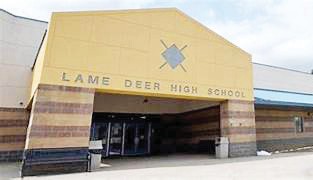
Lame Deer High School in Lame Deer Montana on the NorthernCheyenne Indian Reservation.
This article is pieced together from a variety of sources involved in the public educational system who admit to “being in the dark” about a recent list of Montana public schools which are on a Comprehensive Support and Improvement (CSI) Designation recently. A fact sheet was recently released by the MT Office of Public Instruction (OPI), listing those schools which are seriously deficient in student test scores. This problem must be addressed and hopefully remedied by the named schools in the very near future.
The document lists 45 schools in which students are below proficiency in reading and math. The 29 schools that are on or near Montana Indian Reservations include; Ashland Public (grades 7-8) located next to the Northern Cheyenne; Box Elder (7-12) and Barbara Gilligan School at and Plenty Coups High at Crow; Fort Belknap; Brockton Elementary, Browning Elementary, Brockton High; Bab; Browning Elementary; Nap School and Browning High on the Blackfeet Reservation; Dodson located near Fort Belknap Reservation; Frazer located at Fort Peck ; Harlem Elementary and Hays-lodge pole at Fort Belknap; Hardin High school at Crow; Lame Deer 7-12) at Northern Cheyenne; Lodge Grass High School at Crow; 6-6 School and Poplar High at Fort Peck; Arrow Creek Elementary, Pryor (7-8) and Plenty Coups High at Crow; Rocky (7-8) at Rocky Boy; Pablo Elementary at Flathead; Valier High at Browning; Wolf Point (7-8) and Wolf Point High at Poplar and Wyola School at Crow.
This information was first provided to Norma Bixby, Northern Cheyenne Tribal Higher Education Director while she was on trip for another matter, meeting with OPI officials. “It is very alarming,” she explained when alerting NSNT to this development. “If something isn’t done, the schools could lose accreditation which would be a disaster.”
In the meantime, according to Robert McLean, former Lame Deer Schools Superintendent and current member of the Board of Trustees, the Board has not received any notification or information about this development and what action will be required. A veteran educator, he said that loss of accreditation is not likely, but possible. “We do need to improve,” he acknowledged and we need community support to address problems that lead to low test scores such as poor attendance.” He also noted that the Board has secured a “coach” to redesign a struggling school, and is working to re-establish a Truant Officer’s position, now vacant. “I’ll say for sure that OPI has not been very forthcoming, but they usually aren’t.” Mclean summarized.
He recalled that during his tenure as Superintendent, OPI provided about 3.5 million in funding to Lame Deer School to help improve test scores. “The scores actually went down” McClean ironically explained. “What was missing was community support.”
Another educational professional who does not wish to be named in this article said that the same thing is going on all across America, but is particularly troublesome to schools with native populations. “Test scores are only a snap-shot in time,” she explained, “but drive the whole system. It is very difficult challenge for schools that serve primarily Natives. It is even worse in Alaska where I spent a great deal of my educational career.”
As this article is penned, very few know about this recent development, including the Board of Trustees, but those who do know are extremely concerned. “If we lose accreditation we might as well shut the doors,” one Board member commented.
On the other hand, the Superintendent of Lame Deer Schools, key staff and perhaps school board members will be meeting with OPI officials later in August to present an improvement plan and learn what else might be necessary for OPI school standards. The odds appear favorable that the affected schools will be given some time – perhaps the next academic year to implement a plan which will raise test scores. Such a plan has apparently been in the development stage at Lame Deer for some time, the need to finalize it now urgent.
Officials from OPI could either not be reached for comment or declined to discuss the matter. According to OPI policies inquiry are to be referred to the organizations public relations staff. As of press time, that call was not returned.
In many ways, Lame Deer Public school struggles. In the area, several schools compete for student enrollment including Colstrip, St. Labre, Northern Cheyenne Tribal Schools at Busby, Hardin, Ashland Public and even off-reservation schools. Ashland Public, however has already decided to curtail 7-8 education as a result of this development.
The educational expert who advised on this article bluntly stated the problem: “All the schools like to get the Reservation students for the money.” As this drama unfolds, NSNT will keep our readers updated.
(Contact Clara Caufield at acheyennereview@gmail.com)
The post Crisis threatens Montana reservation schools first appeared on Native Sun News Today.
 Shared by: Native Sun News Today
August 8, 2025
Shared by: Native Sun News Today
August 8, 2025