
Chaos, protest, and a fight for trust on the Northern Cheyenne Reservation
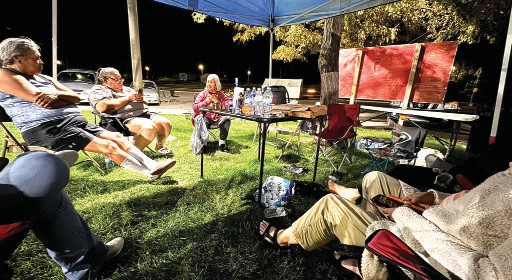
Elders from the Northern Cheyenne Tribe set up a protest camp in front of the Northern Cheyenne Tribal Headquarters in Lamedeer. (Photo courtesy Northern Cheyenne Grassroots Facebook page)
LAME DEER, Mont. – Clara Caufield entered the Aug. 18 Northern Cheyenne Tribal Council meeting in Lame Deer wearing two hats — a correspondent for Native Sun News and chair of the tribe’s Elderly Commission. It was in the latter role that she rose before a packed chamber, carrying grievances elders had voiced at a community feed days earlier and pressing council leaders on their lack of transparency.
“I want to speak to you in a good way, almost like a grandparent would speak to a group of unruly children,” Caufield said. “Being a councilman is very difficult. I have had that experience, some of the worst of my life. Especially if you try to stand up for what’s right.”
The meeting had been called as the latest chapter in a political showdown on the reservation. Council members Melissa Lonebear and Melissa Fischer had put a vote to schedule an evidentiary hearing on the agenda, accusing newly-elected President Gene Small of violating the separation of powers. However, many in the community — including an elder-led protest camp outside the building — viewed their move as a pretext to oust Small and derail the forensic audit he ordered last month into the council’s use of $90 million in CARES Act funding.
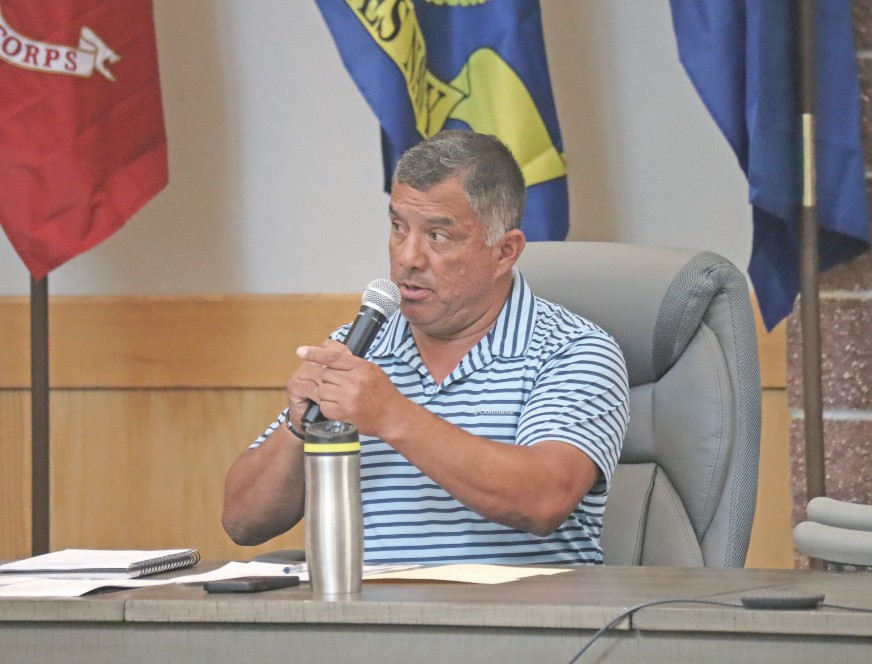
Northern Cheyenne Tribal Chairman Gene Small during a heated Tribal Council meeting over audits of Cares Act funds. (Photo by Emma Jane)
Addressing the council, Caufield emphasized that, if there is a legitimate reason to impeach a president, it should be done through legal means. The evidentiary hearing against Small that Fischer and Lonebear were attempting to schedule, Caufield said, is not standard practice.
“This evidentiary hearing does not even exist in our constitution, any of our ordinances. You guys just made it up,” Caufield said. “What you did, apparently, is erased removal hearing and put in evidentiary hearing.”
The elders’ push for accountability extended far beyond Caufield’s words. For nearly a week, a small but determined group of Cheyenne elders had established a protest camp on the lawn outside the tribal building, vowing to remain until the audit was complete. The standoff for them, is not just about one president or one council, but about breaking a decades-long cycle of scandals in tribal politics.
Jennifer Red Fox, a co-founder of the protest camp, said it’s painful to see poverty and limited opportunities for her fellow Northern Cheyenne citizens while tribal council members receive comfortable salaries for jobs she believes are rarely done. This is not a new issue, as she and other advocates held a similar protest in 2015 to demand accountability following a prior financial scandal. Since then, Red Fox said, things have gotten worse.
“This council is the worst that I have come across so far,” Red Fox said.
Another organizer of the protest camp, Mary Ann Weaselbear, emphasized her belief that the tribal council has lost sight of those who they were elected to serve.
“Where we’re sitting right now is the people’s,” Weaselbear said. “Everything in that building is for the people.”
Lonebear, who has over two decades of experience working for the tribe, said she sees the motivation of protest camp as petty personal grievances rather than a sincere desire for change in the community.
“Anytime there’s anything controversial, that’s when they show up,” Lonebear said. “I just feel like their hearts are filled with hate and they want the drama, bickering, and stress. They thrive on it.”
The Monday morning council meeting drew a full crowd, with Cheyenne citizens filling every seat in the chambers. Before a vote was completed on Fischer and Lonebear’s resolution to schedule the evidentiary hearing, several bursts of violence broke out in and around the chambers — marking the first instance of physical violence in the chambers. First, Dustin Goudreaux, who was hired by the council as security from the protesters, got into a scuffle with a relative of President Small inside the chamber. The confrontation escalated until a BIA o.cer removed Goudreaux from the room. According to Goudreaux, Small’s uncle instigated the violence, but Small confirmed his family member was involved while maintaining that Goudreaux was the instigator.
After the scuffle, Red Fox presented a petition signed by 127 residents of the Ashland district calling for Fischer to step down as their representative on council. This resulted in verbal exchanges between Red Fox, attendees, and Fischer — who repeatedly tried to quell critical comments to stick to the meeting agenda.
At this point, President Small chose to leave the meeting which he said had devolved into finger-pointing. But, before stepping out, Small gave an assurance that, regardless of if he is removed from o.ce, the forensic audit he ordered last month will still happen.
“They’ve got what they need,” Small said referring to the Office of Inspector General. “It’s just a matter of time.”
The chambers erupted in cheers and war cries as Lonebear shot back that Small was threatening her. Small responded that it’s not a threat, just a fact. Evidence that could possibly implicate sitting council members, Small said, is already in the hands of the authorities.
In a later interview, Lonebear said that she voted against the forensic audit due to concerns over the cost of it and her belief that the council’s attention should be focused elsewhere. Lonebear said she doesn’t agree entirely with how the council spent the CARES Act money but, she said, what’s done is done.
Due to the chaos inside, the meeting was adjourned before the vote to schedule the evidentiary hearing against President Small was finished. Afterward, chaos surfaced again as a physical altercation broke out in front of the tribal headquarters, ending in several BIA arrests. Afterwards, community members told BIA Special Agent Deeds that Goudreaux had threatened the protest camp the night before. Deeds asked them to send him any evidence for his investigation. In a subsequent interview, Goudreaux confirmed that he visited the camp, but denied accusations that he threatened the elders.
Weeks before the recent chaos, President Small had announced the launch of a new tribal security department, separate from the council dispute. This department, sta.ed by four overnight guards, was tasked with addressing public safety gaps on the reservation. Small said he had not been consulted on or notified of Fischer’s decision to hire Goudreaux as specific security for the council.
“I wanted Dustin thrown out of here,” Small said. “He’s a convicted felon.”
For President Small, the council’s decision to hire its own security to police protesters evoked a dark comparison: the Wounded Knee Incident of 1973. In that historical event, Oglala Sioux Tribal President Dick Wilson formed a paramilitary group known as the Guardians of the Oglala Nation, or “GOONs,” to confront opposition activists, resulting in violence and arrests.
Elders at the protest camp pointed out that corruption is hardly a new affliction for Indian Country. The roots, many said, stretch back to federal policy itself. Under the 1934 Indian Reorganization Act, tribes were required to abandon traditional forms of governance and adopt Western-style constitutions and elected councils in order to access federal funds. For the Northern Cheyenne, as for many others, this imposed structure often clashed with cultural systems of accountability and created fertile ground for power struggles and infighting.
In the decades since, cycles of mismanagement, infighting, and financial scandal have surfaced again and again, eroding public trust and sparking repeated calls for reform. The elder-led protest in 2015, and now again in 2025, reflects not only frustration with specific leaders but with a system that was designed outside the community and has too often failed to serve it.
For the Cheyenne people gathered outside the Littlewolf Capitol, this fight is not about one man or one audit. It is about breaking free of a cycle that has persisted since colonial systems supplanted traditional governance.
A decade later, their message remains the same: the government belongs to the people—not the council.
NSNT will continue to cover developments on this controversy at Northern Cheyenne.
(Contact Emma Jane at ej.reporter426@gmail.com)
The post Chaos, protest, and a fight for trust on the Northern Cheyenne Reservation first appeared on Native Sun News Today.
 Shared by: Native Sun News Today
August 22, 2025
Shared by: Native Sun News Today
August 22, 2025