Fear of Trump outweighs faith in Trump
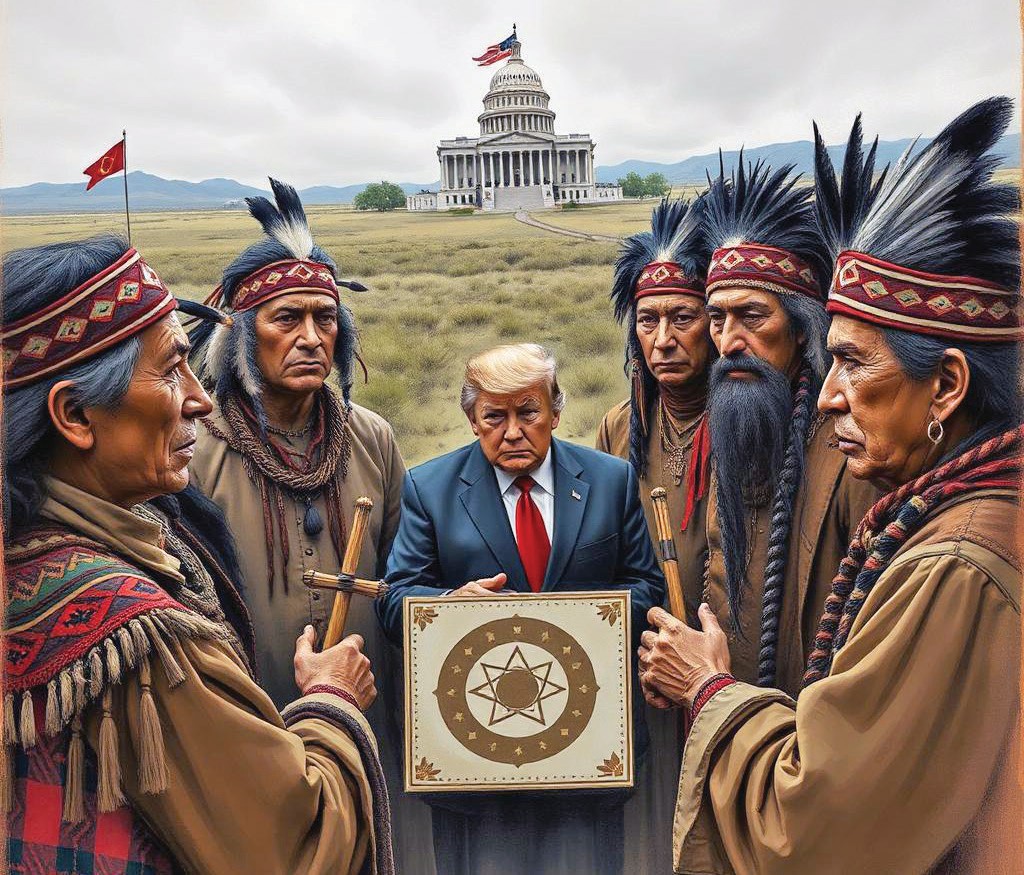
With Trump again wielding executive power, tribal leaders are speaking out—some hopeful, most wary, nearly all watchful. (AI generated image)
RAPID CITY—When Donald J. Trump returned to the White House in January, tribal governments braced for another round of disruption. For Indian Country, his first term from 2017 to 2021 had been a paradox: the administration supported bipartisan measures on missing and murdered Indigenous people and signed a farm bill rich with tribal provisions, yet it also moved to dismantle a reservation, shrink sacred lands, and weaken environmental protections.
Now, with Trump again wielding executive power, tribal leaders are speaking out—some hopeful, most wary, nearly all watchful.
“The ‘chainsaw approach’ of indiscriminately cutting employees, taken by President Donald Trump … will not create efficiencies or save billions of dollars,” warned Stephen Roe Lewis, Governor of the Gila River Indian Community, in testimony before the House. “It is creating a federal workforce that is paralyzed by fear.”
Lewis added a broader concern: “The government-to-government relationship is only as strong as our federal partner. And right now, there is a real concern that the federal side of this partnership has the real potential of being dismantled.”
Those words capture the dominant mood across Indian Country. In the first months of Trump’s second term, the administration froze federal grants, rescinded a Biden-era order meant to streamline tribal funding, and pulled out of the Resilient Columbia Basin Agreement—a pact tribes saw as vital to treaty-protected salmon runs. Each decision struck at the heart of the federal trust responsibility, the legal obligation to honor treaties and provide services.
Tribal leaders and national organizations like the National Congress of American Indians (NCAI) responded in unison. In February, a coalition letter reminded federal officials: “Federal tribal programs are not racial or preference programs, and indeed these federal funds and programs are legally mandated under the trust and treaty obligations owed to us.”
Tribal distrust of Trump did not begin in 2025.
His first administration opened with a proclamation in December 2017 slashing Bears Ears National Monument by 85 percent. Five tribes sued, charging that the move violated the Antiquities Act and ignored tribal sovereignty. In 2018, the Interior Department tried to disestablish the Mashpee Wampanoag Tribe’s reservation in Massachusetts, sparking a legal fight the tribe eventually won.
Meanwhile, the White House championed deregulation, rewriting the National Environmental Policy Act rules in 2020 to narrow environmental review, and curbing state and tribal power under Section 401 of the Clean Water Act. For communities fighting pipelines and mines, these changes cut away their only reliable avenues of consultation.
Lisa DeVille, Mandan, Hidatsa, and Arikara, from Fort Berthold, said at the time: “Any law that provides broad opportunities for public participation in government decisions that affect the environment and local communities shouldn’t be rolled back; rather, laws like the National Environmental Policy Act should be embraced and strengthened. The National Environmental Policy Act is one of the only avenues for tribal members to have any input on federal action.”
Yet even during that turbulent period, tribes saw positive gains. In December 2018, Trump signed a farm bill with more than 60 tribal provisions, giving tribes more control over food distribution and forestry management. In 2019, he issued an executive order creating Operation Lady Justice, a task force to address missing and murdered Indigenous women. A year later, he signed Savanna’s Act and the Not Invisible Act—bipartisan measures requiring the Justice Department to consult tribes and improve data collection.
The COVID-19 pandemic provided another test. The CARES Act of March 2020 reserved $8 billion for tribal governments. But Treasury delayed and restricted disbursement, prompting multiple lawsuits. Courts eventually forced the administration to release funds, but the delay deepened tribal suspicion that commitments would only be honored under duress.
When Trump took the oath again in January 2025, the same contradictions resurfaced.
Buu Nygren, president of the Navajo Nation, struck a cautious but optimistic tone: “In partnership with and building on the work of the previous Trump administration, I am optimistic that the Navajo Nation will continue to address significant economic challenges, improve public safety and alleviate the burdens of overregulation on our lands … I am hopeful that his administration will build upon the groundwork laid during his previous term.”.
On the Pine Ridge Reservation in South Dakota, Rep. Peri Pourier expressed hope about Trump’s new Interior pick, Doug Burgum: “It seems like he has a good grasp on trust responsibilities with Native American tribes and the treaty obligations. I hope he holds the BIA accountable in all aspects. I hope he initiates policy reform, and really weights out their performance when it comes to public safety efforts.”
These are not isolated voices. Some tribal leaders, especially in energy-producing regions, believe Trump’s deregulatory stance could mean jobs and reduced red tape. Others prefer a president who speaks directly, even bluntly, about where they stand.
But those sentiments are outweighed by apprehension. In February, NCAI President Mark Macarro told tribal leaders: “I know tribal communities are debating how to respond to the actions of the new administration … Well, I strongly affirm it’s time to speak up. It’s time to stand-up.”
The trust responsibility is not rhetoric—it is codified in treaties, statutes, and court decisions. Tribes fear that sweeping budget cuts and executive orders could hollow out that obligation.
Already, the administration’s early 2025 freeze of grants and loans has thrown housing, health, and education programs into limbo. Staff reductions at tribal colleges like Haskell and SIPI prompted lawsuits alleging a lack of consultation and threats to campus safety. The removal of the Not Invisible Act Commission’s final report from federal websites sent advocates a chilling signal: progress on missing and murdered Indigenous people could be undone with the stroke of a key.
As one Alaska Native leader told the Anchorage Daily News in March, “We’ve seen this before— promises to consult, then actions without notice. We can’t afford to lose ground on safety, or on our treaty rights.”
The balance sheet of Trump’s relationship with tribes is undeniably mixed. Operation Lady Justice and Savanna’s Act remain landmark achievements, and the 2018 farm bill provisions are still bearing fruit. Yet the larger pattern has been one of conflict, litigation, and unease.
In Indian Country, leaders often say the federal partnership is only as strong as its weakest link. Today, that link feels fragile. Most tribal governments fear that the gains of the past decade—greater self-determination (all the way back to the Nixon Administration), improved consultation, modest funding increases— could be reversed. Tribal leaders are preparing for another hard season, and the mantra, “It’s time to stand-up,” is oft repeated.
(James Giago Davies is an enrolled member of OST. Contact him at skindiesel@msn.com)
The post Fear of Trump outweighs faith in Trump first appeared on Native Sun News Today.
 Shared by: Native Sun News Today
September 18, 2025
Shared by: Native Sun News Today
September 18, 2025