
Tribes misunderstand sovereignty and risk state encroachment
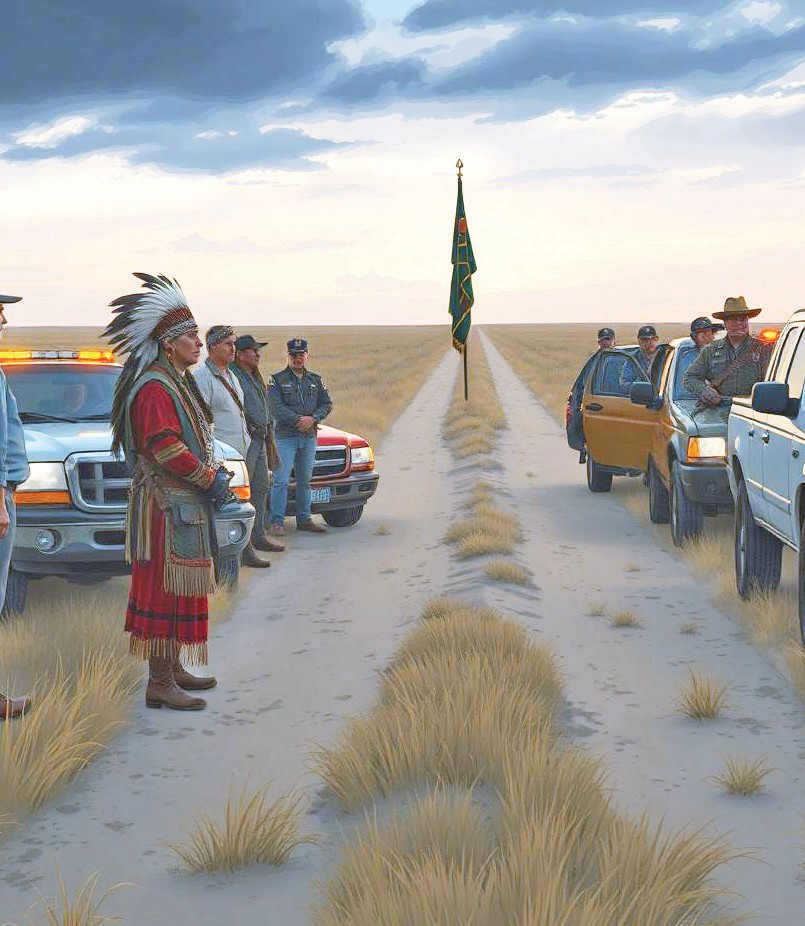
AI-generated image depicting standoff between tribal and state police officers.
In the endless debates about tribal sovereignty, most Native leaders frame the conflict as tribe versus federal government. The Bureau of Indian Affairs, the Supreme Court, Congress—these are seen as the forces impinging on Indigenous self-rule. And in many respects, they are. But this emphasis misses the deeper danger. The federal government is not, and never has been, the deadliest enemy of tribal sovereignty. The real threat lies closer to home—in the states.
That truth was stated plainly by Justice Samuel Miller in the Supreme Court’s 1886 decision in United States v. Kagama. His words are dicta, not binding law, but they cut to the bone of tribal survival:
“They owe no allegiance to the states, and receive from them no protection. Because of the local ill feeling, the people of the states where they are found are often their deadliest enemies.”
This is the dicta tribal leaders rarely invoke. Instead, sovereignty is presented as a shield against federal plenary power. Yet the record shows that sovereignty does not, in practice, operate against the federal government. Congress has plenary power whether tribes accept it. Where sovereignty matters—where it actually protects communities—is in resisting the states. And too often, tribes themselves are lowering the shield.
Kagama arose over the Major Crimes Act of 1885, a statute that placed federal jurisdiction over murder, rape, and other serious crimes committed by Indians in Indian Country. The Court upheld the law, but in doing so refused to tie federal power to any clear constitutional provision. Instead, it invented a rationale: tribes were “wards of the nation,” and from the duty of protection sprang the power to govern.
This so-called “plenary power doctrine” became the foundation of federal authority in Indian affairs. It was paternalistic and often destructive, but it also reinforced one vital boundary— states had no role. Miller’s dicta was blunt: tribes owe nothing to states, states offer no protection, and state encroachment is often rooted in hostility.
Miller’s warning echoed an older precedent, Worcester v. Georgia (1832), which declared that state laws had no force within Cherokee territory. That principle revived in Williams v. Lee (1959), where the Court blocked Arizona courts from hearing a lawsuit against Navajo defendants. The justices reasoned that letting state courts into reservation affairs would undermine the tribe’s right “to make their own laws and be ruled by them.”
The dicta in Kagama provided a framework: the federal government might dominate tribes, but states were categorically excluded. For much of the twentieth century, that line held.
The breach came in 1953 with Public Law 280. Congress handed several states—California, Minnesota, Nebraska, Oregon, Wisconsin, and later Alaska—criminal and civil jurisdiction over reservations within their borders. Other states were allowed to assume jurisdiction with tribal consent, though “consent” often meant little in practice.
South Dakota never fully opted in. It tried partial assertions, most notably over highways crossing reservations, but it remained one of the states where the firewall between tribe and state largely held. That distinction matters: tribes in PL 280 states often found themselves subject to county sheriffs, state prosecutors, and state courts, diluting sovereignty more than any BIA directive could.
PL 280 was an expression of the Termination Era, the mid-20th-century policy to dissolve tribes as political entities and assimilate their members into state society. Schools, policing, and jurisdictional transfers were all levers in that process. The results were predictably disastrous.
The turning point came under President Richard Nixon. In 1970, Nixon rejected termination and embraced “self-determination without termination.” Federal policy shifted toward empowering tribal governments, funding tribal schools, and recognizing the legitimacy of tribal courts and police. It was a watershed, but it did not erase Miller’s warning. States were still waiting for the opportunity to step back in.
Today, tribes themselves are opening the door. The most insidious erosion of sovereignty comes not from Congress or the BIA, but from cooperative agreements that invite state jurisdiction onto reservations:
• Education: Many tribes still allow state-run or state-funded schools to dominate reservation education, embedding state standards and authority in the heart of tribal communities.
• Law enforcement: Across South Dakota and the Northern Plains, tribes are signing training and cooperation agreements with state academies, sheriffs, and state police. A new 13-week police certification course in Pierre even reserves priority seats for tribal recruits. That may sound helpful— but the price is recognition of state authority, state standards, and state jurisdiction creeping deeper into reservation life.
• Mutual aid agreements: When county sheriffs are allowed to police tribal lands under “mutual aid” understandings, the principle of sovereignty is quietly undermined. What was once a firewall becomes a revolving door.
Each of these steps seems pragmatic. But together they amount to what Justice Miller warned against: an invitation to the “deadliest enemy.”
The Supreme Court’s recent direction only sharpens the risk. In Oklahoma v. Castro-Huerta (2022), the Court held that states can prosecute non-Indians for crimes against Indians in Indian Country, unless Congress expressly forbids it. Justice Kavanaugh reframed the question entirely: where Miller had called states hostile outsiders, Kavanaugh called them sovereigns with a legitimate interest in reservation public safety.
That marks a stark departure from Kagama. The federal shield is cracking. And if tribes have already invited state police, state schools, and state courts into their affairs, they will find little room left to object.
This is why the obsession with sovereignty against federal power is misplaced. No matter how loudly tribal leaders assert independence from Washington, the reality is that Congress holds plenary power. Tribes cannot wish it away. What they can do is maintain the bulwark against states. That is where sovereignty is real, practical, and defensible.
Tribal leaders continue to ignore Miller’s dicta. They don’t see the state as the adversary; they see it as a partner. They welcome state police academies, state standards, state curriculum. They mistake cooperation for equality, when in fact it is the quiet surrender of jurisdiction.
South Dakota tribes should remember the rare advantage they hold—unlike tribes in PL 280 states, they still retain legal sovereignty against state jurisdiction. That firewall is a precious inheritance.
If tribal leaders continue to ignore Miller’s words, if they continue to stick out the tribe’s chin in search of short-term fixes, they risk the sucker punch of creeping state authority. And when it lands, sovereignty will be more than a slogan—it will be a casualty.
(James Giago Davies is an enrolled member of OST. Contact him at skindiesel@msn.com)
The post Tribes misunderstand sovereignty and risk state encroachment first appeared on Native Sun News Today.
 Shared by: Native Sun News Today
October 2, 2025
Shared by: Native Sun News Today
October 2, 2025