
‘The memories are in our blood’: Annual walk remembers boarding school survivors, victims
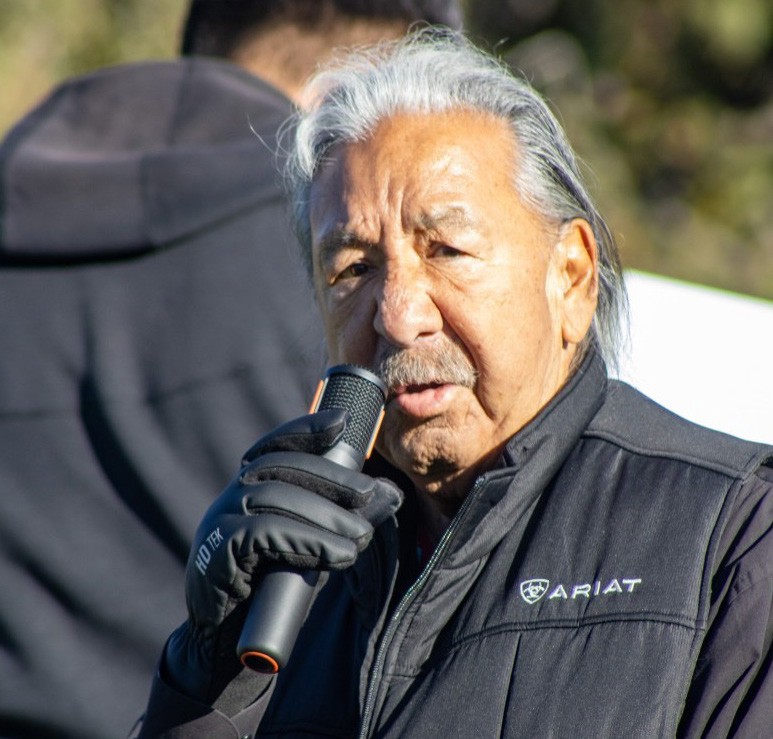
Leonard Peltier, 81, speaks about his experience in boarding school and recent freedom from federal prison during the annual Remembering the Children Walk in Rapid City on Oct. 13.
RAPID CITY, South Dakota – Under crisp autumn winds, a sea of orange moved through the west side of Rapid City on Oct. 13 – Indigenous People’s Day.
Over 270 community members bundled together and walked over one mile to the site of the former Rapid City Indian Boarding School amidst 35-degree temperatures. The group, made up of Native and non-Native community members, gathered together to remember those who never came home.
The walkers weaved through the rolling hills leading to the site of the former school, and for the first time ever finished the walk at the nearly completed boarding school memorial site – greeted by the over six-foot tall statue of a Lakota family surrounding a child taken to boarding school.
“All of us suffer from generational trauma because of the boarding schools,” said Gabrielle Kenny, a high school student from the Rosebud Reservation and Sicangu Youth Council who came to participate in the walk.
The walk was youth-led, with the Sicangu Youth Council and Rapid City Student School Board helping pass out names, walking with poster boards of victims’ names and helping organize. While passing out poster boards with names of victims, Kenny said the first name in her stack was a young girl from the Rosebud Reservation, her home.

Two Lakota men stand facing the ‘Tiwahe’ a statue depicting a Lakota family surrounding a young boy who was taken to boarding school. (Photos by Amelia Schafer)
“I just felt it in my heart,” she said. “(I thought) this is probably somebody I’m related to, and they had to go through that.”
Kenny said her great-grandmother,
MarySue RedBird, was a boarding school survivor. RedBird had since passed on, but would tell stories of what she went through to her great-grandchildren. Kenny said she thought of RedBird while walking.
“We have elders who are still here and who have passed on that went through the boarding schools. We have younger relatives who are here with us today,” Kenny said. “While walking, you have those thoughts, and you know they’re (relatives) still here with you today.”
Finishing the walk at the memorial wasn’t the only new addition this year. Four children’s deaths were uncovered by researchers several months ago, bringing the total number of uncovered deaths to 55, including unidentified children.
Sifting through old superintendent records earlier this year, Remembering the Children Executive Director Amy Sazue uncovered an additional four deaths at the school. This year, those four children – Pearl White, Hattie Black Horse, Joseph Kills A Hundred and Cecelia Parted Hair – were added to the list of names read aloud and honored.
“It breaks your heart, it hurts your stomach,” said Sazue, Sicangu and Oglala Lakota, about finishing the names. “This is the hardest work I’ve ever done, but (also) the most rewarding.”
Conditions at the school, which was one of several Bureau of Indian Affairs-operated schools, were grim and often hazardous. Frequently, “disobedient” children were locked in jail cells, chained together and made to march for hours, starved, beaten and neglected. Early attendees reported meals consisting of boiled beef and bread day after day. Children’s lives were dictated by the bell. They marched to and from class every day, and only spoke English.
The school utilized a military schedule and dual educational and working structure, meaning children as young as seven would work half the day, operating heavy machinery. Many children were injured while working, hands and fingers were lost, Sazue said.
“The school closed in 1933, so not even 100 years ago,” Sazue said. “There are still people as late as 2007 that gave interviews as to their experiences there. This isn’t that far back in history. … It’s easy to forget something or think or think of something that happened in the past and distance yourself from it, but there are people in this community who can’t, because the memories are in our blood.”
In the school’s 35-year run from 1898 to 1933, approximately 2,089 students attended, according to records from the National Archives. A majority of students (88 percent) were from the Oceti Sakowin (Lakota, Nakota, Dakota nations), though some were as far as 700 miles from home.
Survivors of boarding school attended the walk, including Leonard Peltier, who was recently released from a nearly 50-year incarceration after being charged with aiding and abetting in the deaths of two FBI agents during the infamous Jumping Bull Ranch 1975 shootout in Oglala, South Dakota. Peltier has maintained he did not shoot the two agents.
In January on the last day of Joe Biden’s presidency, Peltier was granted clemency and a commuted sentence, meaning the now 81-year-old, American Indian Movement activist could serve the rest of his sentence on the Turtle Mountain Reservation in North Dakota about 20 miles south of the Manitoba border.
Peltier himself is a boarding school survivor, having been taken from his home on Turtle Mountain in 1953 and brought to the Wahpeton Indian Boarding School in North Dakota and later the Flandreau Indian Boarding School in South Dakota.
Addressing the crowd, Peltier recounted a memory of when he was fleeing from the U.S. government following the shootout and was sheltered by the Kamloops Indian Band in British Columbia, which helped hide him.
“I worked on this with Kamloops. … They were fighting very hard to expose the children that had died at the school,” Peltier said. “I love my people. I think we’re the greatest nation in the world. … I’m going to stay a fighter for you until I die.”
Peltier walked as much of the mile as he could, despite the injuries he sustained from medical neglect while incarcerated at the Coleman I Maximum Security Prison in Florida, where he spent the last portion of his sentence.
Also in attendance were Oglala Sioux Tribe President Frank Star Comes Out, Cheyenne River Sioux Tribe Chairman Ryman LeBeau and NDN Collective President Wizipan Little Elk Garriott.
Little Elk Garriott was part of the Department of the Interior team that constructed the 2024 Federal Indian Boarding School Initiative Investigative report alongside former Interior Secretary Deb Haaland.
“In that report we, as in the United States, made it explicitly clear that the purpose (of boarding schools) was for stealing children,” Little Elk Garriott said. “First they took our buffalo, then they took our land, and then they took our children. If there is to be justice, if there is to be healing, if we are going to move on not just as Lakota but as a country, we need to address those three things.”
The memorial is not yet open to the public, as Sazue and other Remembering the Children team members are working to secure an emergency management agreement with Rapid City, Pennington County and the three tribes that are seeking to reclaim the land: the Cheyenne River Sioux Tribe, Oglala Sioux Tribe and Rosebud Sioux Tribe.
When the memorial and walk are open, it will be the only large-scale boarding school memorial in the United States and will feature a walking path, statue, murals and eventually a healing facility and space for prayer.
The post ‘The memories are in our blood’: Annual walk remembers boarding school survivors, victims first appeared on Native Sun News Today.
 Shared by: Native Sun News Today
October 21, 2025
Shared by: Native Sun News Today
October 21, 2025