
What are ribbon skirts?
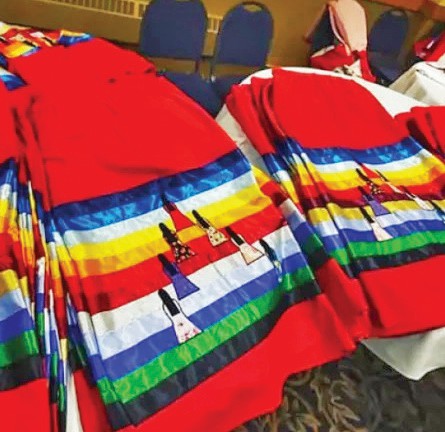
Traditional ribbon skirts. (Photo courtesy of Indigenous Perspectives Society)
Ribbon skirts are handmade skirts worn typically by Indigenous communities. Each skirt is made up of fabric and multiple ribbon colors. Ribbon skirts are most likely worn during pow-wows but can be worn daily; ribbon skirts symbolize Indigenous pride.
Mina Seminole, CDKC Historical researcher pointed out that when the Cheyenne began to get ribbons, they started adorning their dresses with them, especially when cloth largely replaced buckskin dresses.
The ribbons represent many meanings to the individual, such as; their tribal affiliation, family traditions and creativity. Many are required to wear specific colors and attire during different cultural ceremonies. Also, many ribbon skirts depict a story or are just beautiful and designed to be stylish, striking and dazzling. Most ribbon skirts have a hint of personal expression and tradition. Skirts can tell a story.
What we know today as the modern Ribbon Skirt is a collaboration. Adapted from both the European design and the Buckskin dresses, T-dresses, and ceremonial skirts of the Woodlands and Plains, our ancestors modified that design with Indigenous and European materials, patterns and techniques. This is not unlike how the Métis themselves came to be, and to me, the Ribbon Skirt becomes a beautiful analogy of our storied and vibrant culture, acceptance of the past and valuing all of our roots.
Regardless of the role of the ribbons skirt in one’s own community and tradition, what we see today as the modern ribbon skirt is the evolution of a piece of clothing over centuries, having a diverse ancestry in its roots and traditions. I want to explore those diverse roots and uncover the commonalities between all groups who share in this tradition, as there is almost no piece of regalia more wide-spread and shared by more nations than the Ribbon Skirt.
In this new age, more than ever, we need to identify the things we have in common rather than those we have in difference. We have an opportunity to use these similarities in tradition and regalia as tools to find common ground, to open dialogue and to honor one another’s voices. The Ribbon Skirt represents that opportunity for me and was the inspiration behind this project.
A Ribbon Skirt can be a simple as a piece of clothing, or as Sacred as a piece of regalia used only for Sweat lodge and Ceremony. It can be an expression of womanhood and strength, of remembrance of the Missing and Murdered, a symbol of defiance and protection of natural resources against corporate powers, or a representation of the journey of those who are reclaiming their identities through traditional practices. Ribbon Skirts are a symbol of resilience, survival and identity, but their meaning changes with each person who wears one and each person who shares their history.
For Indigenous peoples, the Ribbon Skirt represents our own personal reclamation. It represents reclaiming identity, and wearing that identity proudly. It has become armor. It is a cultural protection against assimilation and degradation. It is a reminder of our roles in our community as women and as members. It reminds us of our sacredness as women and the power in that. It tells our story of adaptation and survival.
When we wear our ribbon skirts, we are reaffirming what we know ourselves to be. This is my strength, and the strength of the community that claims me. It is part of our heritage, a collective heritage and although we all have different traditions and Sacred protocol surrounding the Ribbon Skirt, they do not belong specifically to any one group.
National Ribbon Skirt Day is observed every year on January 4. It was first celebrated in 2023 after being passed into law by the Canadian Parliament in December 2022. It was inspired by the experience of Isabella Kulak, a young Indigenous girl from Saskatchewan who was shamed for wearing her ribbon skirt to a school “formal dress day.”
On January 4, let us stand together in strength, beauty, and sovereignty. The ribbon skirt is more than fabric— it is a living story of our nations, our mothers, our daughters, and our ancestors. Each ribbon carries meaning: resilience, identity, and the unbroken thread of our cultures.
(Contact Clara Caufield at acheyennereview@gmail.com)
The post What are ribbon skirts? first appeared on Native Sun News Today.
 Shared by: Native Sun News Today
December 2, 2025
Shared by: Native Sun News Today
December 2, 2025