
Indian Country swept up in anti-immigration agenda
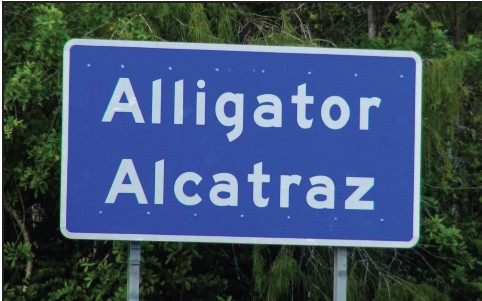
A sign at Alligator Alcatraz, an immigration detention facility in Florida. (Photo: SovNAT)
The Miccosukee Tribe isn’t backing down from its commitment to protect its homelands despite being rebuked by President Donald Trump and abandoned by Republicans in Congress amid a national immigration crackdown that has Indian Country reeling.
On Tuesday, the tribe filed a new brief in an ongoing lawsuit challenging a controversial immigration detention facility in the Everglades of Florida. The litigation against Alligator Alcatraz — and the fact that the tribe had previously secured a legal victory in federal court — was the source of Trump’s retaliation against the Miccosukee people.
“The Tribe’s constitutional commitment to this land runs deep: ‘It’s written into their Constitution to protect the Everglades because the Everglades protected them when they were being hunted by the Government,’” the 58-page document reads
According to the brief, the history of being hunted by the United States is continuing — nearly two centuries after a series of conflicts in the 1800s known as the Seminole Wars. Physical checkpoints are hindering access to traditional sites in the Big Cypress National Preserve of Florida and armed guards are patrolling areas where Miccosukee citizens have long practiced their culture.
“The physical barriers erected around the facility now block Tribal members’ primary access to Big Cypress for traditional activities,” the brief states. “Checkpoints and guards stand where open land once welcomed Tribal hunters, fishers, and gatherers.”
“Tribal members now face the inadvisable prospect of ‘approach[ing] the security guards armed prepared for hunt,’” the brief reads.
The brief features maps and images that detail how Alligator Alcatraz has disrupted the tribe’s way of life. The detention facility lies near the border of the Miccosukee Reservation, and several tribal communities — including two schools — are located in close proximity to the controversial site.
But in spite of the tribe’s longtime existence in the Everglades, Miccosukee leaders say they were never consulted by the state of Florida, or by the federal government, about Alligator Alcatraz. As a result, they say their people are facing “ongoing harms” from the operation of the first state-run, federally-funded immigration detention facility in their own backyard.
“Adding insult to injury is that these harms were entirely avoidable. Had the Defendants engaged in meaningful consultation with the Tribe, as required under [federal law], the Tribe’s objections could have surfaced earlier and the Tribe could have proposed alternatives before harm occurred,” the brief states in reference to the Florida Division of Emergency Management, the U.S. Department of Homeland Security and the U.S. Immigration and Customs Enforcement.
The tribe’s filing comes amid heightened attention to the Trump administration’s aggressive anti-immigrant agenda. Government agents have brutalized Native people and have taken Native people into custody despite American Indians and Alaska Natives being citizens of the United States for more than a century.
In Minneapolis, Minnesota, for example, several tribal citizens reportedly have been detained by Immigration and Customs Enforcement (ICE) agents. On Tuesday, the Oglala Sioux Tribe said it has been given only the first names of four Oglala citizens who were taken into custody as part of a violent — and deadly — immigration crackdown in a state where Native people make up about 1.2 percent of the population.
According to the tribe, one of its citizens was released after being detained by ICE in Minnesota. But the others are reportedly being held at a federal facility in Fort Snelling, the same place where Native people were once held as prisoners prior to the hanging of 38 Dakota men in the largest single-day mass execution in U.S. history in December 1862. Two Dakota chiefs were later executed — at Fort Snelling.
“The irony is not lost on us,” President Frank Star Comes Out said in a news release on Tuesday. “Lakota citizens who are reported to be held at Fort Snelling — a site forever tied to the Dakota 38+2 — underscores why treaty obligations and federal accountability matter today, not just in history.”
The Red Lake Nation has been just as blunt in addressing ICE on their homelands in Minnesota. According to the tribe, 8,000 Red Lake citizens live in the Minneapolis-St. Paul metropolitan area — with one Red Lake descendant having reported being dragged from a car by federal agents before being detained. According to ICT, 20-year-old Jose Roberto “Beto” Ramirez was sent to the ICE facility at Fort Snelling in the Twin Cities.
“We all need to be extra careful, and we must assume that ICE will not protect us, the Red Lake Nation said in a statement on January 7. “In fact, we can assume that anyone associated with the Trump administration, especially ICE, is hostile to us and that ICE will only detain us, or hurt us.”
The ongoing crackdown resulted in the killing of Renee Nicole Good, a non-Native woman, by an ICE agent on January 7. Lt. Governor Peggy Flanagan (D), a citizen of the White Earth Nation who is the highest ranking Native woman in state executive office, is calling on the Trump administration to withdraw its presence in Minnesota
“This is happening across the state of Minnesota — and it’s not OK,” said Flanagan, who is campaigning to be the first Native woman to serve in the U.S. Senate.
Minnesota, which is home to 11 tribal nations, happens to led by Governor Tim Walz (D), who ran against Trump during the 2024 presidential election. Walz was the running mate of former U.S. vice president Kamala Harris, who was the Democratic nominee for president.
In comparison, Florida Governor Ron DeSantis (R) has been far more friendly to Trump. Although Alligator Alcatraz is operated by the state, the federal government has provided significant funding for it — one of the many issues at contention in the lawsuit that the Miccosukee Tribe has joined.
“To be sure, a state contractor that operates a federal prison retains day-to-day operational authority, but no one would suggest the prison is therefore not a federal facility,” the tribe points out in its brief. “What matters is whether the federal government exercises ‘substantial control and responsibility’ — not whether it micromanages every operational detail.”
Along with environmental and conservation groups, the tribe secured a legal victory when a federal judge put a halt to the federal government’s involvement at Alligator Alcatraz. The 11th Circuit Court of Appeals, however, allowed work to continue without fully hearing the dispute on the merits.
And while Alligator Alcatraz became operational last October, President Trump accused the tribe of hindering his immigration agenda. Without overtly citing the lawsuit, he said the Miccosukees “actively sought to obstruct reasonable immigration policies” when he vetoed a Republican-led bill that seeks to add a 30-acre tribal village known as the Osceola Camp to the Miccosukee Reservation in the Everglades of Florida.
In addition to being sponsored by Republicans, H.R.504, the Miccosukee Reserved Area Amendments Act, has enjoyed broad bipartisan support. The bill passed the U.S. House of Representatives by a voice vote under a suspension of the rules, a process typically reserved for non-controversial legislation.
Republicans, however, quickly abandoned the tribe and refused to stand up to Trump. Last Thursday, they failed to speak in support of overriding the veto on H.R.504 — not even Rep. Carlos Gimenez (R-Florida), the Republican sponsor of the bill, came to the floor of the House to explain, defend or promote the legislation.
“No one voted against this bill,” observed Rep. Debbie Wasserman Schultz (D-Florida), who was seen rushing to the floor in hopes of reviving H.R.504.
“This bill is entirely non-controversial and it is so narrowly focused that it makes absolutely no sense — other than the interest in vengeance that seems to have emanated in this result,” added Wasserman Schultz, accusing Trump of retribution for vetoing H.R.504.
The only Republican who spoke about H.R.504 was Rep. Bruce Westerman (R-Arkansas), who chairs the House Committee on Natural Resources, which is the legislative panel with jurisdiction over Indian issues in the chamber. However, he did not encourage Republicans to override Trump’s veto or rebut the White House’s reasoning for rejecting the bill.
“I respect the president’s views on this legislation and his commitment to fiscal responsibility,” Westerman said on January 8.
In contrast, Rep. Jared Huffman (D-California), the highest-ranking Democrat on Natural Resources, spoke in support of H.R.504. He too accused Trump of playing politics with Indian Country legislation, which historically has been non-partisan in nature.
“Let me be clear, tribes are not special interests,” said Huffman, refuting one of Trump’s claims about the bill. “They’re not seeking special treatment. They’re sovereign nations with legal and moral responsibilities to protect the well-being of their citizens and their homelands and the United States has a government to-government responsibility to work with them.”
“Unrelated policy disagreements should never be used to undermine that relationship,” Huffman said in reference to the trust and treaty obligations of the federal government.
To override a veto, at least two-thirds of the members of the House must vote in the affirmative. But the roll call on H.R.504 fell short — only 24 Republicans joined 212 Democrats in voting yes, so Trump’s objections to the tribal homelands bill have been sustained.
Indianz.Com Audio: Veto Message on H.R.504, the Miccosukee Reserved Area Amendments Act
Alligator Alcatraz is located at a site otherwise known as the Dade-Collier Training and Transition Airport. In the late 1960s, Miccosukee leaders worked to halt a project that would have turned the site into the largest airport in the world.
The late William Buffalo Tiger, who was the first elected leader of the tribe, was among those who fought the development, which he said would lead to even more destruction of Miccosukee homelands in the Everglades of Florida.
Speaking to The New York Times for a story published on August 11, 1969 Tiger said of the natural resources in the Everglades: “You can’t make it. You can’t buy it. And when it’s gone, it’s gone forever.”
The post Indian Country swept up in anti-immigration agenda first appeared on Native Sun News Today.
 Shared by: Native Sun News Today
January 15, 2026
Shared by: Native Sun News Today
January 15, 2026