
Border Towns around Northern Cheyenne
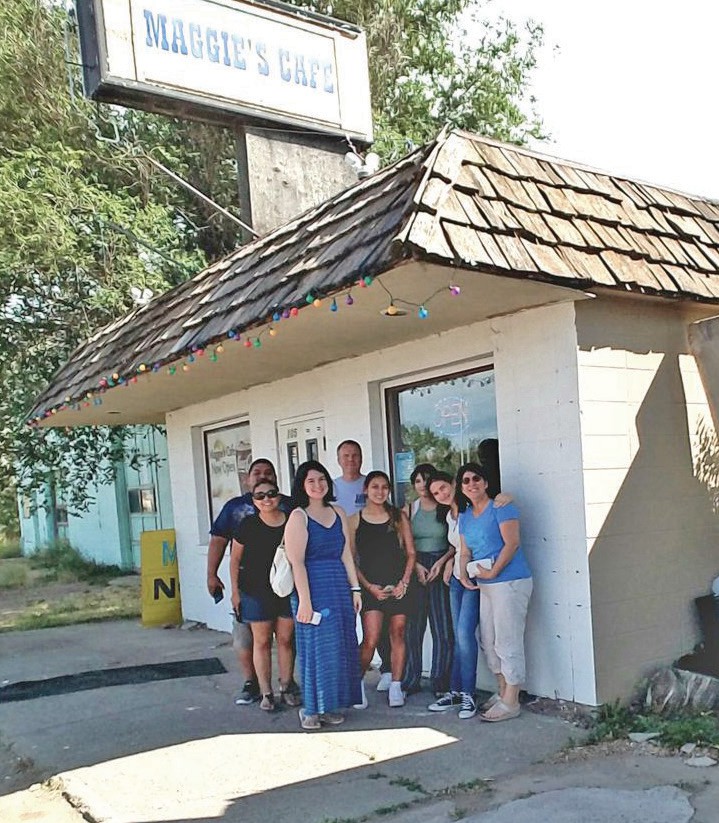
Maggies Cafe Ashland Montana
Ashland – Part 1
This series about towns bordering the Northern Cheyenne Reservation, Montana was inspired by Ernestine Anunkasan Hopa, Editor of Native Sun News Today (NSNT). She is ever curious about tribal communities, both reservations and the towns that surround them. “Have I been there?” she inquired. “If you traveled Hwy 212 to get to the Battlefield from Rapid City you have. Hwy 212 bisects Ashland, could be missed if you blink long enough.”
“Hmm. Don’t remember it. Tell us about Ashland,” she suggested. Good idea and following that will focus on Hardin and Colstrip, Montana and Sheridan, Wyoming.
First: what is a border town? According to dictionary definition a border-town is often characterized by its proximity to a political or geographical boundary. These towns can have a unique culture that mixes influences from both sides of the border, often serving as a hub for trade and commerce, as well as tourism. Many travelers cross the border every day in search of cheaper goods in the border-town and finally, living in a border-town gives residents a unique perspective on both cultures. Unfortunately, in the case of the Northern Cheyenne and many other Great Plains tribal people, a border town is where racism sometimes manifests itself in a manner painful to Natives.
The primary border towns at Northern Cheyenne include Ashland; Hardin; Colstrip; and Sheridan, Wyo. Those used to include Forsyth and Miles City, no longer the case. Rare is it now to sight an Indian in either of those two little bergs, although in the past the Northern Cheyenne traveled there frequently for trade; horseracing and work and some even lived in Miles City. Unfortunately, there were some murders in both of those small communities which caused long-lasting hard feelings between the Cheyenne and non-natives in those areas.
The Northern Cheyenne Reservation was established in 1884 by Executive Order of President Chester Arthur. The natural boundary to the north and east is the Tongue River, thus initially it was known as the Tongue River Reservation.
The Tongue River area was the site of much conflict during the Great Plains Indian Wars, especially the Northern Cheyenne, Sioux and Arapaho allies and enemies, the Crow. The Tongue River is located in southeastern Montana and northeastern Wyoming, historically significant for many Great Plains tribes. The Northern Cheyenne people have inhabited the region for centuries, relying on the river for sustenance and transportation. In the 19th century, the U.S. government’s westward expansion led to conflicts with the Northern Cheyenne, including the Cheyenne Wars. The Treaty of Fort Laramie in 1868 recognized Northern Cheyenne lands but was later violated, leading to further displacement. The Northern Cheyenne Reservation was established in 1884, but it was significantly smaller than their original territory. The river remains culturally important to the Northern Cheyenne, symbolizing their connection to the land and heritage.
The current population estimate is between 946, but the count in 2000 was 464, most likely referring to the off-reservation Ashland immediately east of the boundary of the Northern Cheyenne Indian Reservation and also along the Tongue River. However, that count did not include “Rabbit Town” the Indian HUD housing development on the Reservation side of the Tongue. That is also where the St. Labre Indian Academy, established in 1884 as a boarding school by a Catholic mission to the Cheyenne is located. An estimated 400 or so more people live in that area.
With that, there are basically two different Ashlands: the Cheyenne Ashland including Rabbit Town and the Mission Complex and the largely non-Indian Ashland proper. Rabbit Town was so dubbed according to local sources because years ago it was from time-to-time literally overrun by thousands of Jack Rabbits. The population of that species has sharp increases and declines in a cycle. The jack rabbits have apparently abandoned the area in favor of areas where there are fewer hunters.
The Northern Cheyenne are organized into bands of closely related families. When those bands came onto the Reservation they settled in different districts. The “shy ones” who liked to keep to themselves settled in the Ashland area, heavily influenced by the Sioux whom they frequently intermarried and still do. That includes families such as the Two Twos, Bements, Bahrs and Braines. Actually, it is true that most Northern Cheyenne have Sioux relatives, it seems more predominant in the Ashland area.
When crossing the bridge over the Tongue River, headed North, a traveler leaves Northern Cheyenne Country and enters Ashland. The town was established in 1881 and called Straders after the first postmaster. The name was changed to Ashland in 1886. Ashland had the original supervisor office for the Custer National Forest. There remains an Ashland Ranger District. The 436,000-acre Ashland Ranger District contains the largest contiguous block of land in Federal ownership in eastern Montana and has one of the largest grazing programs in the nation. This area is also rich in coal and wildlife. Some oil and gas activity have taken place, but no producing wells have been found to date. The area offers a variety of topography, varying from rolling grasslands to steep rock outcrops. Vegetation varies from prairie to dense stands of ponderosa pine.
Ashland is division headquarters for the Custer Gallatin National Forest, and it is possible the name comes from the abundance of ash trees. That forest provides for excellent hunting, deer and elk. A historical buffalo jump, burial sites of Indian chiefs, one of Custer’s last camps before the Battle of the Little Bighorn, the Cheyenne Indian Museum, Ten Bears Gallery, Saint Labre Indian School and the Ashland Powwow are of special interest to visitors.
Ashland has a small but self-sufficient economy. Small enough to literally list the businesses. First, comes the tribal community hall; the Otter Creek Saloon, an old-west type of place filled with a huge collection of western antiques and memorabilia collected by tribal people, John David and Lisa Just, proprietors. It is still heated only by a large wood stove. Then comes the Cheyenne Depot, tribally owned Convenience store and gas station, which purveys alcohol because it is off the reservation; three marijuana dispensaries; Post Office, bank, the Tongue River Electric Cooperative office and Range Telephone substation; another bar named The Office; two grocery stores (The Ashland Mercantile, dating back to 1900 and recently recognized on the National Register of Historic places and Warrior Grocery and meat processing plant, owned and operated by Peoples for Progress, a Northern Cheyenne non-profit); three eateries: Michelle’s Munchies, fast food owned by longtime Ashland residents; Rockin Roxies, drinks and desserts owned and operated by Roxie Braine, tribal member and the new JW’s Café, a full-service sit-down eatery. In official capacity there is the local Rosebud County Sheriff station; Custer National Forest Ranger Station; a very active Ashland Fire Department and Ashland Public, serving grades k-6. Off road, you will find the “Miracle on the Hill’, the Heritage Living Center, a state-of-the art elderly independent living center. (Watch for a story about that in future issues).
A very interesting, somewhat new development is the Amish settlement located along the back-gravel road leading from Ashland to either Colstrip or Forsyth, depending upon which turn is taken. The Amish have flourished and provided much to the rural Ashland economy. They operate a cash store selling articles rescued from wrecked semis, but also fresh eggs, meat, home churned butter and many staples. In addition, the Amish men are excellent carpenters, farriers and horsemen; the women excellent seamstresses and bakers. Everyone looks forward to the annual Amish auction where handstitched quilts, log furniture and other yester yore items can be found. The children, barefoot and tow-headed in the summer are very well-behaved. The Amish lend to the colorful cultural mix of the Ashland community.
A majority of the small businesses, including St. Labre, major employer and the Heritage Living Center, are staffed by tribal employees who show good will to all customers. No discrimination and in general people all get along fine. In addition, the small town is clean; no wild dogs are at large; there are very few visible homeless people and there is a very low or nearly non-existent crime rate. Cheyenne and non-Indian work together in Ashland and claim long-standing friendships, often blending families through marriage. As border towns go, this writer gives it a very good score – at least an A. The next segment of this series will take a look at Colstrip, Montana, located some 17 miles from Lame Deer and about 13 miles from the western border of the Northern Cheyenne Reservation.
(Contact Clara Caufield at acheyennereview@gmail.com)
The post Border Towns around Northern Cheyenne first appeared on Native Sun News Today.
 Shared by: Native Sun News Today
February 26, 2026
Shared by: Native Sun News Today
February 26, 2026