
Wíhȟopa: Agnus Ross, a Dakota woman who kept her people’s story alive
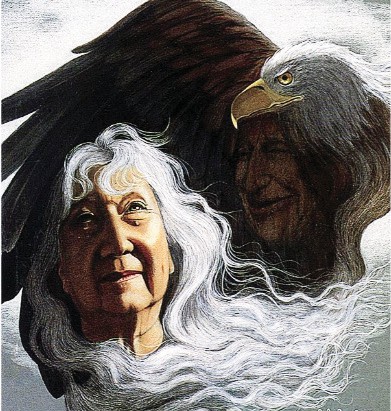
Wihopa: Agnus Ross “Keeper of the Female Medicine Bundle: Biography of Wíh.opa,” written by her son, Allen Charles Ross,Ehanamani.
FLANDREAU — Agnes “Wíhopa” Ross was born along the banks of Wakpa Ipkásan, the Big Sioux River, where the land remembers everything and the water carries the stories of those who came before. She was the daughter of John Allen and Ida Wakeman Allen, a Dakota family whose roots run deep in that place, a family that had survived the Dakota Homeland War of 1862 and rebuilt their lives along the river with quiet determination. They didn’t talk about being Dakota as an idea. They lived it, because it was woven into their very being, their language, their humor, their responsibilities and their way of interacting with one another.
Her Dakota name, Wíh.opa, was explained best by her son, Allen C. “Chuck” Ross, Ehanamani, who carried her story forward. To him, Wíh.opa meant “Beautiful Feather,” not a decorative feather, but a feather that is spiritually good, carried with dignity, a sign of a woman who walks in a good way. He said the name fit her because she moved through the world with gentleness, strength, and a quiet spiritual authority that others recognized long before she ever held a title. Her name described her character as much as it described the feather itself.
Wíh.opa grew up in a community that held each other close. Aunties, uncles, cousins, grandparents, everyone had a role, and everyone helped raise the children.
The river was her first teacher, steady and patient. Her parents were her first leaders, shaping her with the strength of people who had endured history and refused to be erased. She learned by watching, by listening, by absorbing the rhythms of a community that had rebuilt itself along the water’s edge.
From that riverbank upbringing, she carried a sense of purpose that guided her into education. She became the first in her family to attend college, a remarkable achievement for a Dakota woman in the early 20th century. When she graduated in 1931, she didn’t leave her community behind. She brought her education home, treating it as a tool meant to strengthen her people rather than separate her from them.
She stepped into the classroom as a Dakota bilingual teacher, one of the first of her kind. At a time when Native children were punished for speaking their language, Wíh.opa used Dakota as a bridge, a way to help children learn, remember, and feel proud of who they were. She taught with methods far ahead of her time: music woven into lessons, hands-on activities that made learning come alive, approaches that honored the natural curiosity of children. Her creativity and bilingual skill soon led her into pre-kindergarten teaching, where she shaped the earliest experiences of Native children with warmth, cultural grounding, and a deep understanding of how young minds grow.
As federal programs like Title I and Indian Education began to emerge, Wíhopa was already there, helping shape how they would serve Native children. She understood that these programs could only succeed if they honored the community they were meant to help. She used Title I resources to support culturally grounded learning, to strengthen early childhood programs, and to ensure that Dakota families were included in decisions about their children’s education. In Indian Education, she became a quiet architect, influencing curriculum, mentoring younger Native educators, and helping build programs that reflected the community’s values rather than federal assumptions.
During the 1960s, her work carried her west to the Oglala people on Pine Ridge, where she helped organize the first Oglala Sioux Conference on Indian Education. She worked alongside Oglala educators and leaders during a time when tribes were asserting more control over their own schools. In 1968, she supported the creation of the first tribal college on Pine Ridge, helping lay the groundwork for what would become a national movement toward tribal higher education. Her work there strengthened the foundation of Indian Education across the entire region.
But no matter how far her work took her, the river always called her home. After her time with the Oglalas, Wíh.opa returned to Wakpa Ipkásan, to the community that had shaped her and the land that had raised her. She returned not as a young teacher beginning her journey, but as a woman carrying decades of knowledge, educational, cultural, and spiritual, ready to pour it back into her own people.
Alongside her work in education, Wíh.opa carried one of the most sacred responsibilities in Dakota culture: she was the Keeper of the Female Medicine Bundle. This role is recognized in a woman who carries depth, humility, and spiritual discipline. She guided families through healing, protected teachings that had survived war, removal, and suppression, and ensured that the spiritual life of her people remained intact. She held this responsibility with the same steadiness she brought to her classroom, quietly, faithfully, without seeking recognition.
Her leadership extended beyond ceremony and education. Wíh.opa became the first woman chairperson of the Flandreau Santee Sioux Tribe, stepping into political leadership with the calm authority of someone who understood both the old ways and the new systems pressing in on her people. She led with clarity, cultural grounding, and a long-view vision shaped by the teachings she had carried since childhood. Her decisions were made not for the moment, but for the generations coming after.
Her impact was so profound that the Tribe named its central educational institution after her, the Agnes Ross Education Center, a place where children learn, families gather, and Dakota identity is honored. It stands as a testament to the life of a woman who believed that education should strengthen a people, not erase them.
Her story was preserved in the biography “Keeper of the Female Medicine Bundle: Biography of Wíh.opa,” written by her son, Allen Charles Ross, Ehanamani, ensuring that her teachings, her leadership, and her life would not be lost to time. He wrote not as a distant historian, but as a son who had watched her carry her name, Beautiful Feather, with the dignity and goodness it required.
Everything Wíh.opa did, teaching, leading, healing, shaping programs like Title I and Indian Education from the inside, working with the Oglalas, and returning home to Wakpa Ipkásan, came from the same source: she belonged to a community that had survived, rebuilt, and carried itself forward with dignity. She knew the river that raised her. She knew the parents who shaped her. She knew the history her family had endured. She knew the language that carried her people through generations. And she made sure that Dakota children, those in her classroom, those served by the programs she helped shape, and those yet to be born, would know themselves too.
She was a woman who preserved history, traditions, language, and the right of Dakota children to learn as Dakota people, not by holding these things tightly, but by passing them forward. A Dakota woman who carried the past into the future with grace. A woman whose life still ripples outward, like the river that raised her.
The post Wíhȟopa: Agnus Ross, a Dakota woman who kept her people’s story alive first appeared on Native Sun News Today.
 Shared by: Native Sun News Today
March 14, 2026
Shared by: Native Sun News Today
March 14, 2026