
150 years after the Battle of the Rosebud, Tribes prepare to gather again where ‘The Girl Saved Her Brother’
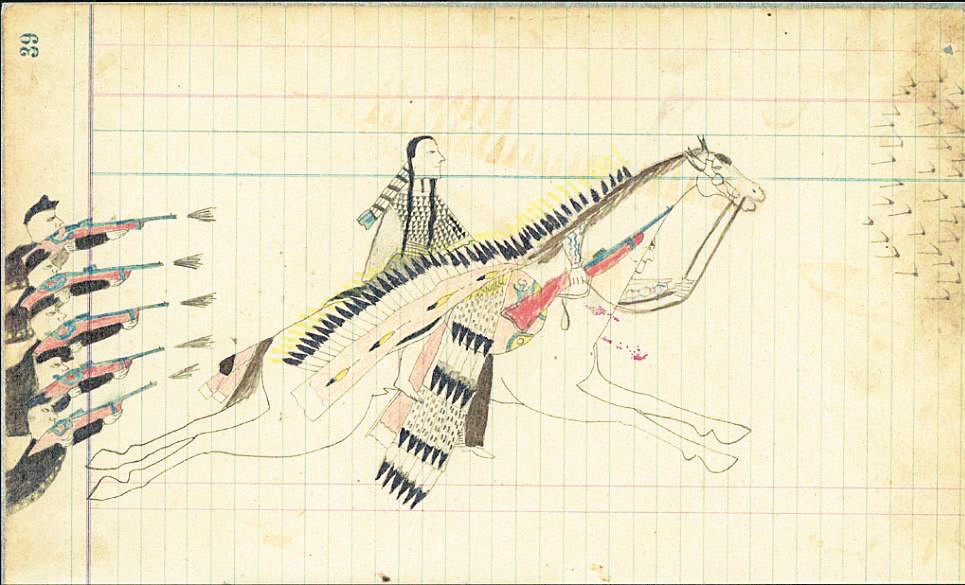
A depiction of Buffalo Calf Road Woman appears on the Yellow Nose Spotted Wolf Ledger, National Anthropological Archives, Smithsonian Institution.
ROSEBUD BATTLEFIELD STATE PARK — On June 17, 2026, the Northern Cheyenne, Lakota, Arapaho, and their allies will return to the Wolf Mountains for a full day of remembrance marking the 150th anniversary of the Battle of the Rosebud — the battle the Cheyenne call “Where the Girl Saved Her Brother.”
The commemoration will begin early, long before the formal program opens. At 8:00 a.m., riders will leave Trail Creek on horseback, following the same route their ancestors traveled into the valley 150 years ago. By 1:00 p.m., they are expected to arrive at Rosebud Battlefield State Park, where they will join the public program for a reenactment of Buffalo Calf Road Woman’s rescue of her brother, Comes In Sight. A Victory Dance will follow at 2:00 p.m., with a community feast at 3:00 p.m.
Montana Fish, Wildlife & Parks announced that the public is invited to attend the full day of events, which also includes morning ceremonies beginning at 10 a.m. featuring prayers, a wreath laying, and a keynote address by Dr. Leo Killsback (Northern Cheyenne) — historian, author, and one of the leading contemporary voices on Cheyenne history and sovereignty.
For many Native families, the commemoration is not simply a historical observance — it is a homecoming.
A Battle overshadowed, but never forgotten
Although the Battle of the Rosebud is often overshadowed by the Battle of the Little Bighorn eight days later, historians say the Rosebud was the moment the Native nations seized the initiative in the 1876 campaign.
On June 17, 1876, Brig. Gen. George Crook led roughly 1,000 U.S. soldiers and scouts north into the Wolf Mountains. Waiting for him was a combined Native force of Lakota, Northern Cheyenne, and Arapaho warriors, estimated between 750 and 1,000 fighters. They had gathered for the great summer encampment and had agreed they would not wait to be attacked. They would meet Crook on the Rosebud and stop him before he reached the Little Bighorn Valley, where thousands of Native families were camped.
The Native leaders included Crazy Horse, the Oglala war leader; Crow King and other Hunkpapa leaders; Hump II, Spotted Elk, and the disciplined Minneconjou akíchita; and the Northern Cheyenne chiefs Two Moon, Young Two Moon, Spotted Wolf, Brave Wolf, and Lame White Man. A small but decisive Arapaho contingent under Black Coal, Sharp Nose, and Yellow Calf also joined the fight.
Their unity was not accidental. It was the result of years of shared struggle, shared grief, and shared determination to remain free.
The Battle That Turned the Campaign
At dawn, the valley lay quiet. Lakota and Cheyenne warriors were already mounted, watching the dust of Crook’s column rising from the south. They knew he was coming. They had chosen the ground. And they were ready.
When Crook’s scouts entered the valley, Crazy Horse struck first. He led a sudden downhill charge that shattered the morning stillness and forced the soldiers into a defensive scramble. Lakota and Cheyenne warriors poured over the ridges like water, firing from horseback, then wheeling away before the soldiers could form a steady line. Crook had expected scattered resistance. Instead, he found himself facing a coordinated Native army.
The Northern Cheyenne fought with fierce precision, moving from ridge to ridge, firing down into soldiers who struggled to climb under fire. Two Moon later said the fighting rolled across the hills “like waves,” and that is how it felt, surges of warriors appearing suddenly on one flank, then disappearing, only to reappear on another.
In the midst of this chaos came the moment that gave the battle its Cheyenne name.
A warrior named Comes In Sight was shot from his horse and lay exposed as soldiers closed in. His sister, Buffalo Calf Road Woman, rode straight into the gunfire, pulled him onto her horse, and carried him to safety. Cheyenne warriors saw her and shouted, “The girl saved her brother!” The cry spread across the field, lifting the hearts of the fighters. Her courage became the turning point of the day, igniting the Cheyenne line with renewed fury.
Crazy Horse, seeing the momentum shift, executed one of his signature battlefield maneuvers. He led a wide flanking sweep around Crook’s left, striking from the side and rear. Hunkpapa and Minneconjou warriors followed with disciplined precision, pressing the soldiers so hard that Crook was forced to pull men from his center just to keep from being overrun.
For eight hours the battle raged across miles of broken country. By midafternoon, Crook’s ammunition was running low, his Crow and Shoshone scouts were exhausted, and his infantry was pinned in the coulees. He could not advance. He could barely hold his position. Finally, he ordered a withdrawal south toward Goose Creek, ending any hope of joining the other U.S. Army columns moving toward the Little Bighorn.
That retreat changed the course of history.
The Road to the Greasy Grass Began Here
The U.S. government had planned a three-pronged campaign to trap the “non-agency” Lakota and Cheyenne. Crook was supposed to come from the south, Terry and Custer from the east, and Gibbon from the west. But after the Rosebud, Crook never rejoined the campaign. He rested, regrouped, and even went fishing in the Big Horn Mountains while the rest of the army moved on without him.
Eight days later, when Custer rode down the bluffs of the Little Bighorn, he rode in alone. The warriors he faced there — Lakota, Northern Cheyenne, and Arapaho — were the same warriors who had beaten Crook. They were confident. They were unified. They were ready.
The Battle of the Rosebud was not a footnote to the Battle of the Greasy Grass. It was the opening victory of the Native summer campaign of 1876. It was the day Crazy Horse, Two Moon, the Northern Cheyenne, the Hunkpapa, the Minneconjou, the Itázipcho, and the Arapaho stood together and stopped an army. It was the day Buffalo Calf Road Woman rode into history. And it was the day the road to the Greasy Grass was set in motion — not by the U.S. Army, but by the warriors who fought to protect their people and their way of life.
A Growing List of Known Warriors
Although an estimated 750–1,000 Native warriors fought at the Rosebud, only about 200 names survive in the historical record. These include:
Northern Cheyenne: Two Moon’s band, Lame White Man’s band, Spotted Wolf’s band
Oglala Lakota: Crazy Horse’s followers, He Dog’s band
Hunkpapa Lakota: Crow King’s warriors, Rain in the Face’s relatives
Minneconjou Lakota: Hump II’s band, Touch the Clouds’ relatives
Lakota: Spotted Eagle’s contingent
Arapaho: Black Coal’s contingent
The full verified and oral history warrior rolls will be available at the commemoration and in the event program.
A Gathering 150 Years in the Making
As June 17 approaches, tribal families say they are preparing not only to honor the past, but to stand on the same ground their ancestors defended.
They will gather. They will ride in. They will speak the names that survived. And they will remember the hundreds more whose names were never written down, but whose courage shaped the history of the Northern Plains.
The 150th anniversary of the Battle of the Rosebud is not simply a commemoration. It is a return.
The post 150 years after the Battle of the Rosebud, Tribes prepare to gather again where ‘The Girl Saved Her Brother’ first appeared on Native Sun News Today.
 Shared by: Native Sun News Today
June 13, 2026
Shared by: Native Sun News Today
June 13, 2026
Tags: Top News