Giago and Mickelson gave South Dakota a day worth honoring
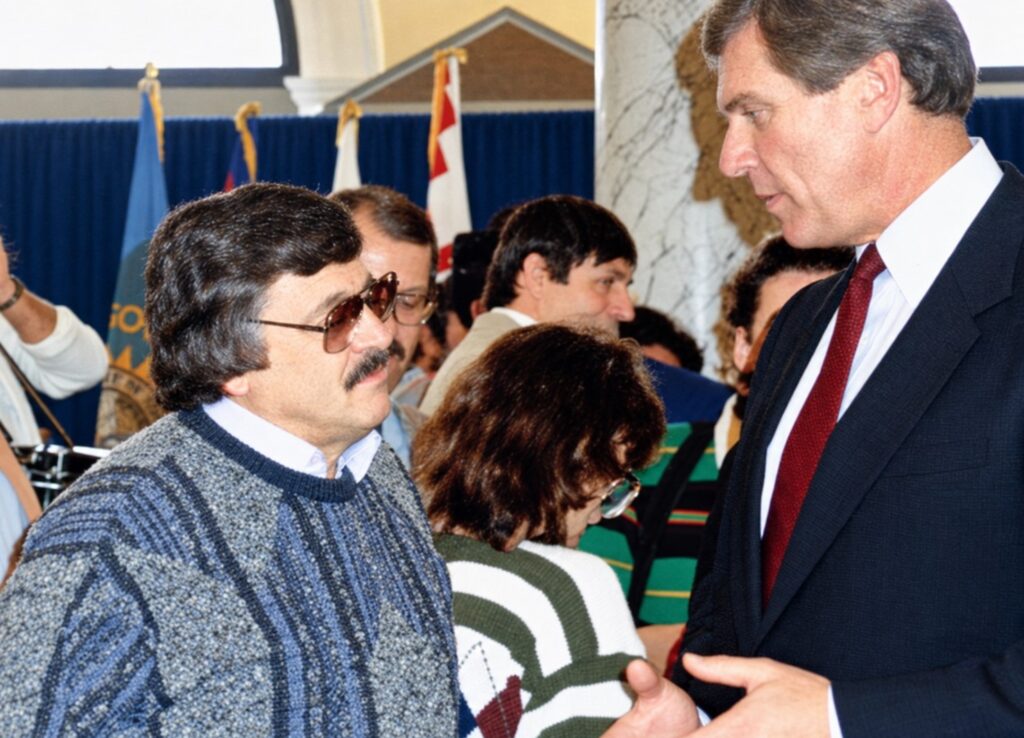
Tim Giago and South Dakota Governor George S. Mickelson in 1990.
RAPID CITY—Long before Indigenous Peoples Day became a national movement, two South Dakotans sat on opposite sides of a historical divide and decided they could do something meaningful together.
One was Tim Giago, an Oglala Lakota newspaperman from the Pine Ridge Reservation. The other was George S. Mickelson, a Republican governor from one of South Dakota’s best-known political families.
Their partnership helped make South Dakota the first state to replace Columbus Day with Native American Day. It was more than a change on the calendar. It was an act of respect, and it remains one of the finest examples of what can happen when an Indian leader speaks plainly and a political leader has the character to listen.
Giago had founded the Lakota Times at Pine Ridge in 1981. At a time when Indian people were usually written about by outsiders—if they were written about at all—Giago built a newspaper that allowed them to speak for themselves. He understood that names, symbols and public observances matter because they tell people whose history counts.
South Dakota had observed the second Monday in October as Columbus Day. Giago challenged the state to use that day to honor the Native people who had lived here for generations before Columbus ever crossed the Atlantic. He pressed the issue in the pages of his newspaper and took the proposal to Mickelson.
Mickelson could have offered a polite response and allowed the proposal to disappear. Politicians are very good at expressing sympathy for an idea they have no intention of advancing. Instead, he listened. That decision deserves to be remembered. Mickelson did not treat Giago as an adversary to be managed or as a token Indian voice to be acknowledged and ignored. He recognized the merit of the proposal and worked with Giago and tribal leaders to make it happen.
The proposal became part of something larger. Mickelson designated 1990 as South Dakota’s Year of Reconciliation, intended to begin improving relations between Indian and non-Indian people. In 1989, the South Dakota Legislature unanimously approved the measures. The state recognized Martin Luther King Jr. Day, proclaimed the Year of Reconciliation and replaced Columbus Day with Native American Day.
Unanimity is rare enough in politics. Unanimity on an issue involving race, history and Indian-white relations was remarkable. That vote did not mean every old grievance had been resolved. It meant South Dakota had chosen a better direction.
The first official Native American Day was observed Oct. 8, 1990. A major ceremony was held at Crazy Horse Memorial in the Black Hills. Mickelson opened his remarks in Lakota, a gesture that carried particular meaning in a state where Lakota children had once been punished for speaking their own language.
There were speeches, ceremonies and public expressions of reconciliation, but the enduring accomplishment was the holiday itself. Every year thereafter, the second Monday in October would bear a name that recognized the first people of the land.
Giago deserves credit for having the vision and persistence to raise the issue. Mickelson deserves credit for recognizing a good idea when it came from outside his own political and cultural world. Neither man could have accomplished the same result alone. Their partnership also tells us something important about reconciliation. Reconciliation is not agreement on every issue, and it is not one side surrendering its identity to the other. It begins with truth, mutual respect and a willingness to act.
Giago did not stop being a hard-nosed Lakota journalist when he worked with a Republican governor. Mickelson did not stop being a South Dakota conservative. Each man brought his own history and convictions to the table. They found common ground without pretending their differences did not exist.
South Dakota’s action came early in a movement that would eventually spread across the country. Berkeley, California, adopted Indigenous Peoples Day in 1992. Other cities followed, including Seattle, Minneapolis, Albuquerque, Los Angeles and Phoenix. States began adopting holidays or official observances under such names as Indigenous Peoples Day, Native American Day and American Indian Heritage Day.
By 2025, at least 17 states and the District of Columbia formally recognized a holiday honoring Indigenous people, sometimes replacing Columbus Day and sometimes observing both. More than 200 cities and local governments had adopted similar observances. California celebrates Native American Day in September, while South Dakota continues to observe Native American Day on the second Monday in October.
The movement reached the White House in 2021, when a president issued the first federal proclamation recognizing Indigenous Peoples Day. Columbus Day remained a federal holiday, but the national conversation had permanently changed. Native people were no longer asking only to be included in somebody else’s account of America. They were insisting that the country recognize a history that began thousands of years before 1492.
South Dakota was well ahead of that national change. It acted before Indigenous Peoples Day became common language, before large cities began changing their calendars and more than three decades before the first presidential proclamation.
Mickelson died in a plane crash in 1993, only three years after the first Native American Day. Giago continued building Indian newspapers and opening doors for Native journalists until his death in 2022. The holiday they helped create has outlived them both, as a worthy tradition should.
Native American Day is now marked by parades, school programs, dances, prayer, public ceremonies and family gatherings. Each generation adds something of its own, but it inherits the day from the people who did the difficult work of establishing it.
That history and legacy must not be lost. Young people should know that Tim Giago imagined a better observance and had the courage to ask for it. They should know that George Mickelson listened, acted and persuaded the state to join him. They should know that Indian and non-Indian South Dakotans worked together and created something that helped point the rest of the country in a new direction.
Tradition matters. It connects a celebration to the people, purpose and sacrifice that gave it life. Native American Day honors the first people of this land, but it also honors the rare and hopeful partnership that made South Dakota a national leader: Tim Giago with the idea, George Mickelson with an open door, and both men with the determination to make history.
(James Giago Davies is an enrolled member of OST. Contact him at skindiesel@msn.com)
The post Giago and Mickelson gave South Dakota a day worth honoring first appeared on Native Sun News Today.
 Shared by: Native Sun News Today
September 25, 2026
Shared by: Native Sun News Today
September 25, 2026
Tags: News