Battle of the Little Big Horn targeted by Trumps ‘Anti-American’ ideology

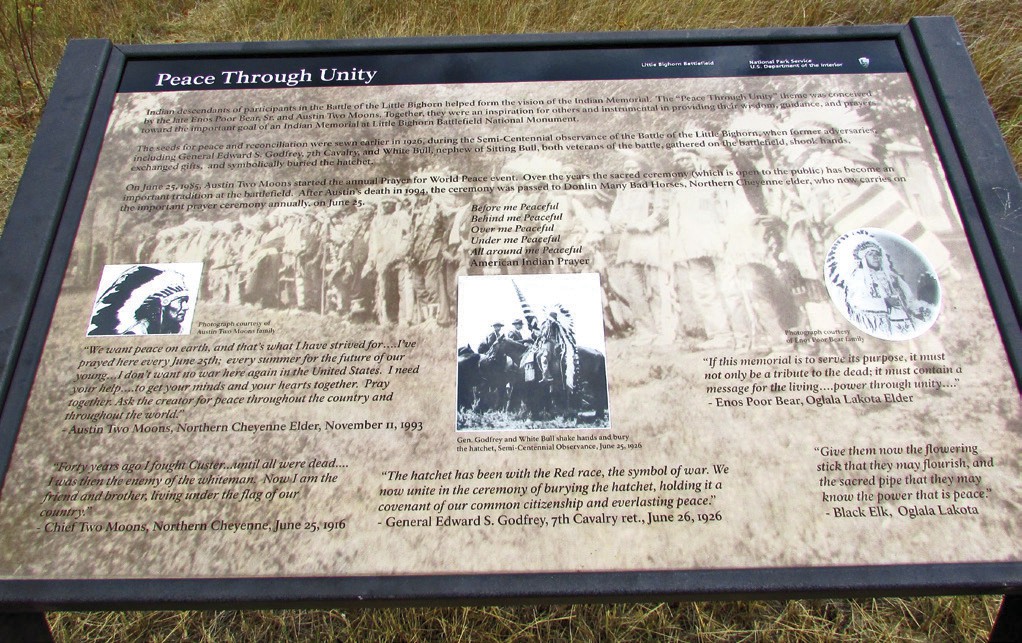
Two markers that the National Park Service have been ordered to be removed from the Little Bighorn Battlefield by the Trump administration’s purge of so called “anti-American ideology.” (Courtesy photo)
LAME DEER, Mont. – Unless the tribal stake holders in the Battle of the Little Big Horn can deter it, the Little Big Horn Battlefield will become the latest victim of Donald Trumps “anti-American ideology” an executive order which targets U.S. cultural and historical institutions, museums, monument and national parks.
Following President Donald Trump’s March 2025 “Restoring Truth and Sanity to American History” order, the National Park Service recently removed signage “describing broken promises to Native American tribes and references to the loss of Indigenous culture and language under boarding school systems,” according to a local Montana outlet, KTVQ.
According to Trump’s executive order, the secretary of the interior has the power to “take action… to ensure that all public monuments, memorials, statues, markers, or similar properties within the Department of the Interior’s jurisdiction do not contain descriptions, depictions, or other content that inappropriately disparage Americans past or living (including persons living in colonial times), and instead focus on the greatness of the achievements and progress of the American people or, with respect to natural features, the beauty, abundance, and grandeur of the American landscape.”
The Northern Cheyenne Tribe was quick to react, enacting a Tribal Resolution of strong opposition. Other affected Tribes and tribal organizations will hopefully join the Cheyenne in opposing the Federal Government, just as they did 150 years ago on the fateful day of June 26, 1876 when Custer was driven into the ground.
As this report is penned, Northern Cheyenne Tribal President Gene Small and a delegation are in Washington, D.C. appealing for aid to thwart this latest affront to Native Peoples by the Trump Administration.
President Donald Trump has targeted U.S. cultural and historical institutions — from museums to monuments to national parks — to remove what he calls “anti-American” ideology. His declarations and executive orders have led to the dismantling of slavery exhibits, the restoration of Confederate statues and other moves that civil rights advocates say could reverse decades of social progress.
Here are some actions Trump has taken to reshape American historical sites and cultural bodies since returning to the White House:
In March 2024,Trump signed an executive order just weeks after taking office targeting what he said was the spread of “anti-American ideology” at the Smithsonian Institution and calling for the ideology’s removal from the vast museum and research complex, a premier exhibition space for U.S. history and culture. The order also directed the Interior Department to restore federal parks, monuments and memorials that had been “removed or changed in the last years to perpetuate a false revision of history.”
Following Trump’s March 2025 executive order, the U.S. Interior Department said all national parks’ interpretive signage – the plaques and panels that explain sites and events — was under review as the Trump administration attempted to reshape public spaces and museums.
U.S. National Park Service staff subsequently removed a slavery exhibit on Jan. 22 from a Philadelphia historic site where George Washington once lived. The exhibit included a reference to Washington’s ownership of enslaved people.
The Washington Post reported that U.S. officials have also ordered national parks to remove dozens of signs and displays related to slavery and the mistreatment of Native Americans by settlers.
The National Park Service said last August it would reinstall a statue of Confederate General Albert Pike that had been toppled and vandalized in 2020 during racial justice protests after George Floyd’s murder. Civil rights groups say such moves undermine the acknowledgment of critical phases of American history. “Stripping enslaved people’s stories from museum exhibits, monuments, and digital archives is not neutrality — it is erasure,” the NAACP said.
Trump also harshly criticized the Smithsonian in a social media post last year, saying it would face the same process as colleges and universities whose funding came under threat for policies that displeased the Trump administration. The 180-year-old Smithsonian, which includes 21 museums and galleries and the National Zoo, receives most of its budget from the U.S. Congress but is independent of the government in decision-making. It includes the National Museum of the American Indian, created by statute under the leadership of the late Senator Ben Nighthorse Campbell, Northern Cheyenne. If Nighthorse Campbell were still with us, there might be hell to pay for this recent disgrace and affront to the Northern Cheyenne, Sioux, Arapaho and the one Ute who protected homelands, family and way of life in the original battle.
The White House launched an internal review of some Smithsonian museums last year, saying it would assess the tone and historical framing of exhibition text, websites, educational materials and digital content. The Smithsonian said it would engage “constructively.”
Thus, so far Trump has been the winner. Is that not what Custer had done before the Battle of the Little Big Horn.
Following is the complete text of a press release issued by the Northern Cheyenne Tribe about this matter.
“The Northern Cheyenne Tribe took official action Monday morning (Feb. 2, 2026) to oppose the reported Trump Administration order to change or remove signs, markers, and exhibits recognizing Native Americans at the Little Bighorn
Battlefield National Monument. In a unanimous vote 11-0, the Northern Cheyenne Tribal Council adopted a resolution to prevent changes to or removals of Native American markers, monuments, and signage at the battlefield.
The Tribe, in its resolution, cited federal Public Law 102-201 that officially changed the battlefield name to the Little Bighorn Battlefield National Monument and authorized the Indian Memorial there. The Tribe also referenced the State of Montana’s constitution Article X that sets the state’s educational goals for the preservation of the cultural integrity of American Indians, which is implemented through Montana’s “Indian Education for All” law MCA 20-1-501. For the Northern Cheyenne Tribe, educating the public about the battle and surrounding events has been vital.
On June 25, 1876 the United States Army 7th Cavalry under the command of Lieutenant Colonel George A. Custer attacked the complex of six Cheyenne and Lakota encampments at the Little Bighorn River, and these allied warriors successfully defended their homes and families by defeating the aggressors, becoming the most famous battle of the West. The rare victory represents the Native American’s proud resistance to the loss of their traditional homelands, and it represents defending the lives and way of life of their people.”
Northern Cheyenne President Gene Small noted: “You know, the 2003 Indian Memorial at the battlefield was themed ‘Peace through Unity’ and it’s ironic that today the Administration is sowing division and conflict.”
For the 2024 Little Bighorn Battle commemoration, the Northern Cheyenne Tribe echoed the sage words of Wooden Legs, a warrior who fought Custer: “A long time ago we were enemies. Today we are friends.” Northern Cheyenne Vice President Ernest Littlemouth, the Tribe’s designated official for the 150th battle anniversary events, stated: “This attempt to change or remove tribal markers and monuments dims the light of the healing and progress we have all made.”
It is the resolute position of the Tribe that to alter or remove signs and exhibits honoring Native Americans at the battlefield — or to harm warrior markers and monuments would go against federal law, and would betray the spirit of Montana’s constitutional goal to preserve American Indian cultural integrity.”
However, before it reaches this flashpoint, the Tribe’s resolution also authorizes consultation with the government regarding this matter. The Northern Cheyenne Tribe will appeal to the voices of reason in the Montana Delegation (Daines, Sheehy, Zinke, Downing), and consult other agencies to prevent any adverse changes or removals of Native American recognition at the battlefield.
In a final note, perhaps Trump, the champion of private enterprise and business might consider that the Little Big Horn Battlefield is the third largest tourist draw in Montana, bringing more than 250,000 visitors annually, who spend money at Crow, Hardin, Billings and other areas surrounding the Battlefield. Removal of the signage and beautiful Memorial could cause a drop in those visitor numbers.
(Contact Clara Caufield at acheyennereview@gmail.com)
The post Battle of the Little Big Horn targeted by Trumps ‘Anti-American’ ideology first appeared on Native Sun News Today.
 Shared by: Native Sun News Today
February 13, 2026
Shared by: Native Sun News Today
February 13, 2026
Tags: Top News