
Cheyenne Manners – Act Better
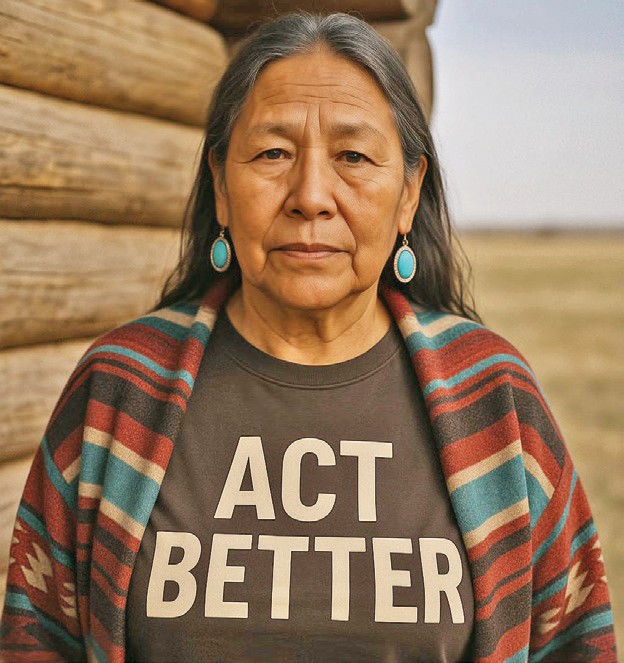
Soon the New Year will arrive—a time for making resolutions and promising to “act better.” With that in mind, reflections about some proper Cheyenne manners might be appropriate. The well of Cheyenne self conduct runs deep; thus, this article touches only upon some very basic etiquette. Some of these manners are in startling contrast to the “non Indian” manner of thinking, which is much more based upon material things.
This article has been reviewed and approved by several elders, as it is important to present and explain some basic Cheyenne manners in the right way—both to some young Cheyenne who haven’t had the opportunity to learn, and even some older Cheyenne who sometimes forget from time to time, as well as “non” friends and readers. Those knowledgeable and venerable ones included Clyde Wolfblack, Lenora Wolfname, Myrna Burgess, and Dick Littlebear—good advisors. This writer is only a translator for others, sharing minimal knowledge which others know in spades.
Conducting Yourself in Public
At any public or even informal gathering, literally sit in the back and “put your ears on”—listen, that is. A very strict Cheyenne admonishment goes this way: You have no ears—no ability to listen. Listening is learning.
There will be plenty of people who have something to say, often in a loud and aggressive manner, trying to convince others that they are smart and have the answers—often to no avail. Another person must try to figure out what is good about their talk. If anyone wants to hear your opinion, they will ask. A soft tone of voice, rather than strident or insistent, is preferable.
Traditionally, that is how the Chiefs behave. They let anyone talk—say what they want to say. At the end, someone will ask a Chief to speak, who then often reminds the People to behave in a good way. “Treat each other good,” is what they advise. After that, the public meeting is over. Then everyone eats together, teasing in a soft and gentle way—sometimes in a “golly” way between brothers in law, always funny.
When Insulted
This is the hardest one to learn and practice. Every once in a while, traveling through life, someone insults—intentionally, angrily, or accidentally. Then it is essential to remain calm and not reciprocate in similar fashion. That is how feuds and long-lasting bad feelings come about. Listen, and then thank them for their advice. Harder still, pray for them and mean it. It might not make them act better, but it makes the insulted one feel better.
Greeting People
It is very important for Cheyenne to greet each other in a positive manner. The standard greetings include: It’s a good day; It is a beautiful day; or at the end of the day, a good night, even if not personally acquainted. If related or friends, also ask, “How are you feeling?” indicating personal concern. That phrase literally translates to “How is your stomach?” (your center/core/essence). A good response is “good”; a moderate response is “okay”; a negative response is “not good.” That is prayer time. The Cheyenne do not lie.
The differences between Cheyenne and the “nons’” style of greeting have been the cause of some cultural misunderstanding. First, the “nons” are quite direct in greetings: gazing into eyes—sort of a psychological challenge; offering a firm handed grip—apparently an indication of strength, willpower, intent, respect, and manners from that point of view. Cheyenne, on the other hand, avoid direct eye contact, perhaps focusing on your right shoulder or something beyond your head— respectful in our view. Sometimes the “nons” take that as being “shifty eyed.” Second, do not show power in a handshake; a slight and gentle touch is preferred. Thus, to many “nons,” Cheyenne may be construed as “limp wristed” people. However they have not yet challenged a fist fight—just want to acknowledge one another. If a Cheyenne wants to fist fight, it will be very clear. Some Cheyenne are quite confused about this, after centuries of conflict, viewing nearly everything with the “nons” as a challenge.
Eating Together
By proper Cheyenne etiquette, when a visitor arrives, a Cheyenne woman will first offer something to drink (a cool glass of water, cup of tea, or perhaps even a soda if one is on hand). After all, the visitor might have walked a long way for the visit. If they stay long enough, that same woman will start cooking—no matter the time of day. They offer some kind of food, even if only a cracker and cup of tea.
The “nons” will usually demur, saying things such as, “No, I just ate. Thank you, but I’m not hungry,” wanting to be polite and respectful in their way. In Cheyenne contrast, the offering of food is always accepted— even after Thanksgiving dinner. Otherwise, it is very rude. In the old-time way, and even now, all that can basically be shared is food—the gift of friendship—which, when declined, signals “you are not good enough.”
Children, ever hungry, are served first; then women; and then the others, including warriors. The Chiefs then eat. The women who have prepared the food and dished it out to ensure that everyone gets to eat go last—sometimes not eating.
There is another rule about eating. Unlike the “nons,” who often have a luncheon or dinner—tax write off to discuss business—that is unacceptable among the Cheyenne. First order: pray. Second: enjoy your food. Third: be thankful you have some. And most important: enjoy one another’s company. We don’t know for sure when we will see each other again. After digestion occurs, business can be pursued.
Children’s Behavior
There are some fundamental words that Cheyenne children learn first: Listen; sit down; be quiet; stop doing that. Children are learning, and in order to do that, they must listen. Often, “nons” will observe that Cheyenne children are very shy. Not so—they are being respectful and listening.
Cheyenne way: children are not to be front and center, as is the current behavior for so many “nons,” and even Cheyenne children, remiss in manners due to not being instructed, will insist upon taking the stage, demanding attention, and even interrupting the conversation of adults. There will come a time in their life when they have something to say, and it will then be acknowledged. In the meantime, it is not appropriate to be intimidated or give in to the demands of young ones.
Do Not Point at Anybody
One of the rudest and most aggressive behaviors among Cheyenne is to use your finger(s) to point at another person. When one finger points out, more aim back at you. That is why Cheyenne use lips—indicating direction, purpose, or to make a point—much politer. Pointing at a person, perhaps even punctuating a chest, is extremely aggressive— time to fight. That is not good, especially among relatives, and should be avoided.
Giving / Generosity
An old Cheyenne saying holds: The best place to store a buffalo is in your neighbor’s stomach. What does that mean? Simple. Sometimes in life, people ride high, blessed with provisions, but often only for a little while. As the “nons” say—“can’t take it with you.”
In a blink, a person could end up otherwise—dependent upon others for sheer survival: a place to sleep, survive the harsh winds of winter, and have something to eat. If not, face death. Although the Cheyenne always survived this way, people were reminded very harshly about this possibility during the Indian wars on the Great Plains. The ones blessed with food and shelter shared.
A notable example was Crazy Horse, married to a Northern Cheyenne woman who ever took his relatives in. If not for him, the Northern Cheyenne might have perished. Perhaps this should be kept in mind: you can go from high to low very quickly. Then perhaps people you helped when you were “high” will remember you when you are “low.” If not, Maheo’o will—but his job is not providing the groceries. The Human Beings, known to each other and the Creator as “the beautiful people,” have to take care of that… forever.
Look to Your Relatives
Tribal peoples are incredibly blessed to be connected to so many others. If two Cheyenne—sometimes even with other Tribes, especially the Sioux, Arapaho, and Crow—who don’t know one another sit and talk long enough, they will discover blood or adopted connections, small groups of people.
It is necessary to acknowledge connection to the other spirits in the world. Some of the most wonderful relatives are four legged—ever so kind and giving, teaching so much, like love without condition. Consider a duck and their way of thinking: keep calm and unruffled, but paddle like the devil underneath. Let the negative roll off your shoulders like oily water.
Talk Straight
Vince Whiteman, who just read this and agrees, suggested this last part. As he counseled, word by word:
“Your feet should always follow your words. Your actions should follow because Maheo’o and the spirits see everything. Move forward, no matter what happens, no matter what it is. And always remember: make it RIGHT.”
He is going to take this article to the Cheyenne Depot and require that everyone he sees read it. “Too many have never learned or forgotten these things,” he said.
Closing
It is very simple: be kind, caring, and helpful when the opportunity arises—even when that is not returned. That is all we have to say right now—classic Cheyenne close.
We wish you and yours a blessed year in 2026. Maybe next year, we can all “act better.”
(Clara Caufield can be reached at acheyennereview@gmail.com)
The post Cheyenne Manners – Act Better first appeared on Native Sun News Today.
 Shared by: Native Sun News Today
December 25, 2025
Shared by: Native Sun News Today
December 25, 2025
Tags: Top News