
Collins Littlewhiteman—Northern Cheyenne cowboy ‘to the bone’
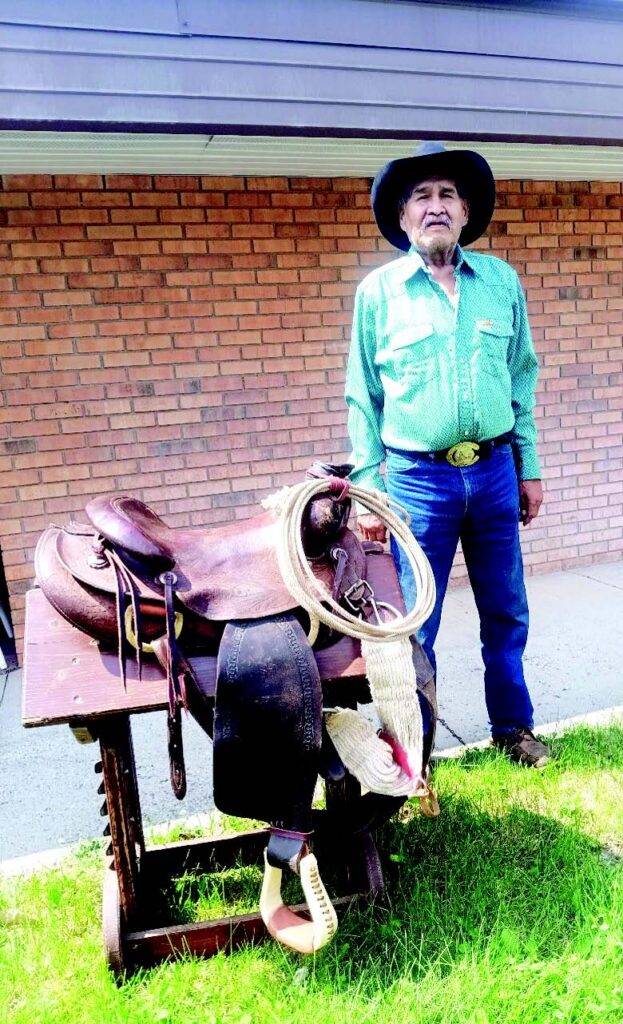
Collins LIttlewhiteman, Northern Cheyenne old-time cowboy.
(Photo courtesy Clara Caufield)
LAME DEER, Mont. – I’ve known Collins for “long time now” and testify he is an Indian cowboy in spades. He likes to read what I write. When asked about a story on him, he shrugged. “Not much to tell. Just cowboying and training a few good horses. That’s about it.”
Like most real cowboys, Collins doesn’t talk much. His work and ability speak for themselves. For example, while reviewing this article his only response was a grin; a nod; and “that’s right.” He only did a little fine-tuning. At 73, he’s still long and lean; a ropin’ machine; overall a good lookin’ son of gun for his years.
Just cowboying? We disagree. This part of the Universe was developed on backs of such men, Collins is one of them. I’m proud to have him call me “pard” or “cowgirl.” That means something coming from him.
Collins is a full-blood Northern Cheyenne, but not the type to brag or dwell upon it. And he has gained respect for the Northern Cheyenne from the many cow bosses he has worked for over the past fifty plus years. “John Small is the only one on Kirby Creek I never worked for. Rode for all the rest of them,” he explained.
Collins came into this world in 1952, oldest of seven siblings born in a log cabin between Lame Deer and Busby. His parents were Wayne and Lucy White Dirt Little Whiteman. His maternal grandfather Charles White Dirt was very influential, teaching Collins traditional ways, which is why Collins is a headsman for the Elk Scraper Military Society.
The log cabin was a far sight from the road, he once pointed out where it was— across a big ravine, but the family home unfortunately burned down. “I grew up quiet and still like it that way,” he smiled. At 14, Collins started a string of rodeo and horse racing successes. His father offered to haul four horses to Crow for an Indian Relay Race provided Collins do the shoeing. He won that day, the youngest jockey and was proud that it was his own working horses, personally trained, to win that coup.
“That’s because they had covered a lot of country,” he explained. As a youngster Collins went everywhere horseback and was frequently asked to put “miles” on known buckers. “I could usually get them over it,” he modestly said. “Got ‘em real tired.”
During high school Collins went to work full-time, cowboying on the huge Padlock ranch which then had most of the Reservation leased. And he got jobs for his cowboy friends such as Kenny Peppers. “We went to Conley Cow Camp on the Crow Reservation in spring and came home in the fall.” he said.
After high school, Collins’ cowboy career, including horse racing and roping at rodeos took him across several states and he was away from the Reservation for 31 years, which is why many younger Cheyenne don’t know what a great “hand” he is. As noted before, Collins isn’t the type to offer such information, unless prodded. He lived in Elko, Nevada for several years, riding horses and working construction, a self-taught carpenter by trade. “There’s a Navajo on every street corner,” he grinned. “Got along with them pretty good. It’s a big country.”
However, he did most of his cowboying at the huge Arapahoe Ranch in Wind River Country where they run about 19,000 head, steers and heifers. “Lot of wet saddle blankets, long days and broncs on that job,” he succinctly noted.
The roping practice paid off in that Collins became a top team roper in the Indian circuit, traveling through the West, most often coming home with cash winnings in his pocket, unless he got trapped in a Casino. He fondly mentioned his two main roping and traveling partners: George Hardin, Western Shoshone and Justin Whiteman, Northern Arapahoe. “They kinda hated to see us coming,” he grinned. “We won a few.”
During off time he rode the rough off of horses for Darrel Winston, the “Marlboro Man” who became a good friend and the two picked a few coins from that collaboration following the cowboy code: buy low and sell high. Of course, in order to do that a lot saddle time is required. For Collins could not only ride the buck out, he had finesse. “Soft hands is what it’s about,” he says. “But so people won’t be confused, I mean gentle hands, not hands that hurt a horses’ mouth.”
In 2010 Collins came home where he became a right-hand man to Jerry Small, Northern Cheyenne, cowboy, a rodeo legend and friend since childhood. And he did “day work” for many other area ranchers. Unfortunately, last year the cowboy we write about was seriously injured by a hit and run driver. Though it’s taken over a year; several surgeries; and wheel chair duty, he is nicely recovering, even able to ride again, though he might now go a little easier on the broncs.
In his spare time, Collins repairs saddles; makes reins; halters and hobbles, functional cowboy gear. “I hung around some old saddle makers to learn that,” he explained. “I unwind old ropes and make a halter that will never break.”
After recovering a little bit more, Collins may return to the Arapahoe Ranch where the foreman needs “somebody who knows what they are doing.”
Chris Small, Kirby rancher who is also still riding even though older than Collins, remarked “Collins always cowboyed the old way. He knows how to work cattle. There’s hardly anybody like him left. These young ones often use 4-wheelers to move cattle which don’t work in big country. Collins worked with the old-time cowboys, and learned at a young age. His brother Duane was the same way. Now Collins is one of the few old-time cowboys left. He knows what he’s doing. He won’t tell you, he’ll just do it and hope you notice.”
Going back to Wyoming will also bring Collins closer to his children and grandchildren who live in the Wind River area. He also has children and grandchildren in North Dakota, seven children and eleven grandchildren in all. Wyoming’s’ gain will be our loss.
Good luck and happy trails cowboy. Keep the wind to your back.
Note: This photo is large, so Collins can clip it and finally have a picture of himself. A darn ex-wife took off with all the other pictures of him. And some trophy buckles too.
“If it was up to pictures to prove I could rope, couldn’t do it,” he chuckled. He stands with a saddle which has seen some hard riding for the past decade, one he purchased second-hand and repaired.
(Contact Clara Caufield at acheyennereview@gmail.com)
The post Collins Littlewhiteman—Northern Cheyenne cowboy ‘to the bone’ first appeared on Native Sun News Today.
 Shared by: Native Sun News Today
August 1, 2025
Shared by: Native Sun News Today
August 1, 2025
Tags: Top News