
Cradleboard archive remembers the missing and murdered

The exhibit featured cradleboards made by mothers of missing and murdered women. (Photo by Marnie Cook)
RAPID CITY – It was an emotional moment for the many who gathered at the Cradle Board Exhibit during the Forty Eighth Annual Lakota Nations Education Conference who were there to remember their lost relative by “saying their name.”
For decades, Native American communities have struggled with high rates of assault, abduction, and murder of tribal members. As advocates describe it, the crisis is rooted in long-standing government practices: forcibly moving Native peoples, appropriating their lands, and inflicting violence.
Women and girls are particularly vulnerable. More than four in five, or more than eighty percent, of American Indian and Alaska Native women have experienced violence in their lifetime, and fifty-six percent have experienced sexual violence, according to a 2016 National Institute of Justice (NIJ) study.
2024 Bush Fellow Lily Mendoza (Cheyenne River Sioux Tribe) started the Red Ribbon Skirt Society (RRSS) to bring awareness to the Missing and Murdered Indigenous Women (MMIW) and Missing and Murdered Indigenous Persons (MMIP) crisis to help families heal by telling their stories and influence national politics.
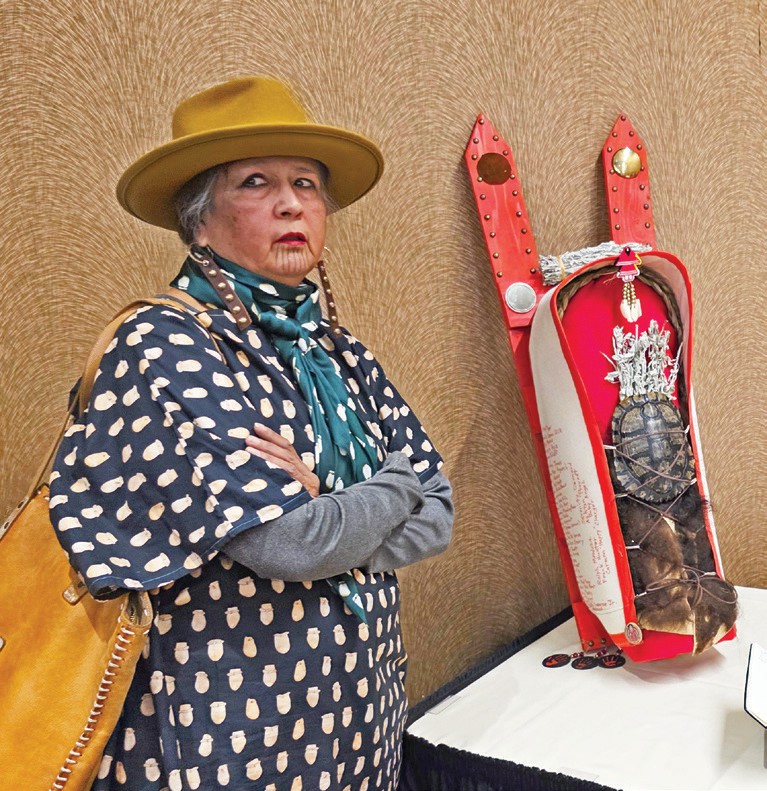
2024 Bush Fellow Lily Mendoza (Cheyenne River Sioux Tribe), founder of the Red Ribbon Skirt Society (RRSS), has continued to expand her work, with the cradleboard project being her most recent initiative. (Photo by Marnie Cook)
Since receiving the Bush Fellowship, Mendoza has expanded her efforts, with the cradleboard project being her most recent initiative.
The exhibit featured cradleboards made by mothers of missing and murdered women. “The cradle board project was designed to support mothers of murdered and missing Indigenous women,” explained Mendoza. “Many of these mothers never had the opportunity to create cradle boards for their daughters. These women gathered together to make cradle boards, honoring their children and sharing their stories.”
While the cradleboard is a traditional infant carrier, they are still used today. Babies are secure, warm, and comfortable. “All my grandchildren and great-grandchildren have grown up in these,” said Mendoza. “They often feel so secure, they just go to sleep.” Women were able to work and travel knowing the baby was secure. Cradleboards are still used today at gatherings and ceremonies.
The cradleboard helps create the deep bond between mother and child. “I think carrying the baby in the cradleboard established how we interact with each other. They are made in such a way you can hang them on a saddle horn or lean them up against a tree. So children were constantly learning from their mothers,” explained Mendoza.
The making of the cradleboard is often a celebration, with a family member making the cradleboard. When the baby is born, the chekpa or the umbilical cord is dried and sewn into a special beaded buckskin pouch which then hangs from the cradleboard. These traditions are still practiced today.
A significant feature of the exhibit was a red cradleboard adorned with a turtle shell, which bore the names of murdered and missing Indigenous women. As the crisis continues, more names will be added to the cradleboard, serving as a living memorial. The cradleboard is scheduled to begin its tour at Mahpiya Luta, carrying the memories of those lost and offering a space for ongoing remembrance.
“We’ll just keep adding names. And then we are going to make sure that this is archived. This is our museum piece that we want to travel all over, archiving. It’s like our winter count,” said Mendoza.
An oversight hearing held by the House Appropriations Committee in 2024 found that in 2023 along, over 5,800 American Indian/ Alaska Native females were missing. Mendoza estimates that number is much greater.
(Contact Marnie Cook at cookm8715@gmail.com)
The post Cradleboard archive remembers the missing and murdered first appeared on Native Sun News Today.
 Shared by: Native Sun News Today
December 25, 2025
Shared by: Native Sun News Today
December 25, 2025
Tags: More News