
Food Self-sufficiency – Indian corn
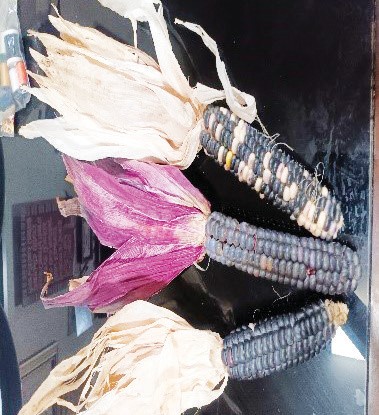
Pictured here is some of the Indian corn Clara Caufield grew from the seeds that Peggy White provided. (Photo credit – Clara Caufield)
Last spring, a Crow friend Peggy White gave me some purple corn seeds. “They are very old,” she explained. “See if they will grow.” It sure did, though the stalks and ears are smaller than domestic yellow corn.
Following is some information gained from many internet sites about Indian corn. Ornamental Indian corn is found in many homes as a Thanksgiving decoration. Another name for Indian corn is flint corn because the kernels are so hard. It is also called calico corn because of its colors. It is one of the oldest varieties of corn and has been grown by indigenous cultures for centuries.
Indian corn, Zea Mays var. indurata, is a variety of maize from the same species as sweet corn. This often called “Indian corn” because of its use by Native Americans. It has been widely grown for centuries. An 1879 census report shows a crop of 62 million acres of Indian corn in that year alone! Indian corn has also been grown throughout China, India, and South America. This type of corn has kernels that come in a wide range of colors including white, blue, and red. The shells are hard, like flint, which gives this type of corn one of its common names
Indian corn is used in many ways including: Decorations – Using Indian corn in wreaths, wall hangings and on your table gives a rustic look to your home during the holidays. It was also livestock feed for cattle, chickens, and goats. As a food source for people, Indian corn is edible, although it is less sweet and more ‘chewy’ than yellow corn.
Sweet corn comes in yellow and white varieties, but ornamental Indian corn has many more beautiful colors to choose from. Some varieties produce ears of a single color – white, blue, red, and even black. However, most ornamental corn varieties are multi-colored, called glass gem corn. It comes in rainbow jewel-like colors and is used in decorating. It is harvested by hand when the husks have dried.
The flavor of Indian corn is not as sweet as yellow corn. It has a starchy texture and tastes a bit like hominy. Indian corn has to be chucked from the corn cob to be used. Once removed, the kernels can be used for popping into popcorn or ground to make what is known as masa, a type of flour, more like cornmeal. It is cornmeal! Many Tribes did eat it, creating wonderful soups. At one time the Northern Cheyenne were farmers, coming from the time they spent along the Missouri river with the Mandan-Hidatsa tribes. This is probably the kind of corn they grew and ate. It is tougher than domestic corn, not needing as much water or weeding.
Indian corn can last for years once it is dry, provided it is stored in a cool, dry location, in a container that is not easily breached by rodents or insects. Preserving it mainly involves thorough drying: The corn should not be harvested until the “hair” on the corn has been brown for at least a week, and preferably longer. Gently pull back the husk to check if the corn is ready— it should be dry and firm, and will usually display several different colors, although some Indian corn is fairly uniform in color.
Detach the ear from the stalk. Use twine to hang the corn from the stalk end for several days in a warm, dry place with good cross ventilation. It should be completely dry in about a week.
Some individuals apply shellac, clear nail polish, or acrylic glaze to make their Indian corn glossier or brighter and to protect it from dust and fading. If you choose to do this, use a small brush and apply in thin coats, following the product’s instructions. This is primarily an aesthetic measure and won’t truly protect the corn from eventual disintegration, which is inevitable with any dried corn, as the fibers that hold the kernels to the cob and keep the cob intact will eventually break down. However, it will last for several years with proper drying. Pictured here is some of the Indian corn I grew from the seeds that Peggy White provided.
(Contact Clara Caufield at acheyennereview@gmail.com)
The post Food Self-sufficiency – Indian corn first appeared on Native Sun News Today.
 Shared by: Native Sun News Today
November 21, 2025
Shared by: Native Sun News Today
November 21, 2025
Tags: Top News