
From Standing Rock to the Stronghold
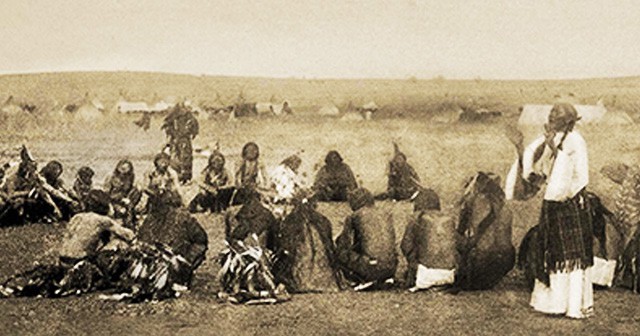
Native Americans performing ritual Ghost Dance. One standing woman is wearing a white dress, a special costume for the ritual dance, 1890. Photo by James Mooney, an ethnologist with US Dept. of Interior. Alamy
On the morning of December 15, 1890, Lakota Medicine man Tatá.ka Íyotake (Sitting Bull) was shot and killed near Little Eagle, South Dakota, along the Grand River on the Standing Rock Indian Reservation. The fatal arrest attempt, ordered by Indian Agent James McLaughlin, was meant to silence what officials saw as a dangerous spiritual movement—the Ghost Dance. Instead, it ignited a wave of fear and flight that would end in one of the darkest chapters of American history: the Wounded Knee Massacre.
Sitting Bull’s death was not the beginning of a war. It was the beginning of a pilgrimage.
A letter denied
Days before his death, Sitting Bull had written to Indian Agent James McLaughlin requesting permission to leave Standing Rock to meet Short Bull, a Brulé Lakota Ghost Dance prophet. Sitting Bull told McLaughlin that his presence was requested and that he ought to go. His intent was spiritual: to witness the return of Waníkiya—the Messiah, as promised in the Ghost Dance prophecy. McLaughlin refused.
The Ghost Dance was not a call to arms. It was a prayer for renewal. The prophecy, first shared by Paiute visionary Wovoka, promised: the return of the buffalo, the resurrection of ancestors, the disappearance of white settlers, a restored Earth, free of suffering
For the Lakota, who faced starvation, disease, and cultural erasure, this vision offered hope. But to U.S. officials, it looked like rebellion.
The Hunkpapa’s flight to Cherry Creek
After Sitting Bull’s death, a group of Hunkpapa Lakota fled south to Cherry Creek on the Cheyenne River Indian Reservation. There, they joined their Mniconjú Lakota relatives and fellow Ghost Dancers—under Chief Spotted Elk (Big Foot). Together, they planned to continue their journey toward Stronghold Table, a sacred mesa in the Badlands where they believed Waníkiya would return.
This was not a military movement. It was a spiritual migration.
Intercepted near Porcupine Butte
On December 28, Spotted Elk’s band was intercepted by Major Samuel Whitside and the 7th Cavalry near Porcupine Butte, just north of Wounded Knee Creek. This location lies east of Stronghold Table, along a natural corridor into the Badlands. It does not align with a route toward Red Cloud Agency, which was located farther southwest. Colonial Forsyth’s diary states that the 7th Cavalry had been camped at Red Cloud Agency for two weeks prior to the massacre, which further supports the idea that the Ghost Dancers were heading for Stronghold table.
They were flying a white flag. Spotted Elk was ill with pneumonia. The group surrendered peacefully and was escorted to a campsite near Cha.kpé Ópi (Wounded Knee Creek).
The Massacre at Cha.kpé Ópi
The next morning, December 29, soldiers attempted to disarm the Lakota. A shot rang out— possibly from a deaf man named Black Coyote—and chaos erupted. The 7th Cavalry opened fire with rifles and Hotchkiss guns, killing between 250 and 300 Lakota, more than half of them women and children.
It was not a battle. It was a massacre.
Medals of Honor and the Legacy of Injustice
In the aftermath, 20 soldiers were awarded the Medal of Honor for their role in the slaughter. These medals remain a source of deep pain and controversy. Native communities have long called for their revocation, arguing that they glorify a crime against humanity.
Now, under the current Trump administration, the issue has resurfaced. Pete Hegseth, the newly appointed Secretary of Defense, has publicly stated he would not support revoking the medals.
Hegseth said the soldiers who received Medals of Honor for their role in the Wounded Knee Massacre “deserve those medals” and will be allowed to keep them. He added, “We salute their memory, we honor their service, and we will never forget what they did.”
This decision followed a review initiated by the Biden administration in 2024, which had tasked a five-member panel with evaluating whether the medals should be rescinded. Hegseth claimed the panel had already concluded that the soldiers should keep their medals, but former Defense Secretary Lloyd Austin “chose not to make a final decision.”
His refusal has sparked outrage among tribal leaders, historians, and descendants of massacre victims. Critics argue that honoring soldiers for their role in the Wounded Knee Massacre perpetuates historical injustice and undermines efforts at reconciliation.
A broader pattern of violence
Historian Robert M. Utley notes that in mid-December 1890, a militia led by Colonel Merritt H. Day killed 12 to 18 Lakota near Stronghold Table—kinsmen of those seeking refuge. This lesser known episode underscores the broader violence surrounding the Ghost Dance movement and the Lakota’s desperate flight to safety.
Why the truth matters
The Lakota were not insurgents. They were believers— Ate´, Ina´, Wak.í.yeža, Lala´ na Uncí — walking toward a prophecy, not a war. They carried songs, not weapons. They sought refuge at Stronghold Table and they were met with gunfire.
The U.S. government called it a battle. History knows better. Wounded Knee was a massacre born of fear, denial, and a refusal to understand Native faith. And now, more than a century later, the refusal continues—with Medals of Honor still draped over the shoulders of men who fired into prayer circles and cradles.
If honor means anything, it must begin with truth. If reconciliation means anything, it must begin with memory. And if justice means anything, it must begin with the voices of the Lakota— who still dance, still pray, and still remember.
Let the record show: they were headed for a miracle. And they deserve more than silence.
This isn’t just a story about the past. It’s about truth, ceremony, and survival. It’s about the prayers that were interrupted, the songs that were silenced, and the ancestors who still speak through the wind at Cha.kpé Ópi.
(Contact Ernestine Anunkasan Hopa at editor@nativesunnews.today)
The post From Standing Rock to the Stronghold first appeared on Native Sun News Today.
 Shared by: Native Sun News Today
October 10, 2025
Shared by: Native Sun News Today
October 10, 2025
Tags: Top News