
Indigenous methods and artificial intelligence reveal hidden policy harms
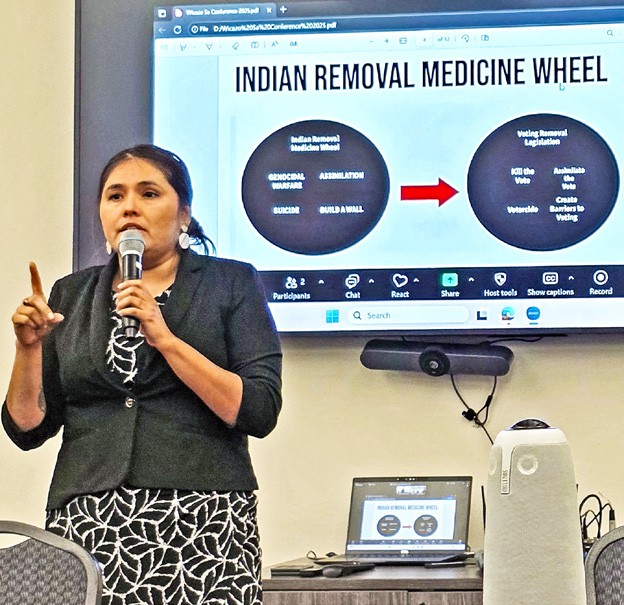
Dr. Millicent Pepion presenting her study at the 40th WSR symposium. Photo by Marnie Cook.
ALBUQUERQUE, NEW MEXICO – At the recent Wicazo Sa Review (WSR) Fortieth Anniversary Symposium in Albuquerque, New Mexico, Indigenous scholarship met modern innovation as Dr. Millicent Pepion (Bitter Water Clan born for the Blackfeet Nation) presented her research combining the Indian Removal Medicine Wheel (IRMW) – a model she developed as a student at Haskell Indian Nations University—with artificial intelligence (ai) tools. Pepion’s analysis of executive orders (e.o.’s) from President Trump’s administration sheds new light on centuries-old strategies used against Native communities, revealing how digital tools can help translate complex legal language and expose the continuing impacts of policy on Indigenous sovereignty, language, and well-being. Her research offers both a sharp critique and a hopeful path forward for Native advocacy and understanding in today’s challenging political climate.
Pepion had developed the model because she said she had wanted to study non-Natives in the same way that they study Natives. Through her IRMW model, she found Indian removal is best explained in four different categories: genocidal warfare, assimilation, build a wall and suicide. “These are the four tactics that I noticed have been implemented since 1492 to Indigenous communities in the Americas.” She said these tactics are still in place but have become obscured for a number of reasons.
She had worked as tribal liaison for Arizona’s Secretary of State during the 2024 election and then for Arizona Native Vote as college program coordinator traveling frequently to the Navajo Nation. “The election results were heartbreaking. That’s when I knew it was time of the coyote again. We were all going to have to brace ourselves.”
The time of the coyote refers to a quote from Many Horses, a Lakota Sioux leader, who had declared, “I will follow the white man’s trail. I will make him my friend, but I will not bend my back to his burdens. I will be cunning as a coyote. I will ask him to help me understand his ways, then I will prepare the way for my children, and their children. The Great Spirit has shown me- a day will come when they will outrun the white man in his own shoes.”
She said this quote has helped inspire her through her studies and was the specific inspiration for the study after the disappointing election. “I wanted to know what’s going on here. I’m very curious why President Trump would issue all of these executive orders.”
In her paper titled “Indian Removal Medicine Wheel Discourse: An Analysis of President Trump’s Executive Orders Affecting Indian Country in His First 100 Days”, Pepion explores the twenty-six e.o.’s Trump issued on first day in office.
These e.o.’s expand on Trump’s first term in 2017, when he issued a rollback of federal land protections, and further threaten Indigenous homelands in favor of the fossil fuel industry by removing restrictions on drilling and disregarding protocols requiring public comment and tribal consultation.
Pepion acknowledged there are language barriers. “But even if you do speak English and you have a PhD, they are written in legalese, which is a type of English that is used by lawyers and it’s very hard to read.”
She transposed the IRMW model into other areas, such as health and legislation. “When you put this model over things such as voting legislation, then it becomes voting removal legislation and you can focus on things such as kill the vote, assimilate the vote, create barriers to voting and votercide, which is the creation of an environment in which people don’t want to vote.” She said one of their biggest obstacles was trying to convince people who were eligible to vote, to vote. “We saw a lot of votercide.”
Her approached included a realistic understanding of ai and caution regarding it’s potential to cause harm. AI can help to improve professionalism, save time by writing emails and reading articles, and can even help to organize your thoughts. The cons include the large amounts of energy needed to power the data centers and job replacement. But Pepion said the biggest drawback is it’s unreliability because it’s unable to distinguish between fact and fiction.” Nevertheless, she argues, because Native Americans are living in two worlds it’s necessary and appropriate to use AI in the white world to understand it.
Through a diligent process of using ai, the IRMW, and the assistance of the Harvard Chain of Density Prompts (COD), Pepion was able to identify primary and secondary tactics being used in the e.o.’s to target Native communities. The Harvard COD was created to highlight how ai can significantly boost efficiency and quality when used correctly while also pointing out its pitfalls.
“Of the 26, ten of them had elements of build a wall,” said Pepion. “Seven of them have elements of assimilating Native people’s into the larger U.S. government, four weren’t listed, four use genocidal warfare, and one of them has elements of suicide.”
She said these elements have continued to create negative environments in Native communities since Christians came to the eastern shores. Her study found assimilation remains a primary tactic. “When you can convince people and create an environment where they do not want to speak their language, where they do not want to practice in their culture, where they want to support candidates like President Trump who are actively destroying their water, land, and communities, and then voting in favor of those kinds of people, that is very dangerous.”
She noted also that the titles of the e.o.’s are misleading. “That’s why we have to use AI, because they are framing things in ways that sound good but in my study, they aren’t good for Native communities. If we can use a tool like ai to help us decipher legalese and put it in English terms that we can understand, that the whole community can understand, then that’s a good thing.”
The WSR, co-founded by notable Indigenous scholars and now edited by Dr. Lloyd Lee, has been published by the University of Minnesota Press since 1999. WSR remains dedicated to supporting Indigenous intellectual and creative pursuits, publishing interdisciplinary work that advances Native American scholarship, culture, and decolonization.
(Contact Marnie Cook at cookm8715@gmail.com)
The post Indigenous methods and artificial intelligence reveal hidden policy harms first appeared on Native Sun News Today.
 Shared by: Native Sun News Today
December 2, 2025
Shared by: Native Sun News Today
December 2, 2025
Tags: Top News