
Lakota Funds expands innovative financial education program across Pine Ridge through public-private partnership
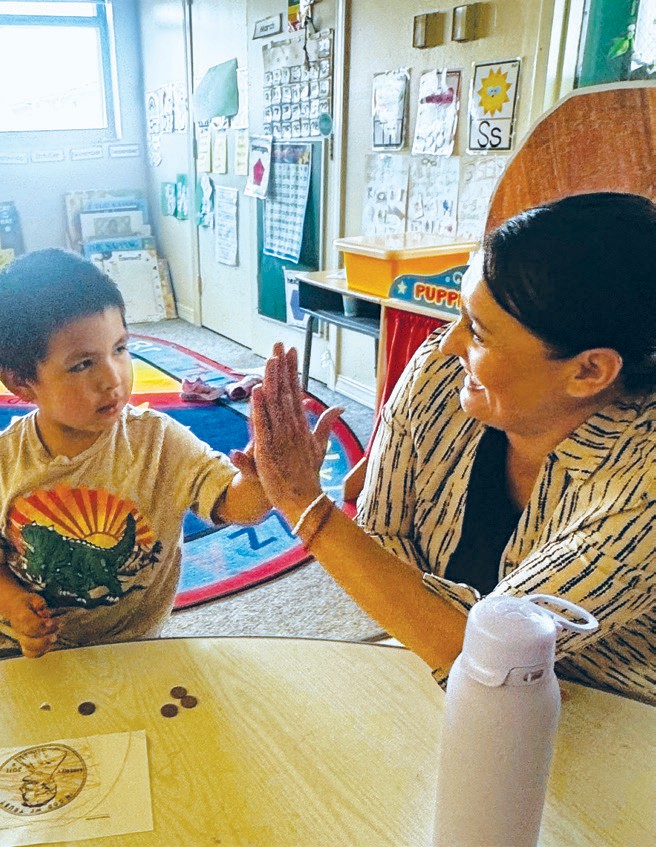
Nicole Pourier and student
KYLE — Lakota Funds, a Native Community Development Financial Institution (CDFI) based on the Pine Ridge Indian Reservation, has launched the second year of its innovative financial education initiative designed to strengthen financial capability and generational wealth-building in Native communities.
As the program enters its second year, Lakota Funds has formally named its education component the Tokeya Financial Education Program — meaning “the first” or “at the beginning” in Lakota — to reflect the foundation it provides for participants as they start their financial journeys. The initiative also includes the Tokátakiya Account Matched Savings Program, named for the Lakota word meaning “moving forward,” which allows participants to apply financial knowledge in real time and take tangible steps toward long-term goals.
Originally piloted in 2024 through a public-private partnership with the Federal Reserve Bank of St. Louis, the program now expands to include adults and families participating in FACE (Family and Child Education) programs on Pine Ridge.
“Financial education is foundational to economic self-determination,” said Tawney Brunsch, Executive Director of Lakota Funds. “By meeting learners where they are — from early childhood classrooms to the family circle — we’re building a community wide culture of financial confidence and self-reliance that supports lasting economic well-being.”
A Collaborative Model Rooted in Community
Launched last year, the program began as a youth-focused pilot delivering age-appropriate personal finance education in FACE early childhood programs and local high schools.
Lakota Funds’ curriculum is developed in collaboration with the Federal Reserve Bank of St. Louis through its Native Economic & Financial Education Empowerment (NEFEE) program, aligning national financial education expertise with the needs and priorities of Native communities.
The curriculum integrates real world financial skills — from budgeting and saving to credit building and goal setting — in ways that reflect local priorities and on-the-ground realities.
The first year reached more than 200 youth and received positive feedback from educators and families, sparking interest in expanding the program to adults. During the pilot year, youth participants learned about making informed decisions in everyday financial choices – from managing spending and saving to understanding the tradeoffs that shape long-term goals. The expansion marks an intentional step toward multi-generational financial empowerment that reinforces learning across households and strengthens long-term community capacity.
“It’s powerful to see participants connect their own goals to the lessons we teach,” said Nicole Pourier, who leads the financial education sessions for Lakota Funds. “The Tokeya Program helps people see what’s possible, and Tokátakiya gives them a way to put that knowledge into action.”
“This partnership shows the difference community-led financial education can make when relationships and local voices guide the work,” said Megan Cruz, Research Officer at the Federal Reserve Bank of St. Louis. “Together, we’re building local capacity to sustain this effort and expand opportunity for future generations.”
Empowering Families, Strengthening Futures
Through its partnership with the Federal Reserve Bank of St. Louis and local institutions like the Lakota Federal Credit Union and schools, Lakota Funds is advancing a model of financial education that not only teaches knowledge but also builds access, capability, and opportunity. With the addition of the Tokátakiya Account Matched Savings Program, participants can apply what they learn through a matched-savings account at Lakota Federal Credit Union, while FACE contributes additional funds to help families cover essential expenses such as utilities, childcare, and reach their savings goals — helping families take concrete steps toward long-term financial goals.
By pairing education with incentives and community-based delivery, the initiative aims to support outcomes such as increased savings, greater confidence in financial decision-making, and improved participation in the financial system.
This collaborative approach is helping to position Pine Ridge as a national example of how community led, evidence-informed financial education can drive meaningful change and advance sovereignty through self-reliance. Lakota Funds invites philanthropic, corporate, and financial partners to join in expanding this innovative model — helping more Native families build assets, financial capability, and the foundation for generational wealth.
Lakota Funds broke ground in 1986 as the country’s first Native American Community Development Financial Institution–with a vision centered on breaking the cycle of generational poverty on the Pine Ridge Reservation. Today, Lakota Funds promotes economic sustainability by providing access to credit for Native people. Learn more at: https://lakotafunds.org/
The post Lakota Funds expands innovative financial education program across Pine Ridge through public-private partnership first appeared on Native Sun News Today.
 Shared by: Native Sun News Today
November 7, 2025
Shared by: Native Sun News Today
November 7, 2025
Tags: More News