
Protecting public lands
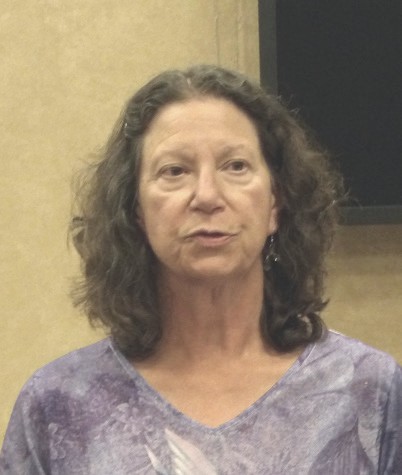
Former Mount Rushmore superintendent Cheryl Schreier speaking at Campus West. Photo by Marnie Cook
RAPID CITY – The Sierra Club Black Hills Group hosted a meeting recently at the Game, Fish and Parks Campus West in Rapid City to give concerned citizens an update from former Mount Rushmore superintendent Cheryl Schreier on the threats to public lands. Michael Melius from Hermosa began the meeting by very briefly introducing himself as the new chair of the Sierra Club Black Hills Group. He has been involved with the Sierra Club for more than 40 years.
Even though the proposal to sell off millions of acres of national parks and national forests to private entities was defeated the threats continue. Oil and gas extraction, coal mining, and logging are still a threat to areas from Alaska to the Gulf of Mexico as the Trump administration has been pushing to increase leasing of federal lands. Project 2025, which has been a detailed blueprint for this Republican administration, lays out proposals to open up more public lands to drilling and mining. There are measures to roll back clean energy tax credits and repeal numerous actions taken by the previous administration.
Many of the Black Hills geographical features are at risk – Mato Tipila, Badlands, Wind Cave, Spearfish Canyon, Mount Rushmore and the Southern Hills but so are the vital natural resources, like surface water and groundwater which are essential to the areas drinking water, irrigation and recreation.
During the last legislative session, South Dakota lawmakers voted down a proposal that would have created an oversight development committee to regulate mining and economic development activities in the Black Hills. The bill was intended to create a plan to slow development, to study growth and where best to develop for the next 100 years.
Federal actions in the Black Hills are designed to speed up uranium mining for a nuclear energy revival. The Black Hills Clean Water Alliance (BHCWA) has been tracking numerous projects – graphite mining, lithium, uranium, gold mining and rare earths.
The executive director of BHCWA Dr. Lilias Jarding said that they have been keeping close track of the fast-moving developments. The latest project, the Ponderosa Project, proposed by Solitario Resources Corp., is located southwest of Cheyenne Cross near Spearfish Canyon along Highway 85. A 30-day comment period for the project just closed with 1,774 comments submitted, most of them opposed to the project. A release from the BHCWA thanked comments and According to a press release from BHCWA, thanked all commenters and “the Spearfish community, through the Common Council, who unanimously passed a resolution opposing the project without further study from an Environmental Impact Statement (EIS).”
The arguments in favor of increased extraction are that it will generate revenue for the government, create jobs and stimulate the economy. The increased domestic production of oil, gas, and minerals can reduce reliance on foreign sources and enhance national energy security as well as help meet the growing demand for energy and critical minerals.
But Schreier says these lands already generate a lot of revenue. “They draw more than 500-million visitors every year and they represent about thirty percent of our nations total surface area. The outdoor recreation industry which depends on access to public lands generates over 640 billion dollars annually.” She said that public lands are important to so many people for so many different uses. “A very high percentage of people want our public lands to be protected, to be used in a sustainable fashion for now and for future generations.”
Schreier recently heard an interview with a former long-time National Park Service employee who is now on the board for the Retired U.S. Forest Service Employees who spoke about the “hollowing out” of the forest service and forest service land. “His comment was that he has seen a piecemeal destruction of the U.S. Forest Service lands. The FY26 Budget has proposed a 30-percent reduction for funding for the U.S. Forest Service, eliminating Job Corps site, also forest research stations, which are very important to the forest service.”
She said there is also a proposal to transfer forest service lands to state, private and tribal entities. “The idea is to right-size the federal estate.” She said plans to reorganize the forest service could impact wildland fire programs. She said currently thousands of employees have been eliminated, removed or retired and are expecting a further reduction in the workforce which she expects to happen shortly.
Schreier, who had been with the National Park Service (NPS) for more than 40 years when she retired said she came out of retirement because she had another opportunity to advocate for the protection of public lands. She is currently serving as the vice chair of the Coalition to Protect America’s National Parks, a more than 20-year-old organization whose members are primarily retired, current and volunteers for the National Park Service (NPS) with more than 4,100 members. “We like to say that we have over fifty-thousand years of experience,” said Schreier followed by some light laughter.
She said her group has been working hard for about six months. “Whether it be meeting with the congressional delegations or doing media interviews – we’re even involved in a lawsuit in regards to federal employees – we have been advocating for the National Park Service.”
Schreier also serves on the Midwest Regional Advisory Council for the National Parks and Conservation Association, a century old conservation organization that has over 1.6 million members.
Schreier, who was Mount Rushmore National Memorial superintendent in 2019, also served as superintendent of Herbert Hoover National Historic Site, Knife River Indian Villages National Historic Site, and completed a detail as acting superintendent at Cuyahoga Valley National Park. She has been with the National Park Service for nearly 40 years. Cheryl has worked at 10 different national park units, including Bryce Canyon, Yellowstone, and Death Valley National Parks. She lives in South Dakota and was a leader in several positions of the Black Hills Group and South Dakota Chapter Sierra Club.
(Contact Marnie Cook cookm8715@gmail.com)
The post Protecting public lands first appeared on Native Sun News Today.
 Shared by: Native Sun News Today
July 26, 2025
Shared by: Native Sun News Today
July 26, 2025
Tags: More News