
Public comments about uranium exploration at Craven Cany focus on water and old drill holes
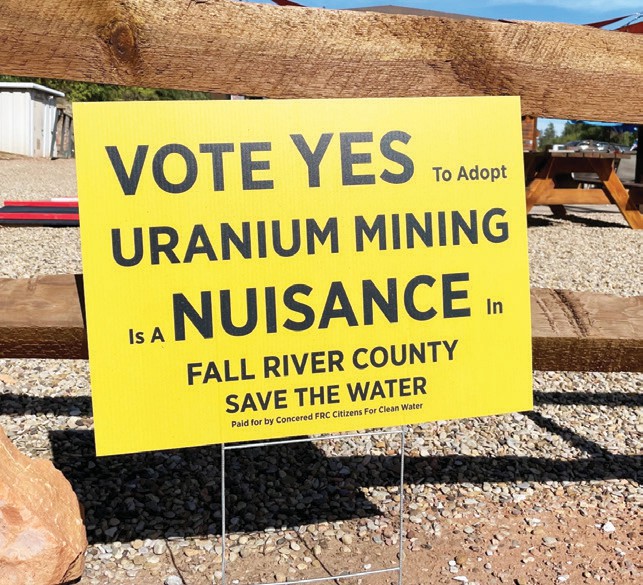
Fall River campaign sign to list uranium mining as a nuisance. Lee Strubinger SDPB
BLACK HILLS – The more residents learn about the negative effects of uranium mining, the more they oppose it. A proposal to drill for uranium on the rim of Craven Canyon and in Craven Canyon in the Southern Black Hills has drawn strong public opposition, with a relative majority of the ninety-four comments submitted to the U.S. Forest Service coming out against the project. Most commenters were residents of the local area and nearby communities.
Canadian-based Clean Nuclear Energy Corporation (CNEC) is asking for authorization to conduct short-term exploratory drilling and aquifer testing on National Forest System lands approximately seven and a half miles north of Edgemont, South Dakota. The proposal, known as the October Jinx Uranium Project, is part of the larger Chord Project which covers about 3,677 acres in the Craven Canyon area.
The Craven Canyon landscape is considered a world-class cultural resources site, home to rock art and cultural use dating back roughly 7,000 years. CNEC’s stated aim is to determine whether uranium is present in the rock and to test groundwater aquifers beneath the site.
CNEC submitted its plan to the U.S. Forest Service in June 2024 and revised it in October. In correspondence with the South Dakota Department of Agriculture and Natural Resources in November 2024, project manager Mike Blady said October Jinx is not within the boundaries of Craven Canyon and, in the company’s view, will not encroach upon, damage, or destroy any historic property within the canyon. The work is described as a short-term effort, expected to last a year or less, with drilling completed primarily from existing roads and trails “to the extent practicable,” and some overland travel between closely spaced drill sites.
Blady and Crystal Hocking of RESPEC Engineering in Rapid City have been designated to answer interrogatories about the project. In written responses submitted in November 2025 to questions from Black Hills Clean Water Alliance (BHCWA), CNEC declined to disclose the names of contractors or potential contractors, calling that request irrelevant. When asked for more detail on routes and distances, the company referred BHCWA back to its application language.
Blady did state in an affidavit to the DANR in early January responding to questions about high-grade uranium drilling safety protocols that the “likelihood of encountering high-grade uranium ore is extremely unlikely in this project.”
Support for the project has come from local rancher Mark Hollenbeck, a longtime project manager for the Dewey Burdock uranium project, who argues that the United States is in “desperate need of uranium for our electric reactors as well as fuel for our military fleet.” He portrays October Jinx as a necessary step in meeting those needs.
Hollenbeck maintains that the exploration itself poses little threat. “The exploration project won’t cause any harm because the company is only drilling test holes and then plugging them,” he said. Hollenbeck notes that he ranches one mile downstream of the project and is in full support of it. “The people that are against this project don’t live anywhere even close to the project,” he added. In his view, opponents are driven more by emotion than by science, and the only way to know whether there is uranium worth mining is to allow exploration to proceed. If uranium is found, he says, the process to permit any future mining operation is lengthy and provides “lots of opportunity for public input before it will ever proceed.”
The National Park Service has also reviewed the proposal. Kevin Tillman, Superintendent of Jewel Cave National Monument, said the Monument’s Resource Manager examined the project and concluded it poses no direct threat to Jewel Cave’s resources. “The proposed wells are approximately 22 miles south of the park,” Tillman said. “The drill sites are not expected to impact the Madison aquifer as they are well below the proposed drilling depth. The park does not believe there is any chance the project would affect the cave lakes because water will not be pumped from them.”
Many residents who commented to the Forest Service are less reassured. They raise concerns about water use in a time of drought and the possibility of contamination in a region where multiple major bedrock aquifers—the Deadwood, Madison, Minnelusa, Minnekahta and Inyan Kara—underlie the landscape, as well as potential damage to a cultural site that has been in use for thousands of years.
Dr. Lilias Jarding of BHCWA notes that this is not the first wave of uranium exploration in the area. She points to work by a geologist at the nearby Dewey Burdock site, who estimated there were about 7,500 old drill holes from past exploration during a time before South Dakota had regulations governing uranium drilling.
“That was his estimate,” Jarding said. “And we know there are old drill holes around Craven Canyon because they have tried to mine uranium there and because of state records.”
The key question, she asks, is what happened to those old drill holes? “How deep are those holes? Were they sealed before there were state regulations to do so? And if so, were they properly sealed?” If holes are deep enough and were left unsealed or improperly sealed, she warns, water from different aquifers could mix, allowing contamination to spread from one aquifer to another. With CNEC planning additional drilling and aquifer testing in a landscape already riddled with legacy drill holes, opponents argue that even exploratory work could aggravate existing, poorly understood risks to the region’s water systems.
For the Oglala Sioux Tribe, the October Jinx and Chord projects raise not only environmental questions but also issues of treaty rights and cultural survival in the Paha Sapa, or Black Hills. In the spring of 2024, the Oglala Sioux Tribe Legal Department requested intervenor status in the broader Chord Project proceedings. In their filing, they stated that the Tribe is opposed to all mineral exploration and mineral development in the Black Hills that would infringe on the Tribe’s treaty rights. They argue that uranium activity leaves land unusable and endangers the health and safety of people, land, and water.
“Past mining activities in the Paha Sapa had devastating impacts on the environment,” OST In-house Counsel wrote, citing “extraordinary harms to the land, water, natural resources, and fish and wildlife in the Black Hills, including surface lands, subsurface structures, water, threatened and endangered species, and other natural resources.” The Tribe cautioned that the Chord Project poses risks to the long-range productivity of watershed lands, public and domestic water wells, aquifer recharge areas, and significant agricultural areas.
Anthropologist Dr. Linea Sundstrom of Day Star Research, who has more than 40 years of experience in archaeology and authored the South Dakota State Plan for Archaeological Resources, including a cultural resources management plan for the Craven Canyon area, views the proposed drilling as a direct threat to an irreplaceable cultural landscape. She says the drilling sites are not “empty land” but part of a continuous, living cultural site that cannot be reclaimed once it is disturbed. According to Sundstrom, drilling operations would take place within sight and earshot of ancient rock art sites in the canyon, with irreversible impacts. She also emphasizes that water is an inseparable part of the cultural integrity of the Black Hills, linking aquifer contamination to the spiritual and cultural survival of Indigenous communities whose ties to the region run back thousands of years.
Local residents have already expressed their views at the ballot box. In 2022, voters in Fall River County approved a measure banning uranium mining, passing it with 56 percent of the vote. While the October Jinx proposal is presented as an exploration project rather than a mining plan, opponents see it as part of a familiar pattern: incremental steps that open the door to large-scale extraction in the future.
As federal and state agencies review CNEC’s proposal and weigh technical assurances against community, tribal and scientific concerns, the debate around Craven Canyon reflects broader questions that have long haunted the Black Hills: whether uranium exploration near Craven Canyon can be justified in the name of energy security, or whether it represents another step in a long history of extractive projects that leave permanent scars on the land.
(Contact Marnie Cook at cookm8715@gmail.com)
The post Public comments about uranium exploration at Craven Cany focus on water and old drill holes first appeared on Native Sun News Today.
 Shared by: Native Sun News Today
March 22, 2026
Shared by: Native Sun News Today
March 22, 2026
Tags: Top News