
Remembering the Dakota 38
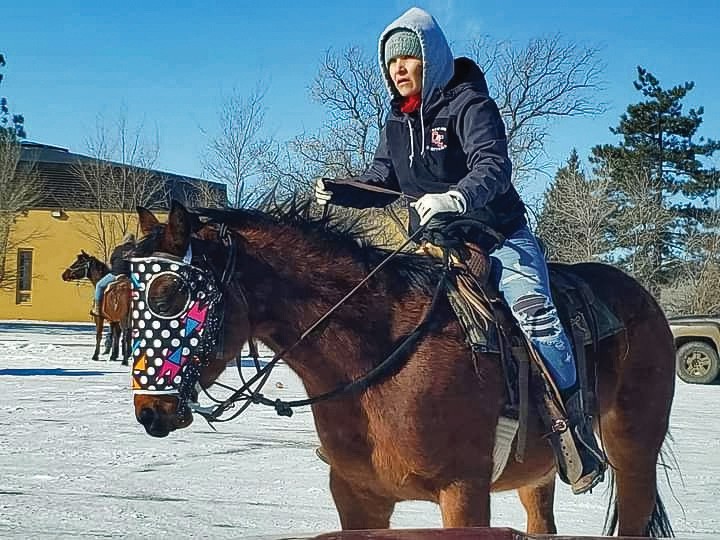
Andrea Eastman and her horse Sadie along with other riders are making the 330-mile Dakota 38 Memorial Ride who remember the 38 Dakota warriors hanged in December 1862. (Photo courtesy of Andrea Eastman)
December is a time for winter celebrations and also a time of mourning. Native American relatives all over Turtle Island mourn for those who died in the Wounded Knee Massacre on December 29, 1890, as well as the 38 Dakota men hanged on December 26, 1862, in the largest mass execution in American history.
Since 2005, a multigenerational group of riders remember those who were executed, known as the Dakota 38, as the riders travel 330 miles on horseback to Reconciliation Park in Mankato, Minnesota, the site of the hanging.
The Dakota 38 Memorial Ride began with Jim Miller’s dream in 2005. Miller is Native spiritual leader from Porcupine, SD. At the time of his dream, he knew nothing about the 1862 Dakota 38 mass execution. One night, he dreamed of riding on horseback across the South Dakota plains to a riverbank in Minnesota, where in the dream he saw his Dakota ancestors hung.
Miller woke inspired to gather horse riders for a 16-day reconciliation ride which has since become known as the Dakota 38 Memorial or the Dakota Exile Ride. Jim Miller returned to Spirit in March, 2023, but his legacy lives on.
The 2025 Dakota 38 Memorial Ride began on Wednesday, December 10. Friends in the Wounded Knee community made a prayer fire for the safety of the horses and riders.
Elder Wilfred Keeble (Hunkpati Dakota) of the Crow Creek Reservation has participated in the ride every year since its beginning. Raising awareness of Dakota history and its origins is Keeble’s passion. He calls the ride an “actual Dakota camp on the move.” He also says the Dakota 38 Memorial is a prayer ride, which is challenging in an age of distracting cell phones and other modern technologies.
At 68 years old, he says his current role in the ride is that of “grandpa.” He quotes a friend who says that the ride helps to “re-enculturate” young riders. “The ride gives new direction, brings awareness, provides methods to promote health, and prevents suicide,” Keeble said.
Alexis Estes, a member of the Kul Wicasa Oyate, participated in the 2018 event and published a report of her experience. According to Estes, “We are able through the Dakota 38 Memorial to bring awareness to the history our Oceti Sakowin ancestors endured. … this annual event has drawn in more participation and awareness each year. This has brought national attention to Native American history. …
“Healing is offered through the Dakota 38 Memorial through reconciling the relationship between Native Americans and non-Natives, through breaking the cycle of intergenerational trauma, and through dismantling Native American stereotypes. The Dakota 38 Memorial includes the therapeutic practices of equine therapy, fitness, ceremony, storytelling, and mentorship. …
“As generations of Native Americans have experienced genocide and assimilation, intergenerational trauma predisposes our people to high rates of impoverishment, diabetes, substance abuse, suicide, and victimization in human trafficking and domestic violence. As a descendent of relatives who overcame boarding school trauma, and as a survivor of domestic violence, I know the capacity we have to heal through trauma.
Kermit Minor has devoted many years to the annual Dakota Exile Ride, and describes it in this way, “Through horseback riding, storytelling and ceremony, we remember this dark chapter and honor our ancestors – their resilience and hope for a better future.
“The Dakota Exile Ride strengthens bonds within the community, fostering youth leadership and cultural identity. Every mile reconnects us with our past and helps build a stronger future. … This is not just a ride; it’s a journey of remembrance, survival, and justice.”
Andrea Eastman (Lake Traverse Reservation, SD) has been part of the memorial for approximately 6 years. She said she looks forward to the ride all year.
Eastman said all the riders have aches and pains for the first few days of the ride from the physical challenge of sitting astride the horses for long hours in the cold, but after a day or two they get conditioned. She added, “Some riders get sick on the ride, and there are other hardships, but our hardships are nothing compared to the hardships our grandmas and grandpas endured.”
She commented, “The other riders are my family. …We ride against the injustices and atrocities inflicted on our people, such as Missing and Murdered Indigenous Relatives (MMIR), massacres, and boarding schools. We ride to tell the dark history of the U.S., the stories not told, and to bring medicine and healing.”
She also said that by being part of the ride she is carrying on the positive legacy of her parents who were Indigenous activists.
Some historians consider the execution of the Dakota 38 in 1862 to be the conclusion of the Dakota War of 1862, also called the Dakota Uprising. Euro-American historians seldom provide factual context for the “uprising” or discuss its aftermath.
In the decades prior to the uprising, the Dakota had endured a tremendous loss of ancestral lands.
Estis said, “… Because the loss of land and culture have influenced intergenerational trauma, the restoration of our relationship with natural resources and indigenous values is necessary to heal. This is the healing I have undergone in building my relationships with family living near my ancestral homelands as a member of the Kul Wicasa Oyate, and partaking in ceremonies such as the Dakota 38 Memorial Ride.”
Under pressure from the US government, in the mid-1800’s the Dakota ceded vast land holdings in Minnesota in exchange for promises of food, cash, and other essentials. Access to hunting and gathering sites drastically decreased. The loss of the Dakotas’ homelands meant the losses of the Dakotas’ ability to self-sustain from natural resources and the Dakotas’ cultural practice of land-based traditions.
When the US became mired in the Civil War in 1860, government food rations and payments were often delivered late or not at all. The system was rife with corruption. Dishonest white traders claimed the Dakota owed them debts, so some of the government payments due the Dakota were diverted to the traders.
By 1862, starving, desperate, and determined to restore hunting grounds to feed their people, a group of Dakota led a series of attacks on neighboring white settler communities, thus beginning what US history refers to as the “Dakota War of 1862.”
Several Dakota attacks led by Dakota Chief Little Crow on settler communities and military forts occurred in a five-month span of the fall and winter of 1862. After good faith negotiations between Little Crow and US Colonel Henry Sibley, the Dakota surrendered. Two thousand Dakota relatives were imprisoned.
A military commission held trials for 498 Dakota men who were suspected of raiding settler towns. According to numerous sources, the trials were deficient in many ways, even by military standards. The officers who oversaw them did not conduct them according to military law.
The defendants were not given defense attorneys to represent them. Many could not speak English. No one explained to them the proceedings. There was very little evidence presented of the individual crimes. Some trials were less than five minutes in length.
Ultimately, 307 Dakota were found guilty of murder and rape and sentenced to death. President Lincoln reviewed each case and commuted the death sentences of 265 prisoners and ordered the execution of 38 men by hanging.
On December 26, 1862, 38 Dakota men took their places on the specially built gallows. Their voices rang out a Dakota song. When white coverings were pulled over their faces, the men grasped each other’s hands. With a single ax blow, the rope holding the platform was cut.
The executions, conducted before 4,000 rowdy spectators, were guarded by 2,000 troops to maintain order.
The rest of the hundreds of tried Dakota men remained imprisoned. Non-imprisoned Dakota were banned from Minnesota by order of the U.S. Congress.
Those fleeing the state, including innocent women, children, and elders, were vulnerable to assault. A twenty-five-dollar bounty was offered to military scouts who would kill a Dakota and prove it with the cut scalp, and a seventy-five-dollar bounty was offered to anyone outside the military service.
The annual Mankato Pow-wow, held in September, commemorates the lives of the executed men.
Reconciliation Park near downtown Mankato, was dedicated in 1997 “to promote healing between Dakota and non-Dakota peoples.” The park features a 67-ton statue of a buffalo by local sculptor Tom Miller and a large boulder with a quote from the late Dakota spiritual leader, Amos Owen. In 2012, the Dakota 38 memorial was unveiled, listing the names of the 38 men who were executed there.
On August 16, 2012, Minnesota Governor Mark Dayton issued a proclamation calling for a Day of Remembrance and Reconciliation for the 150th anniversary of the Dakota War. Flags were also ordered to be flown at half-staff statewide. Dayton repudiated Governor Alexander Ramsey’s calls in September, 1862, for the Dakota people to be either exterminated or driven from the state.
Dakota 38, an award-winning independent film released in 2012, documents the annual long-distance, commemorative horseback journey in honor of the ancestors. Film makers created the film “to encourage healing and reconciliation.” It is often used in classrooms. The full-length film is available for viewing at no cost at https://tinyurl.com/z3ctmhhs .
SOURCES:
Personal interviews with Andrea Eastman, Wilfred Keeble, Kermit Minor, Jim Hallum
https://www.stjo.org/native-american culture/dakota-38/
https:// blog. nativehope.org/the-untold-story-living-the-dakota-38-memorial
https://www.smoothfeather.com/dakota38/?page_id=112
https://en.wikipedia.org/wiki/Dakota_War_of_1862
The post Remembering the Dakota 38 first appeared on Native Sun News Today.
 Shared by: Native Sun News Today
December 21, 2025
Shared by: Native Sun News Today
December 21, 2025
Tags: More News