
Restoring buffalo as wildlife
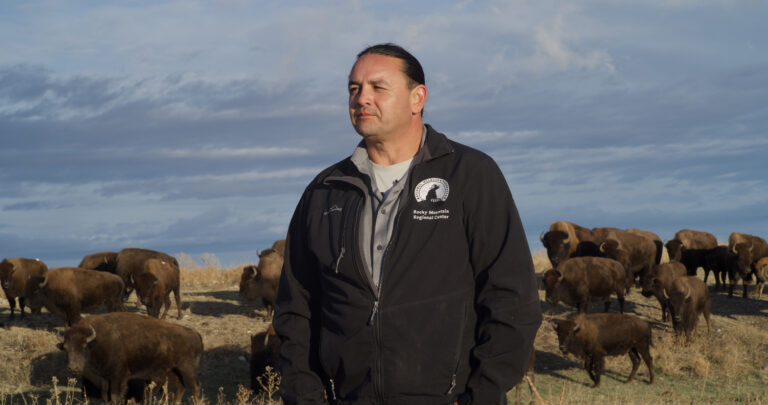
In 2007, Jason Baldes brought the first ten bison designated for conservation to Wind River. Today there are more than one hundred buffalo on the reservation. Photo: Tom Christiansen, courtesy of Jason Baldes.
WIND RIVER. WYO – Like many tribes of the American West, the Shoshone have a long and storied history, from Sacajawea to Chief Washakie. And like all of their neighbors, the Shoshone did not cultivate the soil, they foraged and hunted, and the animal that sustained them, the animal that covered the prairies of their home in the tens of millions, was the bison. The Eastern Shoshone of the Wind River Reservation call themselves Gwechoon Deka, which translates to “buffalo eaters.”
The Shoshone share the Wind River Reservation with the Arapahoe Tribe, even though the tribes are not linguistically related, and had not been on very good historical terms. But it is the return of the bison to their reservation that could unite both tribes in a common goal and purpose. Back in 2016 bison were released onto the Wind River Reservation. The idea was that these bison would be different than any bison outside of wildlife parks. The tribe saw them the same as they did the elk, the deer, the coyotes, the hawks and eagles. They were wildlife, not livestock.
When he was 18 years old, tribal member Jason Baldes accompanied his biologist father to Africa, and there he watched the wildebeest, covering the Serengeti like a blanket, and he had an epiphany. Bison were not livestock, they were like the wildebeest, they were wildlife. How can a people calling themselves the Buffalo Eaters be the people, when they no longer have buffalo to eat, when the beautiful hinterland of the Wind River Reservation has not felt and heard the rumble of bison hooves for almost a century and a half?
There is no way such a change was not elementally infused with profound loss, resulting in a diminishment of tribal identity, spirit, and purpose. Perhaps the first and best symbolic and actual step to restore the people to who they were before, was bringing the bison back to the people, not just as a resource, a product, not as livestock, but as wildlife, as the animal that had sustained the tribe for thousands of years.
Today Baldes is the Executive Director of the Wind River Tribal Buffalo Initiative. He serves as Vice-President of the Intertribal Buffalo Council (ITBC), whose headquarters are in downtown Rapid City. ITBC “is a collection of 87 tribes in 20 different states that facilitates the management of over 20,000 buffalo.”
Baldes is also the senior Tribal Buffalo Program Manager, and told NSNT, “For the Shoshone tribe, I brought the first ten (buffalo) back in 2016. I brought the first ten for the Arapahoe tribe in 2019. And now between the two tribes, in two herds, we have 200 buffalo. We continue to grow.”
Baldes said his tribe “has a history of conservation, fighting for land, water, wildlife, fisheries. Taking a step for the Shoshone Tribe to protect buffalo as wildlife is just a part of that long history. Buffalo are in our songs, in our ceremonies. At Wind River we rely on our hunting, fishing and gathering to feed ourselves. As wildlife (buffalo) are not subject to the permit system that individual livestock producers are required to adhere to. Having the distinction as wildlife, allows us to manage them more like wildlife. It ensures their rightful place back to the land, back to our ceremonies, to our diet, and back to the reciprocal relationship we have always had with buffalo. Restoring this animal, protecting him under tribal law.”
Baldes is also focused beyond the borders of his reservation, and hopes that restoration can occur for other tribes across the nation: “There’s not a lot of tribes that have an opportunity like we do, because of the land base, but that doesn’t diminish the importance of that animal to those tribes, or to those communities, it’s just that we have the potential to do something a little bit different here.”
Baldes says the goal on his reservation is to “open up more of a corridor for migration, but that means changing land use on range units that have been previously prioritized for cattle. We started on 300 acres nine years ago, and we now have 2,000 acres for the Shoshone Tribe. The Arapahoe tribe has 1,700 acres.”
By 1870, bison numbers had been reduced to under ten million, and by the turn of the 20th Century, no bison wandered the prairie as wildlife. Like the tribes, they were confined, fenced into very small spaces, and their number had been reduced to just 500. Both tribes and bison were obstacles to the occupation and development of the land by European standards. The fate then of bison was sealed, because you can’t assimilate bison like you can people. For 150 years assimilation efforts on the plains tribes were two pronged, tribes either being romanticized as stewards of nature, or vilified as burdensome wards of the nanny state. America has struggled to understand who Natives are, their true nature distorted by historians and Hollywood. That distortion filtered back to the reservations and compromised the tribe’s understanding of itself. The restoration of the buffalo to their native habitat could be the first step in allowing a tribe to recover that lost identity, that lost pride and resilience, something every tribe will sorely need as the assimilation process grinds on relentlessly.
Horse camps across Indian Country attempt to introduce Native youth to the horse, and the sacred tribal bond between horse and man can be realized over time in these camps. But there is no way to have a Buffalo Camp, where the youth can bond with animals designed by nature to be independent and adversarial. Buffalo needed to be this way, to thrive in the rugged wilderness, and what Baldes and others are trying to do is recreate the sacred relationship between the tribe and the bison, by bonding the animal back with his natural environment. The tribe cannot recreate their old world, but they have the power to recreate that world for a herd of bison on the Wind River Reservation.
(James Giago Davies is an enrolled member of OST. Contact him at skindiesel@msn.com)
The post Restoring buffalo as wildlife first appeared on Native Sun News Today.
 Shared by: Native Sun News Today
May 15, 2025
Shared by: Native Sun News Today
May 15, 2025