
Storm cleanup big business
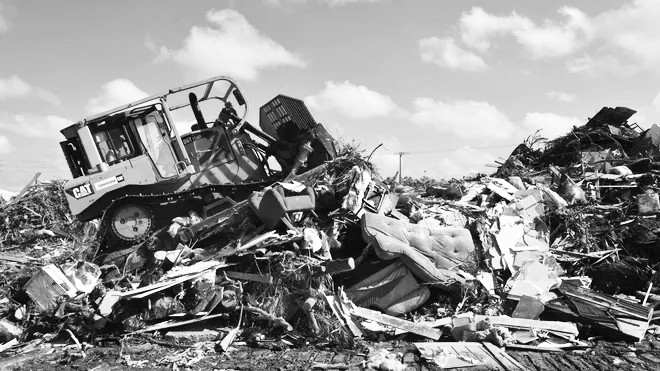
(Photo courtesy of Sarasota Herald-Tribune)
Margie Huggins has spent her retirement tending her parents’ farm in Transylvania County, in the heart of the Blue Ridge Mountains of North Carolina. She grew up there, and has tried to give back to the land by planting native shrubs and flowers. She’s intensified her work since Hurricane Helene tore through the region almost one year ago, in hopes that it could mitigate future flooding.
“We had 12 feet of water in some of these pastures,” Huggins said as she walked to the bank of the Little River behind her property. “If we can understand how we need to take care of the water system, which also will benefit the animals and the creatures that live there, it’s only going to help us all.” Helene brought extreme flooding and landslides to southern Appalachia, killing 108 people and causing $60 billion in damage in Western North Carolina alone. It also reshaped rivers and landscapes, littering them with everything from garbage and trees to cars and homes. The water inundated some of Huggins’ land but spared her house. She’s been working with biologists at the local nonprofit Conserving Carolina to replant the area.
But in the spring, her careful work was disturbed by a crew sent to clean up the river abutting her property months after the storm. “They brought in their big heavy equipment and started coming up Little River to remove debris,” Huggins said. The workers, granted access to the river by the U.S. Army Corps of Engineers, simply arrived one day in March. Before Huggins knew what to do, they had driven through the river, leaving crushed mussels and a flattened riverbed in their wake and, she said, taking healthy trees with them.
It’s often that way with the sprawling, messy business of disaster cleanup. In the aftermath of hurricanes, wildfires, and the like, a nesting doll of contractors and subcontractors, officials at every level of government, and an alphabet soup of agencies are needed to clear debris and set things right.
Local governments can tackle the job by hiring contractors, working with the state, and having the Federal Emergency Management Agency reimburse the costs. But counties usually hand the work over to the feds. In that case, FEMA coordinates the effort through federal agencies like the Army Corps and pays the firms they hire. The goal is quickly clearing roads, houses, and waterways of everything from windblown branches to the wreckage of homes washed away by the inundation. The scope of this work encompasses anything the agency deems “in the public interest,” a potential hazard, and directly related to a declared disaster. Cleanup on private land can operate through a similar system or be left to homeowners.
Because contractors are paid by the weight of waste removed or by the linear foot of ground covered, there can be a struggle to balance expediency and ecological care. Compounding the challenge, there is little oversight. The Army Corps of Engineers is supposed to coordinate with wildlife agencies, but government scientists who spoke with Grist say the Corps failed to do so after Helene, and they worry it’s too late to reverse the resulting damage.
There is a staggering amount of stuff to remove from the region’s waterways — some 7.3 million cubic yards of trees, limbs, and other detritus, by one estimate. That’s enough to load 609,000 dump trucks. No one denies the need to clean up, but the process has sparked arguments about what constitutes debris, what ought to be cleared, and what might be better left alone.
Surveying the stumps and erosion the crew left behind, Huggins wondered if there was a better way. “I’m all for doing what we need to help humans,” she said, “but we have to balance it.”
Transylvania County was spared the worst of Helene’s wrath. Nonetheless, the Army Corps earmarked some $66 million for debris removal there. All told, contractors throughout North Carolina had removed 12 million cubic yards of material from roads and waterways by the end of May, with more costly work ahead. As of the end of July, Governor Josh Stein’s request for Washington to provide $11 billion in additional aid had gone unanswered, even as the state has granted an additional $2 billion in cleanup funds. Federal emergency dollars have reimbursed just 6 percent of the cost of the disaster, estimated at $60 billion.
Before any dig-out starts, FEMA consults environmental entities like the U.S. Fish and Wildlife Service and state wildlife agencies to identify sensitive habitats. Scientists evaluate an ecosystem before, during, and after debris removal to ensure endangered species and historically significant sites are protected. But this process depends on the cooperation of the Army Corps and contractors — and the scientists can only offer guidance, not stop work. “When the dust settles and they have identified and tracked their impacts, we kind of just come behind and check their work,” said Gary Peeples, a biologist with the Fish and Wildlife Service.
Even when people like Hans Lohmeyer, a biologist with Conserving Carolina, try to help, they’re often rebuffed. He said the North Carolina Wildlife Resources Commission sent the Corps a list of best practices and maps of high-quality habitat throughout the region, to no apparent avail. He showed Grist photographs of riverbanks littered with crushed elktoe mussels, which are endangered, and stumps of what he said were healthy trees.
Others who work for state environmental agencies and requested anonymity for fear of reprisal shared similar photos. “They just wrecked it,” one state government scientist said of a stream in Mitchell County. “They nuked it.” He added that “we have documented way, way, way too many” instances in which contractors, paid by the volume of material they remove, felled live trees from locations that were not impacted by the flood.
This story was produced by Grist, co-published with The Daily Yonder, and made possible thanks to support from the CO2 Foundation.
The post Storm cleanup big business first appeared on Native Sun News Today.
 Shared by: Native Sun News Today
August 28, 2025
Shared by: Native Sun News Today
August 28, 2025
Tags: More News