
Supreme Court green lights tribal broadband
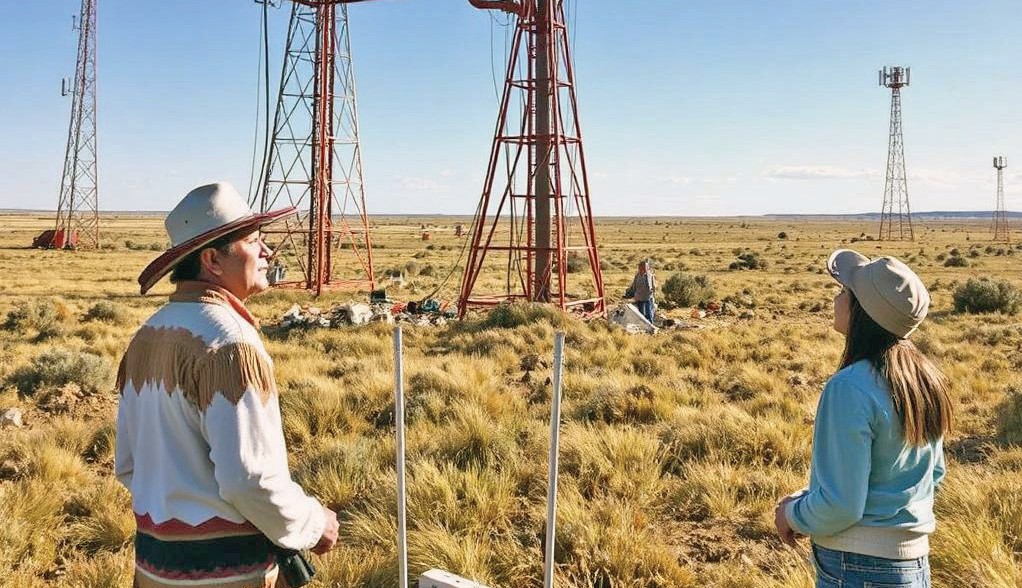
On June 27, 2025, the U.S. Supreme Court voted 6–3 to uphold the constitutionality of the Universal Service Fund (USF), a federal program that subsidizes broadband and phone access for rural and low-income communities. (AI generated photo)
PINE RIDGE— For the people of Pine Ridge, broadband is not just about faster internet or convenience— it’s about survival in the 21st Century. It’s about closing the massive gaps in education, healthcare, and opportunity that afflict our reservation communities. A recent Supreme Court ruling has given the tribes the funding they will need to establish broadband reservation wide.
On June 27, 2025, the U.S. Supreme Court voted 6–3 to uphold the constitutionality of the Universal Service Fund (USF), a federal program that subsidizes broadband and phone access for rural and low-income communities. The ruling preserves billions of dollars in funding for schools, healthcare centers, and tribal governments — funding that directly benefits the Oglala Sioux Tribe and the 2.1 million-acre Pine Ridge Reservation. The digital di- vide is real. And it is brutal.
According to the U.S. Census, Pine Ridge has a population density of just 4.3 people per square mile and the lowest per capita income in the nation: $8,768. Fewer than 12% of residents have a college degree. Nearly 49% live in poverty. The dropout rate among Native youth on the reservation exceeds 70%, and only 28.7% have a high school diploma. Nearly half the reservation population has no healthcare coverage. The average life expectancy? 48 for men, 52 for women — the lowest in the Western Hemisphere outside Haiti.
In the years to come computer literacy will become as essential to tribal survival as the bison were in the 19th Century. And to develop that literacy, broadband access must extend across every corner of the reservation — from Allen to Wounded Knee, from Porcupine to Pine Ridge
Established under the Telecommunications Act of 1996, the USF supports four programs: rural healthcare, schools and libraries (E-Rate), service for high-cost rural areas, and low-income subsidies like Tribal Lifeline. These programs help fund internet and telecommunications access in places where private companies have little incentive to build, like an Indian reservation.
The subsidies are significant. For example, eligible families on Pine Ridge can receive up to $34.25 per month off their phone or internet bills through Tribal Lifeline. First-time users can also get $100 off connection fees through Tribal Link-Up. Meanwhile, schools and libraries get up to 90% off broadband and telecommunications services. In a region where nearly every school qualifies for free lunch, that support is vital.
So is access to telehealth. Pine Ridge IHS facilities, including clinics in Kyle and Wanbli, participate in the USF’s Rural Health Care Program, receiving discounts of up to 65% on broadband costs. These networks link remote clinics to specialists, enabling patients to receive care without traveling hours over dangerous roads.
The Tribe’s efforts to expand broadband aren’t just about using federal dollars — they are about honoring treaty obligated promises.
Oglala Lakota Telecommunications, the Tribe’s own wireless company, aims to replace AT&T Mobility as the primary service provider on the reservation. By becoming the eligible telecommunications carrier (ETC) under FCC order 01-284, the Tribe could control the infrastructure and receive USF subsidies directly — a game-changer in building a self-sufficient digital future.
Every child who logs into a digital classroom with a weak signal or no connection at all is being left behind. Every elder unable to access telehealth is a casualty of neglect. Every household without broadband is a family unable to apply for jobs, participate in civic life, or connect with the world beyond the rez.
When Congress unilaterally seized the Black Hills and 7 million acres of Sioux land in 1877, it made a promise in return — to provide “all necessary aid to assist the said Indians in the work of civilization.” That promise is codified in Section 5 of the Act of February 28, 1877, and reaffirmed by the U.S. Supreme Court in United States v. Sioux Nation of Indians (1980), which labeled the taking of the Black Hills a “confiscation.”
Today, that promise means internet access and telecommunications infrastructure. It means reliable connectivity for schools, clinics, families, and tribal governments.
To default on that promise now — when the technology exists, when the funds are available, and when the need has never been greater — would force the tribe to operate like the 20th Century, in the 21st Century. When you compare how people in the 20th Century would have fared living like it was the 19th century, you can see the depth and urgency of the problem.
In her majority opinion, Justice Elena Kagan wrote that the Universal Service Fund does not violate the Constitution, and that Congress provided clear guidance in authorizing the FCC to ensure “rural Americans should not be abandoned on the wrong side of the technology divide.”
To this point, Justice Neil Gorsuch has been the best friend tribes have in Washington, That perfect record ended with this ruling, He dissented, joined by Justices Alito and Thomas, arguing that only Congress should set such rates. But the majority recognized what tribal leaders have long known: governance in Indian Country isn’t theoretical. It’s practical. And access to basic tools like broadband cannot be held hostage to abstract constitutional fights.
The Oglala Sioux Tribe and Indian Country now have the green light — legally, morally, and technologically — to build a digital future. But federal support alone won’t solve the problem.
Tribal councils must prioritize broadband as critical infrastructure. Grants must be pursued aggressively. Partnerships must be forged with providers who respect tribal sovereignty. Training programs must be implemented to grow computer literacy from the ground up — not just in schools, but in homes, community centers, and even jails.
The next generation of Lakota children require the tools to survive in a world where technology is expanding and advancing at an exponential rate.
(James Giago Davies is an enrolled member of OST. Contact him at skindiesel@msn.com)
The post Supreme Court green lights tribal broadband first appeared on Native Sun News Today.
 Shared by: Native Sun News Today
July 4, 2025
Shared by: Native Sun News Today
July 4, 2025
Tags: Top News