
The long fight over Oak Flat and the new Federal decision
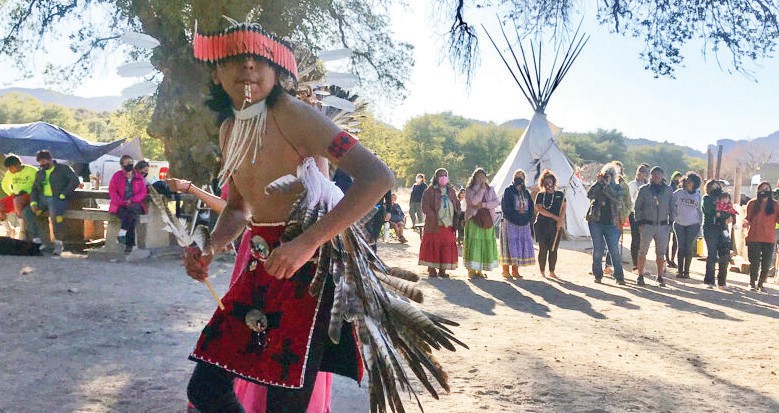
Waya Brown, who is Apache and Pomo, dances in a circle at Oak Flat campground on Saturday, Feb. 27, 2021, near Superior, Arizona. RNS photo by Alejandra Molina
SUPERIOR, Ariz. – For nearly twenty years, the fight over Oak Flat (Chi’chil Bildagoteel) has stood at the center of one of the most consequential clashes between federal mineral policy and Indigenous religious freedom in modern U.S. history. The land, a 6.7-squaremile ceremonial and cultural landscape east of Superior, Arizona, is sacred to the Western Apache and other Native nations. It contains old growth oak groves, springs, burial sites, and the grounds where girls’ coming of age ceremonies have been held for generations.
But beneath that sacred ground lies one of the largest untapped copper deposits in North America. For years, Resolution Copper, a joint venture of multinational mining giants Rio Tinto and BHP, has sought access to the ore body. The company’s proposed underground mine would eventually cause the surface to collapse into a crater nearly two miles wide and more than a thousand feet deep, permanently destroying Oak Flat. Federal environmental documents acknowledge this outcome.
How Congress set the stage
The turning point came in 2014, when Congress passed the Southeast Arizona Land Exchange and Conservation Act as part of the National Defense Authorization Act. The law required the U.S. Forest Service to transfer 2,422 acres of Tonto National Forest land, including Oak Flat, to Resolution Copper in exchange for more than 5,000 acres of private land elsewhere.
This exchange was controversial from the start. It bypassed tribal consent, was added to the defense bill at the last minute, and immediately triggered years of litigation, protests, and political battles. Apache Stronghold, the San Carlos Apache Tribe, environmental groups, and interfaith allies argued that the transfer violated religious freedom, treaty rights, and the federal trust responsibility.
The 2026 decision that changed everything
On March 16, 2026, the U.S. Department of Agriculture announced that the Forest Service had completed the land exchange and issued its final Record of Decision, formally transferring Oak Flat to Resolution Copper. The announcement followed a March 13 ruling by the Ninth Circuit Court of Appeals, which upheld a lower court’s refusal to halt the exchange. The court determined that the Forest Service’s final environmental impact statement constituted “final agency action,” clearing the last procedural barrier.
With that ruling, the land transfer proceeded. Resolution Copper now owns Oak Flat. The company has already notified the Supreme Court that it intends to begin exploratory drilling.
A blow to Apache religious freedom
For the Apache, the implications are immediate and devastating. The Ninth Circuit acknowledged that transferring Oak Flat into private hands will “permanently destroy the tribe’s historical place of worship.”
Once the mine advances, public access will be cut off for safety reasons, as contemplated in federal statute. The springs, oak groves, ceremonial grounds, and archaeological sites will be lost. The Apache women who filed an emergency request to the Supreme Court described the looming destruction as the erasure of a living religious landscape central to their identity and spiritual practice.
A victory for federal mineral policy and a loss for tribal sovereignty
The USDA framed the decision as a national security achievement, aligning with federal goals of increasing domestic mineral production and reducing reliance on foreign supply chains. The agency emphasized copper’s importance to defense systems, renewable energy, electric vehicles, and grid modernization.
But for tribal nations, the decision underscores the limits of federal sacred site protections. Oak Flat was listed on the National Register of Historic Places as a Traditional Cultural Property, yet that designation offered no shield once Congress mandated the exchange. The case highlights a structural reality: on federal lands, tribes have religious rights but not religious control.
The legal fight is not over, but the terrain has shifted
Apache Stronghold and allied groups continue to pursue religious freedom claims, including appeals to the Supreme Court. But the land is no longer federal, which narrows the legal pathways. The transfer also complicates legislative efforts to reverse the exchange, since Congress would now have to reclaim land already conveyed to a private company.
International human rights bodies may become increasingly relevant, as Apache leaders argue that the destruction of Oak Flat violates global norms protecting Indigenous cultural and spiritual heritage.
A future shaped by loss, resistance, and precedent
The completion of the land exchange marks a historic moment, one that will shape federal tribal relations for years to come. For the Apache, it represents the potential loss of a sacred site comparable to a cathedral or mosque. For the mining industry, it opens access to one of the richest copper deposits in the world. For policymakers, it sets a precedent for how Congress can override tribal objections when mineral or energy priorities are at stake.
The story of Oak Flat is not finished. It now enters a new chapter, one defined by the tension between a community fighting for its spiritual survival and a federal system that continues to privilege resource extraction over Indigenous sovereignty.
(Contact Ernestine Anunkasan Hopa at editor@nativesunnews.today)
The post The long fight over Oak Flat and the new Federal decision first appeared on Native Sun News Today.
 Shared by: Native Sun News Today
March 22, 2026
Shared by: Native Sun News Today
March 22, 2026
Tags: More News