Update on the current Northern Cheyenne ‘Political Revolution’
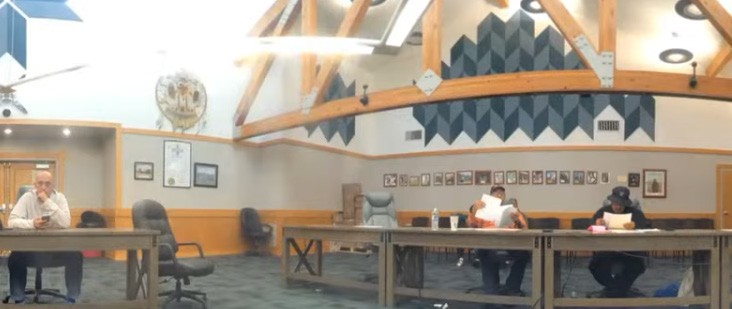
Northern Cheyenne interim tribal council conduct business at Northern Cheyenne Tribal office in Lamedeer, Mont. (Photo courtesy YouTube)
Revolutions do not ever go smoothly or according to plan. Instead, they seem to take on a life of their own. That’s what appears to be happening at Northern Cheyenne.
It has been a chaotic few months for the Northern Cheyenne tribal government and tribal citizens on the reservation. New developments seem to occur day-by-day, even hour-to-hour. As a result, it’s difficult to keep up or truly understand what is happening. Part of the problem is that we lack regular news sources, relying instead on Facebook—which must be taken with a grain of salt—Native Sun News Today, and the occasional radio or television snippet.
Though tribal citizens have been frustrated with the IRA system of government since the beginning, we largely felt that we were “stuck” with it. The Tribal Constitution, first adopted in 1934 under the Indian Reorganization Act, has been amended twice (in 1960 and 1996) in hopes of creating a more effective and accountable government. Neither amendment achieved that goal. There is now a general consensus that a new constitution and form of government, based on Cheyenne values, are needed—and that some mechanism must be in place to ensure elected officials adhere to it. So, we find ourselves back at it again.
The root of the current problem stems from money—some $90 million in COVID-related funds. Many people question how that money was used, with suspicions that some of it has been misused. Tribal President Gene Small ran on a platform of accountability, calling for a forensic audit of all tribal monies. Soon after his election in November 2024, he requested such an audit covering the past seven years, which was initially approved by the Tribal Council.
As the results began to emerge, several Council members became concerned, especially when the Office of the Inspector General stepped in. Overall, there is broad support within the community for conducting such an audit.
The in-fighting that plagues every Tribal Administration soon began, with the Tribal Council attempting to remove the Tribal President. More than a dozen Northern Cheyenne Tribal Presidents have been removed in the past 20 years—some for good cause, and others for reasons the Tribal community does not fully understand. In this case, the Council did not refer to the audit but based their action on the Separation of Powers constitutional provision, claiming Small had violated it by signing the Chief Judge’s leave slip and meddling in other tribal court personnel matters.
During an August Council meeting when a resolution for his removal was presented, violence erupted right in the Council chambers, even involving some Tribal Council members. A number of BIA police and other Federal officers, on hand because of that possibility, arrested individuals. Such a calamity had never before occurred at Northern Cheyenne.
Since then, the situation has become even more confusing, in my opinion. The Traditional Chiefs, with Small’s approval, ousted the elected Council, Tribal Treasurer, Secretary, and one tribal employee who assisted the previous Council. The Chiefs then assumed the role of Tribal Council. The elected or previous Council— what is the right adjective here?—continues to meet in secret and has allegedly absconded with travel records and even some blank tribal checks. The BIA has wavered several times but apparently has now recognized the Chiefs, who are largely serving without compensation as they try to reorganize. A protest camp still remains outside the Tribal Building, and security guards have been increased. Everyone in key positions has hired lawyers, including President Small, the Chiefs, and the old Council. The lawyers must be making a lot of money.
The Tribal office was closed for a week, and several short-notice “administrative leave” days were granted. One tribal member wonders if everyone is still receiving pay during this time—probably so. Due to this turmoil, 1st Interstate Bank closed the tribal checking accounts, uncertain of who the authorized check signers are. Last I heard, President Small has successfully gained support (or should I say approval?) from high levels at the Department of Interior to reopen the accounts soon. In the meantime, programs are waiting for checks to conduct business, and people who rely on tribal services—including myself— are on hold.
Adding to the confusion, the Chiefs, who have only agreed to serve temporarily, have called a special election to fill the seats of the eight ousted Council members. Two members were allowed to remain in office. However, they decided to skip the constitutional requirement for a primary and general election, opting instead for a single election. That election is to be held soon, pending BIA approval.
And then! The Chiefs have also expressed the belief that women cannot stand for tribal public office because it is not traditional. As far as I know, they have not officially documented this stance, but it has been made quite clear. This has deeply disturbed many women on the reservation—including myself. Yes, traditionally, women were not Chiefs or leaders. However, this is 2025, not 1876. Women across America have fought for years to achieve suffrage rights—specifically voting and holding political office.
Do we, as Northern Cheyenne women, have to start a civil battle to protect our rights within our own tribe? A core saying among the Northern Cheyenne is: “It will not be over until the hearts of the women are on the ground.” Our hearts are not on the ground. We are too busy for that—the women are the backbone of this tribe.
It will be interesting to see how this unfolds. Hopefully, small matters—such as elderly meals, regular Head Start classes, Medicare reimbursement, and assistance for the neediest, already impacted by this chaos—will not fall through the cracks while the Chiefs focus on the larger issues. Sadly, these developments have pitted large families against each other.
Hopefully, these rifts can be healed through our cultural and spiritual beliefs.
In closing, I want to remind readers that the vast majority of Northern Cheyenne are responsible, thoughtful people—kind to one another. On the other hand, some seem to have become entangled in the forces of this internal conflict, which is taking on a life of its own.
(Contact Clara Caufield at acheyennereview@gmail.com)
The post Update on the current Northern Cheyenne ‘Political Revolution’ first appeared on Native Sun News Today.
 Shared by: Native Sun News Today
October 10, 2025
Shared by: Native Sun News Today
October 10, 2025
Tags: More News