
White sands footprints
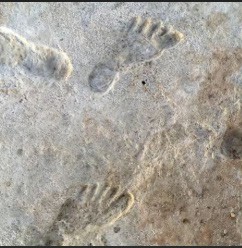
Ancient footprints at White Sands perhaps 23,000 years old (Photo courtesy of chrissysenecal.com)
HILL CITY—Prominently located on Main Street in Hill City is the Black Hills Institute Museum, primarily focused on the fossils of extinct dinosaur and mammal megafauna. This fossil record is deep, and scientifically certain, but before fossils fossilize, there is a layer of archaeological evidence, as the first non-fossilized human remains date back only 60,000 years.
For more than a century, archaeologists have scoured the Americas for signs that people were here before the last Ice Age had reached its peak. After decades of debate, the discovery of fossilized human footprints at White Sands National Park in New Mexico sparked renewed excitement—and controversy. Radiocarbon and luminescence dating suggest the tracks may be as old as 23,000 years, placing them squarely in the midst of the Last Glacial Maximum. If accurate, this would be the oldest unequivocal evidence of human presence in the Americas.
Despite the flurry of pre-Clovis discoveries over the past few decades—from Monte Verde in Chile to Cooper’s Ferry in Idaho— none have produced the kind of fossil or skeletal remains that define ancient human activity in Africa, Asia, and Europe. Homo erectus, Neanderthals, Denisovans, and early Homo sapiens all left physical traces of their presence across the Old World. In Africa and Eurasia, the fossil record stretches back millions of years. This fossil record is absent in the Americas.
There are no Homo erectus skull caps in Kansas. No Neanderthal jawbones in the Yukon. No Denisovan teeth in Texas. In fact, there is not a single scientifically accepted human fossil in the Americas that predates the 23,000-year-old White Sands footprints.
The footprints, discovered along the ancient shoreline of Lake Otero, tell a compelling story. Teenagers, children, and the occasional adult walked through the wetlands, their impressions preserved in layers of sediment alongside tracks of dire wolves, mammoths, and giant ground sloths. Multiple dating methods—radiocarbon analysis of plant seeds and optically stimulated luminescence (OSL) of sand grains—suggest the tracks were made between 21,000 and 23,000 years ago.
For some archaeologists, that evidence is a game-changer. “White Sands provides the first unequivocal evidence for human presence in the Americas during the Last Glacial Maximum,” said Dan Odess of the National Park Service.
Critics, such as Michael Waters of Texas A&M, argue that the radiocarbon dates could be skewed by the “reservoir effect”—a phenomenon where aquatic plants like Ruppia cirrhosa absorb ancient carbon from groundwater, making them appear older than they truly are. If the seeds are even a few thousand years off, the implications are significant: the footprints might not predate the end of the Ice Age at all.
This uncertainty has led many to withhold final judgment. As David Madsen and colleagues wrote in Science, “Whether the footprints reliably date to >20 ka remains an open question.”
No matter how compelling footprints or stone tools may seem, the cornerstone of paleoanthropology remains fossilized human remains. In Europe, Neanderthal skeletons date back over 400,000 years. In Africa, the hominin record stretches back millions of years, including australopithecines, archaic Homo species, and anatomically modern humans.
In East Asia, fossils of Homo erectus date to at least 1.6 million years ago. In Siberia, Denisovan DNA has been recovered from tiny fragments of bone and teeth dating back 100,000 years.
If humans—or any human ancestors— originated in the Western Hemisphere, or even occupied it for any significant amount of time before 23,000 years ago, we would expect to find fossil evidence. We don’t. The absence isn’t for lack of effort. Archaeologists have been actively searching for more than a century, and yet there is no clear record of hominin evolution in the Americas prior to the last Ice Age.
The Clovis-first theory, long the dominant paradigm, held that humans arrived around 13,000 years ago. That view has since crumbled under the weight of pre-Clovis findings. Yet the revised timeline— 16,000 to 23,000 years ago—still leaves a yawning void compared to other continents.
If people had evolved in or migrated to the Americas in deep antiquity— say, 100,000 years ago— we would expect a fossil trail. We would expect bones, tools, middens, fire pits, or even DNA in cave sediments. We would expect the kind of evidence we routinely find across Africa, Europe, and Asia. But the archaeological silence of the Americas before 23,000 years ago is deafening.
Meanwhile, Europe has yielded Neanderthal footprints in Portugal dated to 78,000 years ago. These trackways, discovered at Monte Clérigo, show adults and children foraging along a coastal dune— much like their modern human analogs would later do at White Sands. But the European site predates the first accepted human presence in the Americas by more than 50,000 years.
The simplest explanation remains the most convincing: Homo sapiens are not indigenous to the Americas. They are late arrivals— part of the broader human diaspora that began in Africa more than 100,000 years ago.
That doesn’t make the Indigenous cultures of the Americas any less profound. It simply means they descend from ancestors who arrived relatively recently in geological terms—and the evidence suggests maybe 25,000 years ago.
Yes, some claims, such as the controversial artifacts at Pedra Furada or the sloth-bone pendants in Brazil, suggest even older human activity. But these sites lack the broad scientific consensus and corroborating fossil evidence that would be necessary to rewrite the human origin story.
As Vance Holliday acknowledges, “Exactly when people first arrived in the Western Hemisphere and when continuous occupation was established are still both uncertain and contested.”
Until direct fossil evidence emerges as old as Old World evidence— and until that evidence withstands rigorous, independent dating and verification—the idea that humans originated or even arrived here during deep prehistory remains speculation.
Science doesn’t operate on belief. It operates on evidence. And while the story of White Sands is both compelling and poetic, it remains a single chapter in a book whose earliest pages are still missing in the Americas.
(James Giago Davies is an enrolled member of OST. Contact him at skindiesel@msn.com)
The post White sands footprints first appeared on Native Sun News Today.
 Shared by: Native Sun News Today
July 26, 2025
Shared by: Native Sun News Today
July 26, 2025
Tags: More News