
Gorsuch’s Indian law record receives limited recognition
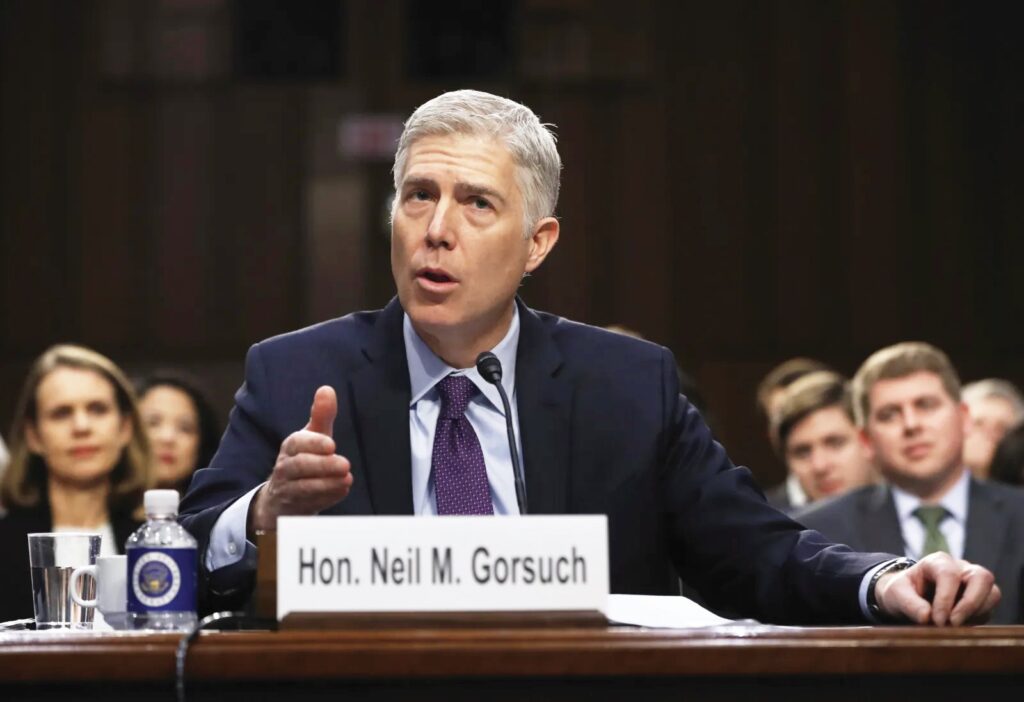
Neil Gorsuch is the first justice to put the spotlight on plenary power, by questioning aspects of the 1886 Kagama decision. (Photo courtesy of Newsweek)
RAPID CITY—Every few years, Neil Gorsuch’s Indian law record receives another examination. His name is familiar, but much of that record receives limited public attention. Tribes celebrate favorable Supreme Court decisions, lawyers analyze them and politicians claim whatever credit is available. Gorsuch has repeatedly supplied a decisive vote, a controlling opinion or a detailed dissent in major Indian law cases.
Publicly searchable records did not reveal a national tribal proclamation or comparable formal honor devoted to Gorsuch. His opinions have nevertheless made tribal sovereignty a recurring part of his written work.
President Donald Trump nominated Gorsuch in January 2017 to fill the seat left vacant by the death of Justice Antonin Scalia. Senate Democrats opposed the nomination, while Gorsuch arrived labeled a conservative originalist and textualist. His Tenth Circuit record, however, already contained substantial experience with tribal cases.
That record included eleven years on the Tenth Circuit Court of Appeals, where cases from the western states regularly placed Indian law before him. Writing for the American Bar Association after his nomination, John Dossett noted that Gorsuch had written 18 opinions and participated in 42 additional cases involving federal Indian law or Indian interests. His work addressed sovereign immunity, state intrusion onto tribal land, trust funds, religious freedom and criminal jurisdiction.
The pattern followed him to the Supreme Court.
In 2019, Gorsuch joined the Court’s four liberal justices in Washington State Department of Licensing v. Cougar Den. The Court held that Washington could not impose its fuel tax in a manner that violated the Yakama Nation’s treaty right to travel on public highways. In a concurrence, Gorsuch wrote that the Yakama had surrendered millions of acres in return for promises and that Washington wanted to escape the consequences of one of them. Holding the government to its word, he wrote, was “the least we can do.”
Two months later, he again joined the liberal justices in Herrera v. Wyoming. The Court held that Wyoming statehood did not erase Crow treaty hunting rights. A treaty did not disappear merely because the map changed around it.
Gorsuch wrote the majority opinion in McGirt v. Oklahoma in July 2020. Oklahoma had acted for generations as though Congress had erased the Muscogee reservation. Congress had never done so. “Because Congress has not said otherwise,” Gorsuch wrote, “we hold the government to its word.” The 5-4 ruling recognized that the reservation remained Indian Country for purposes of federal criminal law.
Two years later, the Court changed direction in Oklahoma v. Castro-Huerta, allowing states to prosecute non-Indians who commit crimes against Indians in Indian Country. Gorsuch dissented with the three liberal justices and wrote: “Where this Court once stood firm, today it wilts.”
His record continued. In Ysleta del Sur Pueblo v. Texas, Gorsuch wrote the 2022 majority opinion rejecting Texas’s effort to regulate tribal bingo where state law did not prohibit the game outright. In Haaland v. Brackeen the following year, the Court upheld the Indian Child Welfare Act by a 7-2 vote. Justice Amy Coney Barrett wrote the majority opinion, while Gorsuch wrote separately to place ICWA inside the long history of government policies that broke apart Indian families and threatened tribal survival.
Gorsuch has also stood with tribes when he could not assemble a majority. In Arizona v. Navajo Nation, he joined the three liberal justices in dissent after the Court rejected the Navajo Nation’s attempt to compel the federal government to assess and address the tribe’s Colorado River water needs. His opinion began with the plain fact that the Navajo reservation is largely desert and that many Navajo families still lack running water.
In 2024, Gorsuch joined the five-justice majority in Becerra v. San Carlos Apache Tribe, requiring the Indian Health Service to pay certain contract support costs incurred by tribes operating their own health programs. The decision had direct funding consequences for tribal self-determination contracts.
In May 2025, the Court refused to hear Apache Stronghold v. United States, leaving in place a federal land transfer that threatens to destroy Oak Flat, a site sacred to Western Apache people. Gorsuch dissented, joined by Justice Clarence Thomas, arguing that the Court had refused to apply to an Indian religion the same protections it had enforced for other faiths.
Then came Veneno v. United States in November 2025. Gorsuch again dissented from the Court’s refusal to hear a case, this time asking his colleagues to reconsider United States v. Kagama, the 1886 decision that helped create congressional plenary power over tribes.
Kagama upheld the Major Crimes Act not because the Constitution clearly authorized Congress to take internal criminal jurisdiction from tribes, but because the Court described Indians as weak, dependent wards in need of federal control. Gorsuch called that theory one “that should make this Court blush.” He wrote that it had no constitutional foundation and rested on “archaic prejudices.” Only Thomas joined him.
That dissent reaches beyond one prosecution. Plenary power is the doctrine Congress has used to alter tribal rights, override agreements and intrude into internal tribal affairs. Gorsuch’s argument is that the Constitution grants the federal government significant authority in relations with tribes, but it does not hand Congress ownership of every inherent power tribes possessed before the United States existed.
Gorsuch is not a liberal justice. His positions on abortion, religious liberty and regulation remain conservative. His Indian law opinions instead apply the textualism and originalism that characterize his broader jurisprudence: Congress must clearly disestablish a reservation; treaty language binds governments; and federal authority over tribes must have a constitutional foundation.
Tribal leaders have praised the results in McGirt, Brackeen and other cases. Formal recognition directed specifically at Gorsuch remains harder to locate. His nomination came from Trump, while his Indian law opinions reflect a distinct approach to treaties, statutes and tribal governmental status.
For nearly a decade on the Supreme Court, Gorsuch has repeatedly argued that the United States must honor its legal commitments to tribes. In Veneno, he asked the Court to reconsider a doctrine rooted in the language and assumptions of 1886. The Court declined to hear the case. His dissent nevertheless placed a direct constitutional challenge to tribal plenary power in the Supreme Court record.
(James Giago Davies is an enrolled member of OST. Contact him at skindiesel@msn.com)
The post Gorsuch’s Indian law record receives limited recognition first appeared on Native Sun News Today.
 Shared by: Native Sun News Today
October 2, 2026
Shared by: Native Sun News Today
October 2, 2026
Tags: Top News