
Tohono O’odham Nation battles federal government over border wall on ancestral lands
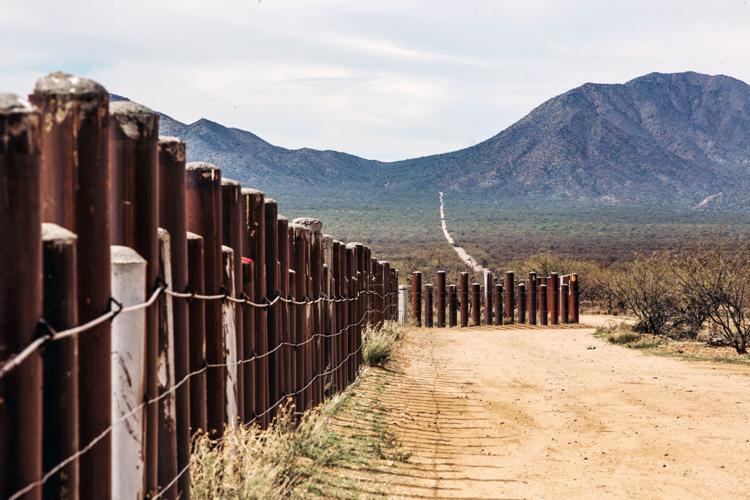
(Photo courtesy of Arizona Daily Star)
RAPID CITY—A confrontation has materialized between two sovereign governments whose interests in protecting the international border have historically been closely aligned. The Tohono O’odham Nation has taken its longstanding opposition to a border wall on its reservation into federal court.
At issue is the Trump administration’s plan to construct approximately 62 miles of border wall along the Nation’s southern Arizona reservation, a project tribal leaders contend threatens sacred sites, ancestral burial grounds, water resources and the continued relationship between O’odham communities on opposite sides of the international boundary.
The federal government maintains that securing the border is a fundamental responsibility of the United States and that the Nation cannot prevent construction within a federally reserved corridor along the boundary.
The disagreement presents a difficult question: How far does federal authority extend when national security measures directly affect the lands, culture and religious practices of a federally recognized sovereign Indian nation?
The Tohono O’odham have inhabited the Sonoran Desert since time immemorial. Their ancestral territory extended across what is now southern Arizona and northern Mexico long before either country established its present boundaries.
The 1854 Gadsden Purchase divided those lands, leaving O’odham communities separated by an international boundary they had no part in creating.
Today, the Nation has approximately 37,000 enrolled members and a 2.8-million-acre reservation. Thousands of O’odham continue to reside in Mexico, maintaining family, cultural and religious relationships with relatives in the United States.
For them, crossing the border is not simply a matter of international travel. It is part of maintaining a people whose homeland predates the border itself.
The Nation’s opposition to a physical wall should not be confused with opposition to border security. For decades, tribal authorities have cooperated with Customs and Border Protection, Immigration and Customs Enforcement and other federal agencies to combat illegal immigration, drug trafficking and human smuggling. The Nation has authorized vehicle barriers, federal checkpoints, surveillance towers, patrol roads and forward operating bases. Its police department participates in a multiagency drug-trafficking task force involving federal law enforcement.
Among the most distinctive operations is the Shadow Wolves, an all-Native federal tracking unit established in 1985 that combines traditional tracking skills with modern law enforcement techniques.
The Nation reports that illegal crossings on its lands declined more than 95 percent over a recent two-year period, although that figure alone does not establish which enforcement measures produced the decline.
The tribe maintains that these cooperative arrangements demonstrate that effective border enforcement does not require constructing a continuous wall through its homeland.
The Trump administration takes a different position. Federal officials contend that existing vehicle barriers, while capable of stopping automobiles, provide inadequate protection against people crossing on foot. They argue that the remote desert corridor has long been exploited by drug smugglers, human traffickers and criminal organizations, placing migrants, tribal residents and law enforcement officers at risk.
CBP Commissioner Rodney Scott has described the proposed Smart Wall as an important combination of physical barriers and surveillance technology intended to prevent illegal activity and assist Border Patrol agents.
Federal attorneys also maintain that the United States possesses an independent sovereign responsibility to secure its international boundaries, regardless of whether an adjoining tribal government consents.
Central to their argument is the Roosevelt Reservation, a 60-foot-wide strip of federal land established along portions of the Mexican border by President Theodore Roosevelt in 1907.
The government maintains that construction within this federally reserved corridor does not constitute an unlawful taking of tribal land.
The Nation disputes the practical implications of that position, arguing that a major construction project cannot realistically be confined to such a narrow strip without affecting adjoining reservation lands and resources.
The Nation’s objections extend well beyond ownership and jurisdiction. During earlier border construction in 2020, federal contractors blasted through areas around Monument Hill, damaging ancestral burial grounds and sacred sites. In April 2026, construction activity damaged the Las Playas Intaglio, a roughly 1,000-year-old geoglyph in the Cabeza Prieta National Wildlife Refuge. Tribal leaders also fear additional construction near Quitobaquito Springs, a desert oasis sacred to generations of O’odham people. The spring supports rare wildlife and has served as a destination for religious pilgrimages and ceremonies. Construction-related groundwater extraction and disturbance have raised concerns about the long-term survival of this culturally and environmentally important site. The Nation argues that such damage cannot be adequately remedied through financial compensation after construction is completed.
Federal officials have pledged consultation and cooperation to address tribal concerns, although the disagreement over whether construction should proceed remains unresolved. On June 16, the Nation filed suit against Homeland Security Secretary Markwayne Mullin, CBP Commissioner Scott and Border Patrol Chief Rosario Vasquez. The tribe sought a preliminary injunction preventing construction while its legal claims were considered. On August 14, U.S. District Judge Richard Leon denied that request.
Leon concluded that the Nation had not demonstrated a likelihood of succeeding on its claims that construction would unlawfully alter reservation boundaries or constitute trespass. He also found that federal interests in border security, immigration enforcement and public safety outweighed the harms established for purposes of the preliminary injunction. Importantly, the ruling did not resolve every underlying dispute or constitute a final judgment on all the Nation’s claims. Leon expressly expected federal officials to fulfill their commitments to consultation and cooperation.
The Nation subsequently appealed, maintaining that the decision failed to adequately address the permanent destruction of sacred places and other consequences of construction.
The controversy illustrates a recurring difficulty in federal Indian law. Tribal nations possess recognized sovereignty and government-to-government relationships with the United States, yet federal authority over Indian affairs and international boundaries remains extensive. The federal government has a legitimate responsibility to protect the country from unlawful entry, criminal trafficking and threats to public safety.
The Tohono O’odham Nation likewise has a responsibility to protect its citizens, ancestral lands, water resources and religious traditions. Those responsibilities need not be mutually exclusive, as decades of cooperation between the two governments demonstrate.
The question now is whether the federal government can accomplish its security objectives without imposing irreversible cultural and environmental consequences on a people who have occupied this region for centuries.
With construction anticipated as early as October, the Nation’s appeal places that question before the federal courts. For the O’odham, the international boundary is a relatively recent political creation across an ancient homeland. For the United States, it is a national boundary that must be secured. How those two realities are reconciled will have implications extending far beyond the Sonoran Desert.
(James Giago Davies is an enrolled member of OST. Contact him at skindiesel@msn.com)
The post Tohono O’odham Nation battles federal government over border wall on ancestral lands first appeared on Native Sun News Today.
 Shared by: Native Sun News Today
October 2, 2026
Shared by: Native Sun News Today
October 2, 2026
Tags: Top News