
Indiana was once full of actual Indians
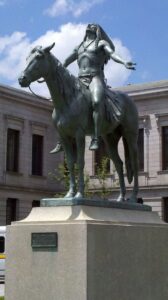
Statue of fictional Chief
Munsee in town square, Muncie, Indiana.
MUNCIE, IN.—High above the White River in Muncie sits an Indian on horseback, arms extended, face turned toward the sky. People have called him Chief Muncie. There was just one problem. There was no Chief Muncie.
The bronze statue is a replica of Cyrus Dallin’s famous Appeal to the Great Spirit, originally sculpted in 1909. After industrialist Edmund Burke Ball died in 1925, his family selected the image as his memorial, and the Muncie statue was dedicated in 1929.
Dallin’s Indian is a generalized Plains Indian, far more likely to remind a viewer of a Sioux warrior than any Indian who historically lived along Indiana’s White River. The Indians around Muncie were Woodland people. Even the city’s name did not come from some forgotten chief. Muncie derives from Munsee, associated with the Lenape, or Delaware, people who lived in the region.
A Plains Indian who never lived there became the symbol of a city named for Indians who did. That city sits in a state called Indiana—literally the land of the Indians—whose capital is Indianapolis, the city of Indiana.
And most of the Indians were removed.
Long before Indiana became a state in 1816, however, Indians had been living, trading, farming, fighting and building communities across the region for thousands of years. The story reaches much farther back than the tribes encountered by Europeans. Pre-Columbian people throughout the Ohio and Mississippi valleys constructed enormous earthworks. Archaeologists once lumped many of these cultures together under the misleading term “Mound Builders,” as though they constituted some mysterious vanished race.
They did not.
They were Native peoples whose societies developed over thousands of years. Adena and Hopewell peoples constructed elaborate burial and ceremonial earthworks. Farther west, the Mississippian world eventually produced Cahokia, across the Mississippi River from present-day St. Louis, a city that at its height rivaled many European communities in population. By the time Europeans began penetrating the Great Lakes and Ohio Valley, the political map had changed repeatedly.
Indiana became principally Miami country. Miami bands included the Wea and Piankashaw, and their homeland extended well beyond today’s state boundaries. Illinois peoples were also associated with the region. Potawatomi became increasingly important in northern Indiana, while Shawnee and Lenape communities moved into portions of the territory as colonial expansion and intertribal warfare displaced people elsewhere.
The Lenape established villages along the White River during the late eighteenth century. It is their presence that ultimately gave Muncie its name. Then came the United States. American independence from Great Britain did not mean independence for Indians. It accelerated pressure upon their land. No Indian leader understood that danger better than Tecumseh.
Born Shawnee in what is now Ohio, Tecumseh attempted something extraordinary: organizing tribes beyond their individual identities into a political and military confederacy capable of stopping American expansion.
His brother Tenskwatawa, known as the Prophet, established Prophetstown near the confluence of the Tippecanoe and Wabash rivers in Indiana. Indians from numerous nations gathered there.
Tecumseh rejected the American assumption that individual tribes could simply sell portions of a common Indian homeland. His argument was remarkably straightforward. The continent had belonged collectively to Indian people, and one tribe had no more right to sell the land beneath another tribe than an individual citizen could sell the state of Indiana.
Indiana territorial governor William Henry Harrison saw Tecumseh’s confederacy for exactly what it was—a serious obstacle to American expansion.
While Tecumseh was away recruiting allies, Harrison marched on Prophetstown in 1811. Fighting erupted at Tippecanoe, and Harrison’s soldiers subsequently burned Prophetstown. Tecumseh continued his resistance during the War of 1812, allied with the British, until he was killed at the Battle of the Thames in Canada in 1813. His confederacy died with him. Indian land soon followed.
Treaty after treaty transferred millions of acres into American hands. Sometimes tribal leaders willingly negotiated because they saw no viable alternative. Sometimes factions signed agreements opposed by other leaders. Economic pressure, debt, alcohol, political manipulation and the overwhelming demographic weight of American settlement all played roles.
Congress passed the Indian Removal Act in 1830, and removal became national policy.
Indiana’s Potawatomi suffered one of the ugliest episodes.
Chief Menominee refused to leave his village near present-day Plymouth. In September 1838, nearly 900 Potawatomi were forced west under armed guard toward Kansas.
Their journey became known as the Potawatomi Trail of Death. About 40 people died along the way, many of them children.
The Miami held on longer. In 1846, more than 300 Miami were forcibly removed from Indiana. About 150 were permitted to remain because of treaty provisions and individually owned lands. Their descendants maintained a Miami presence that never entirely disappeared.
Neither did the Potawatomi. Leopold Pokagon’s band avoided the fate suffered by many other Potawatomi and remained in the Great Lakes region. Their descendants, the federally recognized Pokagon Band of Potawatomi, eventually regained sovereign land in Indiana. In 2016 the federal government approved 166 acres in South Bend for trust status—the first federally recognized tribal trust land established in Indiana.
The Miami Tribe of Oklahoma also maintains land and a cultural presence in Fort Wayne, while the Miami Nation of Indiana, although not federally recognized, maintains its headquarters in Peru and traces its community directly to Miami families who remained behind.
So Indians never completely disappeared from Indiana. But their disappearance from the political landscape was so extensive that today people can drive through places named Indiana, Indianapolis, Miami County, Wabash, Tippecanoe, Potawatomi and Muncie without stopping to consider why those names are there. The Indians became geography. Their villages became towns. Their trails became highways. Their rivers retained Indian names while the people themselves were pushed west.
Which brings us back to that lonely Indian on horseback in Muncie.
He isn’t Chief Muncie. He isn’t Lenape. He isn’t Miami. He isn’t even dressed like the Woodland Indians whose history surrounds the place where he sits. But perhaps unintentionally, Appeal to the Great Spirit became an appropriate monument after all. An Indian who never existed sits in a city named for Indians who did, in a state whose very name proclaims it to be the land of Indians.
The irony is difficult to improve upon.
(James Giago Davies is an enrolled member of OST. Contact him at skindiesel@msn.com)
The post Indiana was once full of actual Indians first appeared on Native Sun News Today.
 Shared by: Native Sun News Today
September 18, 2026
Shared by: Native Sun News Today
September 18, 2026
Tags: Top News