
Oglala Sioux Tribe challenges Bear Lodge rare earth project
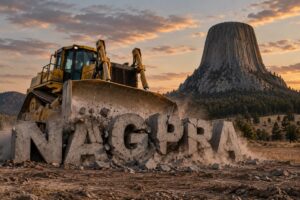
Graphic (Courtesy of AI)
PINE RIDGE—More than a century after gold miners first transformed the Black Hills, another mineral buried beneath the Hills has placed the Oglala Sioux Tribe at odds with a proposed mining operation—this time rare earth elements considered critical to modern technology and national defense.
Oglala Sioux Tribal Chairman Frank Star Comes Out submitted nine pages of scoping comments Aug. 28 challenging aspects of the proposed Bear Lodge Rare Earth Project in northeastern Wyoming and demanding formal government-to-government consultation before the project advances further through the federal environmental review process.
“They have the right to do that because of the 1851 Treaty,” Oglala attorney Mario Gonzalez said.
Rare Element Resources proposes developing the Bull Hill Mine near Sundance on Black Hills National Forest land. The deposit contains neodymium and praseodymium, rare earth elements used in permanent magnets important to defense and high-technology industries. Federal records list the project as undergoing environmental review, with the overall federal permitting process currently projected for completion in March 2028.
For the Oglala, however, Bear Lodge is not simply another proposed mine on federal land.
“Our people require us to continue to assert our claims to the Black Hills region and to the history that supports those claims,” Star Comes Out wrote, extending that assertion to “the environment, the water, the earth, and the air” that sustain life and Lakota culture.
NAGPRA, the Native American Graves Protection and Repatriation Act, enacted in 1990, potentially applies to any situation where energy or mining activities require altering the physical landscape.
“There’s three levels,” Gonzalez explains. “Level one is lineal descendants have a property right, first preference to cultural resources if they can show the connection to their families, lineal descendant. Second, is a tribe that might have an historical connection like an earthen lodge along the Missouri River might have an historical connection to a tribe like the Three Affiliated Tribes. The third preference is to a tribe that has a ruling by the Indian Claims Commission, that that was their aboriginal treaty territory.
OST connects Bear Lodge culturally and spiritually with Mato Tipila, or Bear Lodge, commonly called Devils Tower, and with the greater Black Hills. Star Comes Out described the connection as “an umbilical cord running from our sacred Mato Tipila to Mato Paha and to the sacred mountains within the Black Hills region; they are all one.”
OST contends mining could affect water and air quality, wildlife habitat, sacred sites and traditional ceremonies while potentially exposing the surrounding area to radioactive and hazardous minerals, although the radioactivity aspect will be difficult to establish.
Rare Element Resources acknowledges that trace amounts of naturally occurring thorium and uranium are present in the Bear Lodge deposit. Its proposed commercial processing facility would be located on private land approximately 40 miles from the mine. Federal permitting records describe a project whose total development capital is expected to exceed $700 million.
The Forest Service announced July 29 that it would prepare an Environmental Impact Statement examining the proposed mine. The agency expects the completed EIS in late 2027. Unlike the normal Forest Service process, no draft EIS will be published and there will be no project-level administrative objections process because the decision will be made by the USDA Under Secretary for Natural Resources and Environment.
OST specifically objected to that abbreviated administrative structure.
“The Oglala Sioux Tribe requires consultation over and above the notice-and-comment process established by this Notice,” Star Comes Out wrote. OST argues its status as a sovereign tribal government entitles it to consultation independent of opportunities afforded the general public.
Federal records show Section 106 historic-preservation consultation with state and tribal historic preservation officials was initiated in April, with completion currently targeted for October 2027.
Perhaps the most expansive argument in the Tribe’s comments concerns water.
OST invokes the Winters doctrine, under which Indian reservations can possess federally reserved water rights, and argues the Forest Service must consider potential effects extending far downstream from Bear Lodge.
Water from the project area can enter the Belle Fourche River, then the Cheyenne River and eventually the Missouri River. OST contends Sioux tribes possess reserved rights in those waters and says the Forest Service must consider both the existence of downstream tribal water claims and possible effects of the mine upon them.
The Tribe also invokes Article 16 of the 1868 Fort Laramie Treaty, characterizing the Bear Lodge area as part of traditional Lakota hunting grounds and unceded treaty territory. The legal reach of those assertions in the present federal permitting proceeding could become an important issue as environmental review continues.
Another provision in the OST filing could have practical consequences for how cultural-resource work surrounding the mine is conducted.
Star Comes Out calls for a Traditional Cultural Properties survey to identify sacred sites and other cultural resources and specifies that it “should be conducted by a qualified Indian-owned Cultural Resource Management (CRM) firm.” The demand appears twice in the Tribe’s comments.
Tribal historic preservation offices and Native cultural-resource specialists increasingly participate in federal projects where construction could disturb archaeological, historic or sacred properties. Bear Lodge could therefore test not only the extent of federal consultation obligations but how tribes participate in identifying and protecting cultural resources on lands they continue to claim.
That question reaches back to an unresolved chapter of Black Hills history.
In 1980, the U.S. Supreme Court upheld monetary compensation for the government’s taking of the Black Hills. OST never accepted the money. Efforts during the following decade to obtain congressional return of federal lands through legislation failed, leaving the Black Hills dispute in an unusual position: the federal government exercises jurisdiction over the land while Sioux tribes continue to assert that the Hills were never legitimately surrendered.
Bear Lodge places that old dispute inside a modern federal regulatory proceeding.
OST stops short of declaring unconditional opposition to any possible Bear Lodge development. Instead, Star Comes Out wrote that the Tribe opposes the project “to the extent it destroys a pristine environment and threatens the way of life of the Tribe’s leaders and members.”
In its conclusion, OST demands formal consultation, a full examination of treaty water rights, air quality, cultural and sacred sites and public-health effects, while expressly preserving its ability to challenge the eventual Environmental Impact Statement or Record of Decision.
Rare earth elements may be the newest reason outsiders are looking beneath the Black Hills.
For the Oglala Sioux Tribe, the argument over who has a voice in what happens there is much older.
(James Giago Davies is an enrolled member of OST. Contact him at skindiesel@msn.com)
The post Oglala Sioux Tribe challenges Bear Lodge rare earth project first appeared on Native Sun News Today.
 Shared by: Native Sun News Today
September 14, 2026
Shared by: Native Sun News Today
September 14, 2026
Tags: Top News