
Reclaiming the history of the fight at the Little Big Horn

Close to 400 Lakota, Dakota, Nakota, Northern Cheyenne, Northern Arapaho, and Crow riders from across the Northern Plains converge on the valley for the annual Charge, a powerful display of unity and remembrance. (Photos by Ernestine Anunkasan Hopa)
LITTLE BIG HORN, Mont. – Nearly a year ago, Oglala Sioux Tribal President Frank Star Comes Out began laying the groundwork for a unified approach to the 150th Anniversary of the Battle of the Greasy Grass. He urged every Lakota, Dakota and Northern Cheyenne tribe to take part, launching a strategic campaign to ensure the commemoration reflected the full story, not the narrow version long repeated in textbooks, museums and military histories.
For generations, the narrative of June 25, 1876 was told through the lens of the Seventh Cavalry. But the Lakota, Dakota and Northern Cheyenne have always remembered it differently. On that day, their ancestors fought not as scattered bands but as sovereign nations defending homelands, families and a way of life the United States was actively trying to erase. They refused to be confined to reservation boundaries drawn by people they believed had no rightful claim to the land.
The victory at the Greasy Grass was not an accident, not an ambush, and not a mystery. It was a deliberate stand by nations determined to protect the Black Hills and the freedom promised to them in the Fort Laramie Treaty. The battle shaped the future narrative of a people who would not surrender their identity, their land or their sovereignty.

Cheyenne River Sioux Tribal Chairman Ryman LeBeau addresses the crowd at the Little Bighorn commemorative event, speaking from the National Park Service stage as tribal flags stand behind him in a display of respect and presence.
Today, as Lakota, Dakota, Northern Cheyenne and Arapaho leaders reclaim the story, the focus has shifted from Custer to the descendants of those who fought, the families who carry the memory, the tribes who still honor the victory, and the land that continues to hold the truth of what happened. The 150th Anniversary was not simply a commemoration. It is a restoration of voice, a correction of history, and a reminder that the story of the Greasy Grass belongs first to the people who won it.
Throughout the year, planning meetings were held on several reservations across the Northern Plains as tribes prepared for a large gathering at the battlefield. By June 4, at a regional planning meeting at the Doubletree in Rapid City, the results of the yearlong effort were visible. Tribal leaders reviewed schedules, camp maps and coordination plans for the multi day gathering at Greasy Grass. Plans were made for food, emergency services, youth programming, security, and ceremonial protocol.
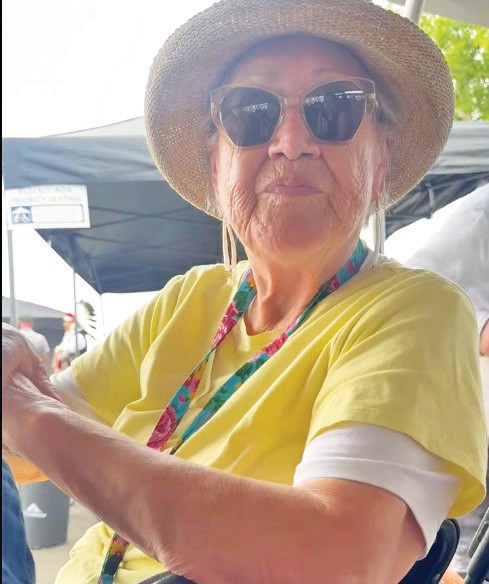
History professor Patricia Tawaca Waste Good Will, from Sitting Bull’s Wood Mountain community in Canada and a descendant of Black Moon who traveled north with Sitting Bull after the 1876 battle, was on site for the 150th Commemorative event at the Little Big Horn/Greasy Grass.
During spring planning meetings, Mark Van Norman, attorney for the Cheyenne River Sioux Tribe, announced that Cheyenne River had purchased 300 acres of land near the Little Big Horn Battlefield. The tribe announced plans to use the property for its own encampment and cultural programming, marking one of the most significant tribal land acquisitions in the area in recent years.
The land purchase added to an already growing intertribal footprint. The Real Bird family, long time caretakers of land adjacent to the battlefield, opened their property to tribal nations for the anniversary. Their support allowed Oglala, Rosebud, Northern Cheyenne and Northern Arapaho encampments to be established just south of the battlefield, creating one of the largest intertribal gatherings at Greasy Grass in generations.
The Rosebud Sioux Tribe’s 150th Victory Day Executive Planning Committee issued a call for 20 volunteers to travel to Montana to harvest tipi poles and willows for the encampment. The group delivered the poles to Crow Agency on June 17.
The real story began when the nations arrived.
On June 25, while presentations began at the Little Big Horn visitor’s center, at around 11:00 a.m., nearly 400 horseback riders that rode from reservations in South Dakota, North Dakota, Minnesota, Nebraska, Montana and Wyoming rode into the valley below the battlefield. This culminated in the largest intertribal Charge in living memory, with Lakota, Dakota, Northern Cheyenne, Northern Arapaho and Crow riders descending the hills in waves.

Women from Cheyenne, Oceti Sakowin and Arapaho Nations gather at the Little Big Horn Battlefield for the Women Warrior Victory Parade, marking the 150th anniversary of the Battle of the Little Bighorn/Greasy Grass with a powerful display of sovereignty, strength and remembrance.
They carried staffs, tribal flags, eagle feathers, and the prayers of their people. Youth riders rode alongside elders. Families rode together. Some riders had traveled hundreds of miles. Others had prepared all year. All came to honor the warriors of 1876.
And when the Charge reached its full strength, when the riders gathered and the nations stood together, the momentum carried them up the hill long known as Last Stand Hill.
There, thousands of Lakota, Dakota, Northern Cheyenne and Arapaho formed a circle and began a Victory Dance on the very ground where the Seventh Cavalry once fell. The sound rose across the high ridge, the akíša and lilílili carried through the valley, echoing off the hills, reclaiming a place that had never belonged to Custer.
It was a momentous moment. A sovereign moment. A moment when the land itself seemed to remember.

Former Cheyenne River Sioux Tribal Chairman Harold Frazier, who rode horseback with fellow Cheyenne River riders to Greasy Grass, visits with Frankie Jamerson, former vice president of the Standing Rock Sioux Tribe, at Pezi Sla, newly purchased Cheyenne River land.
For the first time in generations, Last Stand Hill was not a symbol of defeat or a monument to the cavalry, it was a place of Native victory.
A motorcycle ride, beginning in Belle Fourche, arrived at the battlefield around 1 p.m., adding another powerful moment of unity as riders on two wheels joined riders on four legs, all converging on the same sacred ground.
A Women’s Warrior Victory Parade honored the women who fought at the Rosebud and the Little Big Horn, Moving Robe Woman, Buffalo Calf Road Woman, Minnie Hollow Wood, Pretty Nose, and others whose names live in oral history. Women warriors from multiple tribes marched and carried staffs in their honor, marking the first large scale women’s warrior procession ever held at the battlefield.
Throughout the week, several runs, youth, veterans and memorial, traced the historic landscape. Tribal health programs and veterans’ groups organized the events, connecting today’s young people to the endurance and strength of their ancestors.

Four tipis rise on Pezi Sla, newly purchased Cheyenne River Sioux Tribal land near the Little Big Horn Battlefield, where Cheyenne River and Standing Rock tribal members camped together in a sovereign presence during the 150th Commemorative event.
For the first time since the 1876 battle, nearly 15,000 members of tribal nations represented at the 1876 Battle of Greasy Grass came together to celebrate their ancestors’ victory. They stood on the same hills, rode through the same valleys, prayed and camped on the same ground where their ancestors once fought for their lives, their land and their future.
This anniversary was not about revisiting the past. It was about reclaiming it. It was about standing together as nations, Lakota, Dakota, Northern Cheyenne, Northern Arapaho, and saying:
This is our story. This is our land. This is our victory. Lililililili!
(Contact Ernestine Anunkasan Hopa at editor@nativesunnews.today)
The post Reclaiming the history of the fight at the Little Big Horn first appeared on Native Sun News Today.
 Shared by: Native Sun News Today
July 2, 2026
Shared by: Native Sun News Today
July 2, 2026
Tags: Top News