
Trump visit puts Indian Country in national spotlight
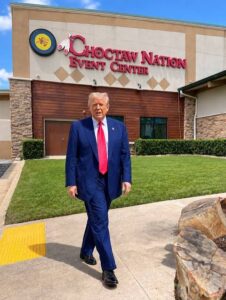
U.S. President Donald Trump at midterm campaign rally in Choctaw Nation of Oklahoma. (Courtesy photo from Meta.)
DURANT, OK— President Donald Trump brought his midterm campaign push to the Choctaw Nation of Oklahoma Thursday, making him one of only a handful of sitting presidents to visit an Indian reservation.
The purpose of the trip was political. Trump came to the Choctaw Event Center to rally Republican voters ahead of the November midterm elections, not to announce a new Indian policy initiative. The Republican National Committee selected Durant in part because it is just across the state line from Texas, another important stop on Trump’s campaign itinerary.
But a presidential visit to Indian Country remains significant even when Indian Country is not the main purpose of the visit. Presidents routinely meet tribal delegations in Washington. Very few make the trip to a reservation and stand before tribal leaders and citizens on their own land.
Choctaw Principal Chief Gary Batton welcomed Trump while carefully separating the Nation from the campaign holding the event.
“This is the third time we have had the honor of a sitting U.S. president coming to the Choctaw Nation, and we welcome President Trump,” Batton said before the rally. “We hope his visit provides an opportunity to learn more about what we do as a sovereign nation for our members and for all people in southeast Oklahoma.”
Batton made clear that the Trump 47 Committee rented the facility under the same terms available to other private organizations. Hosting the rally did not amount to a Choctaw endorsement of Trump, the Republican Party or any candidate.
Trump’s arrival was delayed by bad weather that prevented him from flying from north Texas to Durant. He made the roughly 85-mile trip by motorcade rather than cancel the appearance.
“They wanted me to postpone the event, and I said, ‘NO WAY, I’M GOING TO OKLAHOMA!’” Trump wrote before arriving.
Thousands waited through persistent rain to attend. Once Trump reached the stage, the speech remained what it was advertised to be: a Republican campaign rally. He urged the crowd to vote as if he were personally on the ballot and warned that Democratic control of Congress would threaten his agenda.
Trump briefly recognized Batton and other tribal leaders. He said he had met with Choctaw representatives before the speech and pointed to a falling poverty rate that included American Indian households. Recent Census Bureau figures support the claim that the official poverty rate has fallen sharply, although other measurements that include housing, taxes and government assistance present a more complicated picture.
Indian issues did not occupy much of Trump’s hour-long speech. That omission will disappoint those who hoped a rare presidential visit would produce a detailed statement on treaty obligations, tribal jurisdiction, health care or federal trust responsibilities. It would also be unfair, however, to pretend the administration had nothing to say to the Choctaw people.
U.S. Treasurer Brandon Beach made the administration’s strongest Indian Country argument from the stage. He pointed to the Choctaw Nation’s economic development as evidence that tribal enterprise can create jobs and build communities.
“Choctaw Nation is a clear example of capitalism working,” Beach said. “Look at the development here. The private sector creates jobs. Gary (Batton) creates jobs.”
Beach then tied that development to the administration’s position on tribal government.
“President Trump is protecting you, your family and your community by investing in private-sector growth and protecting your sovereignty,” he said.
The White House also released an Oklahoma-specific account of its record. The administration says its Working Families Tax Cuts protected 63,000 Oklahoma jobs and preserved $6 billion in wages, while providing an estimated $223 million for rural health care. It also points to increased natural-gas production, agricultural disaster assistance and new industrial investment.
Trump’s visit also carried some political risk inside Indian Country. Oklahoma Gov. Kevin Stitt, a Cherokee citizen, has had a combative relationship with several tribal nations over jurisdiction, gaming compacts and the consequences of the Supreme Court’s McGirt decision. Republican nominee for governor Mike Mazzei used the rally to promise a more cooperative approach.
“Your commitment to family, culture and service reflects values that mean a great deal to me personally,” Mazzei told Choctaw leaders. He said he looked forward to working with tribes on jobs, schools, roads and health care.
Choctaw citizen Crystal Michels, who wore a MAGA hat and waited in the rain, saw the visit as an opening rather than an endorsement.
“I think it’s an opportunity for our chief and assistant chief and our tribal council members to speak to the president to make sure that we are all considered and that our tribal sovereignty is maintained,” she said.
The history of presidents entering Indian Country is not reassuring. Chester A. Arthur’s 1883 stop at Wind River included an effort to persuade Shoshone and Arapaho leaders to divide communally held reservation land into private parcels. Both chiefs refused.
Theodore Roosevelt’s visit to Havasupai country came during an era of land loss, while Calvin Coolidge’s 1927 Pine Ridge appearance reflected the federal government’s assimilation and boarding-school policies.
The character of later visits changed. Bill Clinton came to Pine Ridge in 1999 and acknowledged that the federal government had failed to meet its obligations to tribal nations. Barack Obama visited Standing Rock in 2014 and spoke about economic opportunity and tribal self-government. Joe Biden traveled to the Gila River Indian Community in 2024 to apologize for the federal government’s role in the Indian boarding-school system.
Trump did not come to Durant to apologize for the past or unveil a new federal relationship with tribal nations. He came looking for Republican votes. The Choctaw Nation understood that distinction and stated it plainly.
Still, the president came. Choctaw leaders stood before a national audience, sovereignty was spoken of from the stage, and tribal citizens had a direct opportunity to judge the president for themselves.
Although a partisan political rally, and not a tribal policy summit, because sitting presidents have so rarely set foot in Indian Country, the visit cannot be dismissed as meaningless.
(James Giago Davies is an enrolled member of OST. Contact him at skindiesel@msn.com)
The post Trump visit puts Indian Country in national spotlight first appeared on Native Sun News Today.
 Shared by: Native Sun News Today
October 9, 2026
Shared by: Native Sun News Today
October 9, 2026
Tags: Top News