
A history of the Lakota treaties
AI Graphic
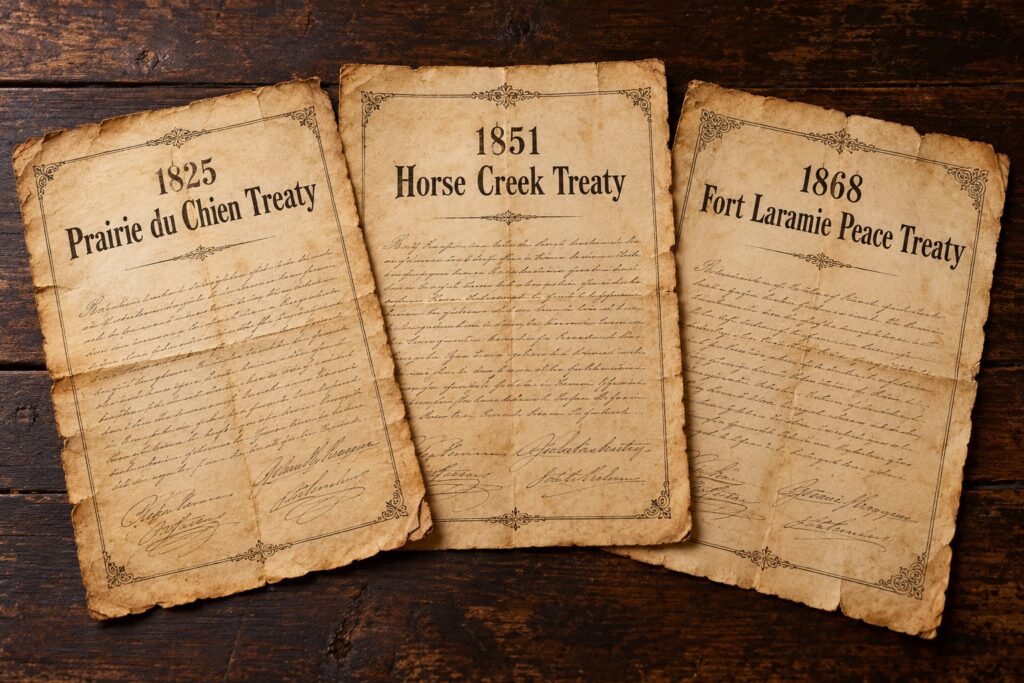
RAPID CITY—No treaty history for any tribe is orderly or simple. What follows are the three main treaties impacting the Lakota Nation.
THE 1825 TREATIES
In 1825, federal commissioners Henry Atkinson and Benjamin O’Fallon traveled up the Missouri River to make treaties with different tribal nations to secure their allegiance to the United States after the War of 1812 with Great Britain.. On July 5, leaders identified as the “Sioune and Ogallala” met with the Atkinson O’Fallon Commission at the mouth of the Teton River near present day Fort Pierre to sign the Treaty of 1825. The Treaty brought the Sioux tribal nations under the “protection of the United States. The 1825 Treaty established the political relationship between United States and signatory Indian nations and made them protectorate nations of the United States, both internationally and domestically. That 1825 Treaty was not a land cession treaty and did not sell the Black Hills or any other Sioux territory..
THE 1851 TREATY
The 1851 Fort Laramie Treaty gathered the Sioux and several other Plains nations. It sought peace among them and recognized broad territories. The Sioux that signed the 1851 Treaty were the seven Titonwan and Yankton Sioux and recognized sixty million acres of territory in these signatory nations, that extended from the Missouri River westward, and encompassed all of western South Dakota, and portions of North Dakota, Montana, Wyoming and Nebraska.
This was recognition of territory, not yet creation of the Great Sioux Reservation. The tribes allowed the United States to establish roads (the Oregon Trail) and military posts. In return, the United States promised protection from depredations by its own citizens and annual payments.
The Senate shortened the promised annuity period from 50 years to 10, with an option for five more. Tribal assent was eventually obtained, although federal mishandling of the paperwork produced lasting confusion over ratification. An incident involving a Sioux Indian butchering and eating a Mormon cow predicated the so-called Gratten fight that annihilated Lt. Gratten and his entire command that latter resulted in the Blue Water Creek Massacre by General Harney in which the village of Chief Little Thunder’s Band was massacred at Blue Water Creek near present day Ashcroft, Nebraska.
The 1851 Treaty did not result in a sign transaction in which a unified “Sioux Tribe” disposed of all Sioux country. Different Dakota and Lakota bands entered treaties affecting different lands. The 1851 Traverse des Sioux and Mendota treaties ceded immense areas in Minnesota and Iowa. The 1858 Yankton Treaty relinquished millions of acres while reserving approximately 400,000 along the Missouri.
That distinction matters. The Oceti Sakowin is a political and cultural confederacy, but treaty rights often attach to the nations or bands signing a particular document.
THE 1868 TREATY
By the 1860s, emigrant roads, military posts and settlers had overwhelmed promises made in 1851. Red Cloud’s war forced the United States back to the negotiating table. The resulting Fort Laramie Peace Treaty of 1868 that created the Great Sioux Reservation, covering the western portion of present-day South Dakota, including the Black Hills. According to signatory tribes the language in the treaty ceding land was added against their declaration they would surrender no land, after they signed.
The United States pledged the reservation for the “absolute and undisturbed use and occupation” of the Sioux. A separate region north of the North Platte River and east of the Bighorn Mountains was designated unceded Indian territory. Whites were not to settle there or pass through without Indian consent. Lakota hunting rights continued across additional country while buffalo remained in sufficient numbers to justify a chase. At the same time, the United States embarked on a policy to exterminate all buffalo on the northern and southern plans to force tribal nations onto reservations because of lack of food.
Article XII established an extraordinary protection: no cession of reservation land would be valid unless signed by at least three-fourths of all adult male Indians occupying or interested in it.
Three years later, Congress ended treaty-making with Indian nations. The 1871 law did not erase existing treaties, but Washington would no longer negotiate treaties requiring approval by two-thirds of the Senate. Congress increasingly imposed decisions by ordinary legislation.
The weakness was obvious. A treaty was considered the supreme law of the land, but Congress claimed the power to alter that law without obtaining the consent of the other party.
Gold made that imbalance decisive.
THE 1877 ACT
George Armstrong Custer’s 1874 expedition confirmed gold in the Black Hills. Miners poured into land the United States had promised to protect. The Army initially removed them, but President Ulysses Grant’s administration quietly stopped resisting the invasion in 1875.
The government first tried to purchase or lease the Hills. When those negotiations failed, Congress cut off appropriations for Sioux subsistence unless the Black Hills and outside hunting rights were surrendered. The Manypenny Commission carried a prepared agreement to the agencies in 1876. It obtained signatures from only about 10 percent of the adult Sioux men—not the three-fourths required by Article XII.
Congress enacted the agreement into law anyway on Feb. 28, 1877. The act removed the Black Hills and other land from the Great Sioux Reservation and ended the protected hunting territory. It was not another ratified treaty. It was Congress overriding the terms of the treaty already in force.
THE 1889 ACT
The 1889 Sioux Act divided 18 million acres of what remained of the Great Sioux Reservation. Nine million acres was used to create the Pine Ridge, Rosebud, Standing Rock, Cheyenne River, Lower Brule and Crow Creek reservations. Allotment broke communal land into individual parcels, with “surplus” lands passing out of Indian ownership. The reaming nine million acres surrounding the smaller reservations was opened up to white homesteaders.
In 1903, Lone Wolf v. Hitchcock confirmed the legal imbalance: Congress possessed broad power to abrogate Indian treaties unilaterally. The United States could make a promise with an Indian nation and later change it through legislation passed only by itself. This is called Plenary Power, and given the breadth and depth of its application, it is astonishing most tribes are unaware of its importance.
The Sioux pursued the Black Hills claim for generations. A 1920 jurisdictional act allowed it into the Court of Claims, which rejected it in 1942. Congress later created the Indian Claims Commission, where the case was revived. In 1980, the Supreme Court ruled in United States v. Sioux Nation of Indians that the 1877 act had taken tribal property without just compensation.
The award was based on $17.1 million as the 1877 value of the Black Hills, plus more than a century of interest. The decision was a money judgment. It did not restore title to the land, repeal the 1877 act or reconstruct the Great Sioux Reservation.
The history generally told today is that the Sioux tribes refused the money because the Black Hills were never for sale. That version leaves out the decisive facts.
Arthur Lazarus had been hired to pursue monetary compensation for the Sioux claimant tribes. Their representatives sat together at his counsel table. Except for the Oglala Sioux Tribe, the tribes were prepared to receive the money. They cannot be described as always rejecting payment when their attorney was in court obtaining it.
OST changed the outcome at the eleventh hour. The tribe maintained that Lazarus had allowed his OST contract to expire and lacked authority to accept its award. On July 18, 1980, OST sued for restoration and moved to prevent the United States from tendering any portion to OST. Because the judgment belonged jointly to the claimant tribes, if OST could not be paid, distribution could not proceed to the others. The judgment money was deposited into a federal trust account but not distributed to the tribes.
That intervention prevented distribution of the judgment and kept the United States from treating payment as final settlement of the Black Hills claim. Other tribes later embraced the land-restoration position, but that later unity should not be projected backward onto 1980. OST’s action preserved the Black Hills claim when payment appeared imminent.
The treaties are not simply historical artifacts. They remain federal law. Courts use treaties and later statutes to decide reservation boundaries, jurisdiction, hunting rights, water rights and federal obligations. Modern courts say treaty promises survive unless Congress clearly removes them, although Congress retains powers it would never claim over an ordinary foreign nation.
The story is not that every agreement was identical or every acre taken through the same mechanism. The mechanisms changed: trade treaties, boundary recognition, negotiated cessions, coerced agreements, congressional acts, allotment and judicial compensation for an earlier taking.
The consistent element was the direction of travel. Whenever settlers, railroads, miners or government planners wanted more land, the Indian estate became smaller and the meaning of the previous promise became negotiable.
The treaties never disappeared. The land did.
(James Giago Davies is an enrolled member of OST. Contact him at skindiesel@msn.com)
The post A history of the Lakota treaties first appeared on Native Sun News Today.
 Shared by: Native Sun News Today
October 20, 2026
Tags: Top News