Tribes say Senate permitting bill threatens sacred sites
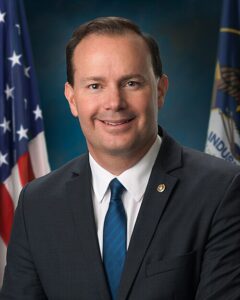
Utah Senator, Mike Lee. (Courtesy photo)
WASHINGTON—A bipartisan Senate bill intended to speed construction of energy and infrastructure projects is drawing strong opposition from tribal organizations that say it could weaken one of the few federal laws protecting sacred sites and cultural resources.
The Bipartisan American Affordability and Jobs Act of 2026, S. 5653, was introduced Sept. 30 by Sens. Shelley Moore Capito, R-W.Va., Mike Lee, R-Utah, Martin Heinrich, D-N.M., and Sheldon Whitehouse, D-R.I. The bill has been referred to the Senate Committee on Energy and Natural Resources and has not passed either chamber.
Its sponsors say federal permitting has become too slow, costly and unpredictable, holding up power lines, mines, roads and other major projects. The sprawling proposal would rewrite portions of several federal laws, including the National Environmental Policy Act, Clean Water Act and National Historic Preservation Act.
Lee said the country once completed projects such as the Hoover Dam and Golden Gate Bridge in years rather than decades. Heinrich said the legislation would get energy projects to a “yes or no” faster while preserving environmental safeguards and the ability of tribes to consult formally.
Tribal organizations disagree sharply with that assessment.
In an Oct. 9 letter to Senate leaders and the bill’s sponsors, nine organizations called for the complete withdrawal of Title III, the section rewriting the historic-preservation process. Signers included the National Congress of American Indians, Native American Rights Fund, National Association of Tribal Historic Preservation Officers and Rocky Mountain Tribal Leaders Council.
At issue is Section 106 of the National Historic Preservation Act. Section 106 does not automatically stop a project and does not give a tribe veto power. It requires a federal agency to examine how a federally funded, licensed or approved undertaking could affect historic properties and to consult tribes when sacred places, burial sites or other culturally important resources may be harmed. That consultation often represents the only opportunity for a tribe to warn an agency that a place appearing empty on a government map carries religious, historical or cultural importance.
The tribal organizations acknowledge that Title III contains some improvements. It would write tribal consultation into federal law more explicitly, increase money available through the Historic Preservation Fund and establish a grant program for Tribal Historic Preservation Officers. But they contend those benefits are overwhelmed by other provisions.
The letter says the bill would narrow key definitions determining which projects receive Section 106 review. It would also permit federal agencies to establish the area of potential effects, identify historic properties and assess possible harm before consulting affected tribes. Tribes could then be left responding to conclusions the agency had already reached.
The bill would generally give a Tribal Historic Preservation Officer, tribe or other consulting party 30 days to respond to an agency report or finding. If no substantive objection is received within that period, the agency could proceed. The tribal organizations argue that 30 days is inadequate for understaffed tribal programs that may have to consult elders, spiritual leaders and cultural experts before answering.
The proposal also increases federal oversight of Tribal Historic Preservation Officers. A tribal preservation program that repeatedly misses consultation deadlines could be declared inconsistent with federal requirements. Contracts, agreements and preservation funding could be suspended, and the Interior Department could eventually assume some or all of the officer’s functions.
Tribal organizations called that response backwards. Many preservation offices lack staff because Congress and federal agencies have chronically underfunded them. Under the proposed legislation, a tribe could be punished for failing to meet new deadlines imposed by the same government that failed to provide adequate resources.
The organizations also object to limits on court challenges, including a 150-day filing deadline and language favoring remand without vacating a federal decision. That could allow construction to continue while an agency corrects an inadequate review, potentially leaving little to protect once the ground has been disturbed.
Supporters contend predictable deadlines are necessary because projects can remain trapped in federal review for years, raising costs and discouraging investment. The bill has drawn support from energy producers, construction unions, utilities and business organizations. It also contains provisions aimed at preventing large data centers from shifting the cost of electrical-grid expansion onto ordinary ratepayers.
The tribal groups are not opposing infrastructure development itself. They argue that bringing tribes into a project early can identify conflicts before money is spent and construction begins.
“We must be part of the solution, not pushed away from the table,” their letter states.
That distinction is important in the Black Hills, where mining, drilling and transmission projects can threaten places whose significance will never be apparent to an outside contractor. Speeding a permit may save a developer time. Once a sacred place is bulldozed, however, no later consultation and no court ruling can put it back.
(James Giago Davies is an enrolled member of OST. Contact him at skindiesel@msn.com)
The post Tribes say Senate permitting bill threatens sacred sites first appeared on Native Sun News Today.
 Shared by: Native Sun News Today
October 20, 2026
Tags: Top News